
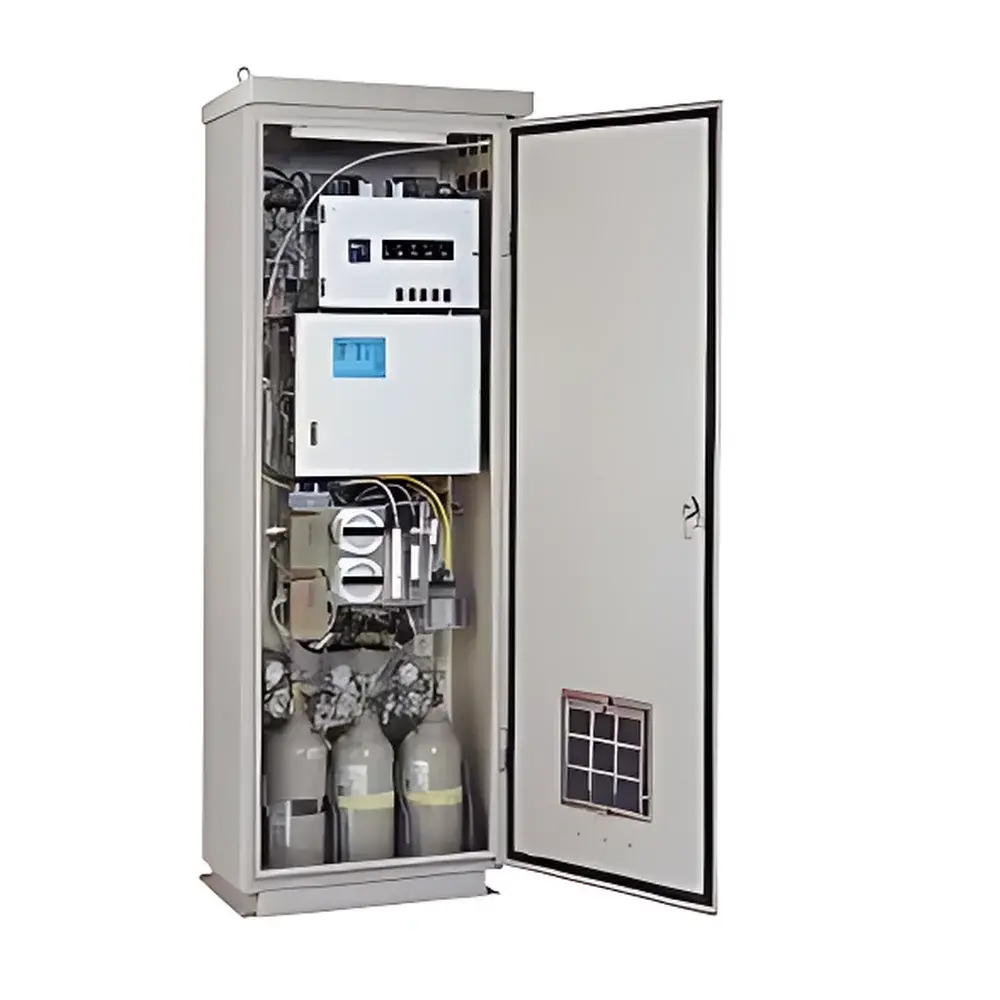
HORIBA ENDA-600ZG Continuous Emission Monitoring System (CEMS) for Flue Gas Analysis
| Brand | HORIBA |
|---|---|
| Origin | Japan |
| Model | ENDA-600ZG |
| Instrument Type | Continuous Emission Monitoring System (CEMS) |
| Measurement Accuracy | ±1.0 %F.S. |
| Repeatability | ±0.5 %F.S. |
| Response Time (SO₂) | 60–240 s |
| Stability | ±2.0 %F.S./week |
Overview
The HORIBA ENDA-600ZG is a compact, high-integrity Continuous Emission Monitoring System (CEMS) engineered for real-time, simultaneous measurement of up to five key flue gas components: NOx, SO2, CO, CO2, and O2. Designed for regulatory compliance and long-term operational reliability in demanding industrial environments, the system integrates dual physical detection principles: alternating-flow non-dispersive infrared (NDIR) spectroscopy for NOx, SO2, CO, and CO2; and magnetic pressure (paramagnetic) detection for O2. This hybrid architecture eliminates cross-sensitivity artifacts common in single-technology platforms and ensures zero-point stability without optical recalibration—achievable through synchronous 1-second alternation between sample and reference gas streams across identical optical paths. The ENDA-600ZG meets international performance standards for CEMS applications, including ISO 14956, EN 15267, and EPA Performance Specification 3 (PS-3) and PS-4A for gaseous pollutants. Its design supports integration into plant-wide environmental management systems compliant with ISO 14001 and fulfills data integrity requirements under EU IED (Industrial Emissions Directive) and US EPA 40 CFR Part 60 Subpart B.
Key Features
- Single-analyzer architecture for concurrent, independent quantification of NOx, SO2, CO, CO2, and O2—reducing footprint, calibration complexity, and maintenance overhead.
- Alternating-flow NDIR detection with integrated interference compensation filters—minimizing spectral overlap effects from H2O, CO2, and other matrix gases on target analytes.
- Magnetic pressure O2 sensor operating without carrier gas; ambient air serves as reference medium—eliminating N2 supply infrastructure and associated operational costs.
- Zero-drift optical design: continuous self-cleaning of measurement cells via alternating gas flow prevents contamination-induced span drift and maintains baseline fidelity over extended intervals.
- Integrated CO2 sensor for real-time correction of CO2-induced interference in NOx measurement—a critical capability for combustion stoichiometry-dependent emissions reporting.
- Front-access modular layout: all service operations—including filter replacement, calibration validation, and sensor inspection—are performed from the instrument’s front panel, enabling installation in constrained spaces.
- Reduced form factor: overall volume is 50% smaller than predecessor models; anti-backpressure automatic back-purge controller measures only 350 × 550 × 180 mm (W×H×D), mountable directly to walls or support structures.
Sample Compatibility & Compliance
The ENDA-600ZG accommodates diverse flue gas matrices through application-specific sampling subsystems. For waste incineration, optional Cl2 scrubbers mitigate corrosion and extend probe lifetime; for coal- or biomass-fired boilers, NH3 removal modules prevent sulfamic acid formation during SO2 analysis. A three-stage electronic cooling system—comprising primary and dual secondary chillers—achieves dew points below 2 °C, minimizing aqueous-phase loss of soluble species (e.g., SO2, NO2) while retaining >95% of analyte mass in the vapor phase. Integrated SO3 mist eliminators protect downstream optics and detectors from acidic condensate. All sampling configurations comply with EN 14181 (QAL2/QAL3) requirements for automated performance verification and are validated against ASTM D6522 and ISO 12039 for NOx and SO2 measurement uncertainty.
Software & Data Management
The ENDA-600ZG features an embedded Linux-based control platform with a 10.4-inch resistive touchscreen interface supporting multilingual operation (English, Japanese, Chinese, German). Real-time display shows instantaneous concentrations of all five components, O2-corrected values (per EN 14792), and 1-hour rolling averages. Calibration logs, alarm histories, and diagnostic flags are timestamped and stored locally for ≥12 months. Data export complies with Modbus TCP, RS-485/232, and analog 4–20 mA outputs (up to 12 channels configurable per parameter). Audit trails include user authentication, change history, and event-driven logging—fully traceable for GLP/GMP and FDA 21 CFR Part 11 readiness when paired with validated networked data acquisition servers.
Applications
The system is deployed globally across regulated emission sources requiring continuous compliance reporting: thermal power plants (coal, gas, biomass), municipal solid waste incinerators, glass melting furnaces, iron and steel production facilities (sintering plants, blast furnaces), sulfuric acid manufacturing units, and industrial steam boilers. Its robustness in high-dust, high-moisture, and chloride-rich environments has been verified under IEC 61000-6-2/4 EMC standards and IP54-rated enclosure protection. Field-proven in over 100,000 installations, the ENDA-600ZG supports stack testing protocols per ISO 10849 and enables dynamic emission factor calculation for carbon accounting frameworks.
FAQ
What gas components can the ENDA-600ZG measure simultaneously?
NOx, SO2, CO, CO2, and O2—all in a single analyzer unit without external gas switching valves or multiplexing hardware.
How does the system handle water vapor interference?
It employs proprietary interference-compensation filters in the NDIR optical path and includes inline H2O correction algorithms calibrated against certified humidified standards.
Is the ENDA-600ZG suitable for high-chlorine flue gases?
Yes—when equipped with the optional Cl2 scrubber module, it achieves T90 ≤ 90 s for SO2 measurement even in waste-to-energy applications.
What is the recommended calibration frequency?
Automated zero/span verification is scheduled every 7 days; manual full-range calibration is advised quarterly or after major maintenance events.
Does the system support remote diagnostics and firmware updates?
Yes—via secure SSH-enabled Ethernet connection; remote access requires role-based authentication and TLS 1.2 encryption for data transmission.







