
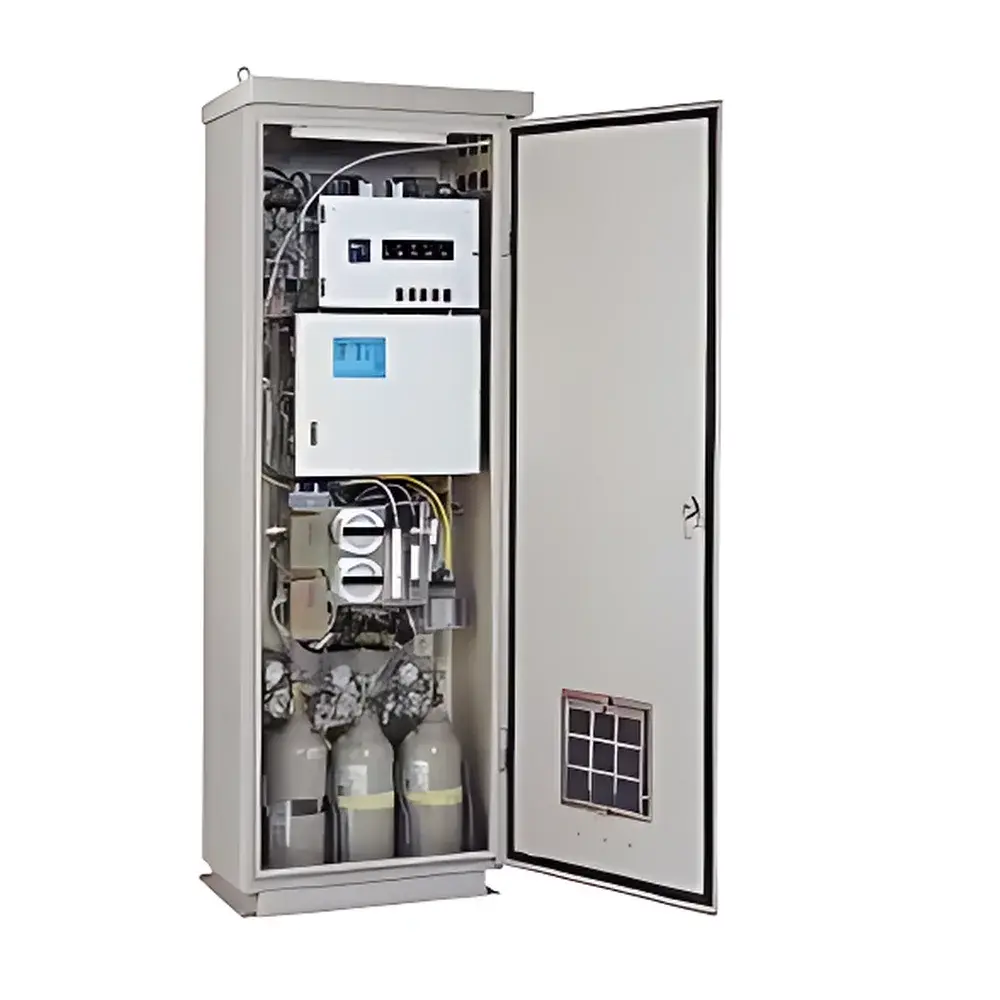
HORIBA ENDA-600ZG Series Continuous Emission Monitoring System (CEMS) for Flue Gas Analysis
| Brand | HORIBA |
|---|---|
| Origin | Japan |
| Model | ENDA-600ZG |
| Instrument Type | Continuous Emission Monitoring System (CEMS) |
| Measurement Accuracy | ±1.0 %F.S. |
| Repeatability | ±0.5 %F.S. |
| Response Time | 60–240 s |
| Long-term Stability | ±2.0 %F.S./week |
Overview
The HORIBA ENDA-600ZG Series is a compact, high-integrity continuous emission monitoring system (CEMS) engineered for real-time, simultaneous measurement of up to five key flue gas components: NOx, SO2, CO, CO2, and O2. Designed for regulatory compliance and long-term operational reliability in demanding industrial environments, the system integrates alternating-flow non-dispersive infrared (NDIR) spectroscopy for acidic and combustible gases with paramagnetic oxygen detection—eliminating the need for external carrier gas. Its core architecture leverages dual-beam, reference-compensated optical paths and periodic sample/reference gas alternation at 1 Hz, ensuring inherent zero-point stability and immunity to optical misalignment following transport or maintenance. The system meets fundamental performance requirements aligned with ISO 14956, EN 15267, and EPA Performance Specification 3 (PS-3) for O2 and PS-4A for SO2/NOx, supporting data validity under EU IED and U.S. Clean Air Act Title V reporting frameworks.
Key Features
- Single-analyzer platform for concurrent, continuous quantification of NOx, SO2, CO, CO2, and O2 without external gas switching manifolds
- Alternating-flow NDIR detection with integrated interference compensation filters to correct cross-sensitivity from H2O and CO2—particularly critical for accurate NOx and SO2 measurement in wet, variable-composition flue streams
- Paramagnetic O2 sensor utilizing ambient air as reference gas—no bottled N2 supply required, reducing consumables, footprint, and lifecycle cost
- Self-cleaning optical path: continuous purging of measurement cells via alternating sample/reference flow minimizes particulate deposition and suppresses span drift
- Integrated CO2 sensor for real-time correction of CO2-induced matrix effects on NOx response
- Touch-enabled 10.4-inch TFT-LCD display with intuitive navigation for calibration, alarm history, concentration conversion (e.g., dry/wet basis, 3%/6% O2 correction), and diagnostics
- Physical footprint reduced by 50% vs. prior-generation ENDA systems; fully front-accessible service design enables all routine maintenance—including filter replacement and calibration—without rear panel disassembly
- Auto-blowback controller (350 × 550 × 180 mm) with 23% volume reduction, wall-mountable for constrained installation sites
Sample Compatibility & Compliance
The ENDA-600ZG series accommodates highly variable flue gas matrices through application-specific sampling subsystems. For waste incineration, a chlorine scrubber prevents Cl2-induced corrosion; for coal-fired power plants, an NH3 removal module mitigates sulfamic acid formation during SO2 analysis; and for high-NO2 streams, a high-efficiency NOx converter ensures complete thermal reduction. A three-stage electronic cooling system (primary + dual secondary coolers) achieves dew point suppression below 2 °C, minimizing dissolution losses of SO2 and NO2 in condensate while removing SO3 aerosols via integrated demister filtration. All sampling probes feature direct-mount primary filters with tool-free replacement. The system supports GLP/GMP-aligned audit trails when paired with optional data acquisition software compliant with FDA 21 CFR Part 11 requirements.
Software & Data Management
- Onboard firmware supports configurable output channels (up to 12 analog/digital outputs) for instantaneous concentrations, O2-corrected values (per EN 14181), and rolling 1-hour averages
- Automated calibration scheduling (default 7-day interval) with dry-gas SO2 calibration completed in ≤3 minutes—reducing downtime versus legacy wet-calibration protocols (15 min)
- Pre-alarm diagnostics identify early-stage anomalies (e.g., pressure deviation, cooler temperature excursion, optical signal decay) before fault conditions trigger full system alarms
- Embedded event logging records calibration events, alarm triggers, maintenance actions, and configuration changes with timestamp and operator ID
- Optional HORIBA CEMS Manager software provides remote monitoring, report generation (PDF/CSV), trend analysis, and integration with plant DCS/SCADA via Modbus TCP or OPC UA
Applications
The ENDA-600ZG is deployed globally across regulated thermal processes where precise, auditable emissions data is mandatory. It is certified for continuous monitoring in utility-scale coal and gas-fired power plants, municipal solid waste (MSW) and hazardous waste incinerators, iron and steel sintering and blast furnaces, sulfuric acid production units, glass melting furnaces, and industrial steam boilers. Its robust sampling interface handles particulate loadings up to 10 g/Nm³ (with auto-blowback), acid gas concentrations exceeding 5,000 ppm SO2, and operating temperatures up to 200 °C at the probe tip. The system’s compactness enables retrofit installations in space-constrained facilities—such as aging boiler houses or modular CEMS shelters—where legacy analyzers could not be accommodated.
FAQ
What regulatory standards does the ENDA-600ZG comply with?
The system meets the instrumental performance criteria of EN 15267-3 (for QAL1 certification), ISO 14956 (ambient air quality), and EPA PS-3/PS-4A. It supports QA/QC procedures required under EU IED Annex IV and U.S. 40 CFR Part 60, Subpart Da/Db.
Can the ENDA-600ZG measure NO2 directly, or only total NOx?
It measures total NOx (NO + NO2) via catalytic reduction in a heated stainless-steel converter. Optional high-efficiency converters are available for applications with >30% NO2 fraction.
Is humid gas correction handled automatically?
Yes—integrated H2O compensation algorithms use real-time moisture data from the cooling system’s condensate trap sensor to correct NDIR absorbance readings per ISO 12039 Annex B.
What is the minimum detectable concentration (MDC) for each component?
MDCs are application-dependent and defined during QAL2 testing per EN 14181. Typical ranges: SO2 (1–5 ppm), NOx (1–10 ppm), CO (5–50 ppm), O2 (0.1% vol), CO2 (0.1% vol).
Does the system support remote firmware updates?
Firmware updates require local USB connection and administrative authentication; no over-the-air (OTA) capability is provided to maintain cybersecurity integrity per IEC 62443-3-3.







