
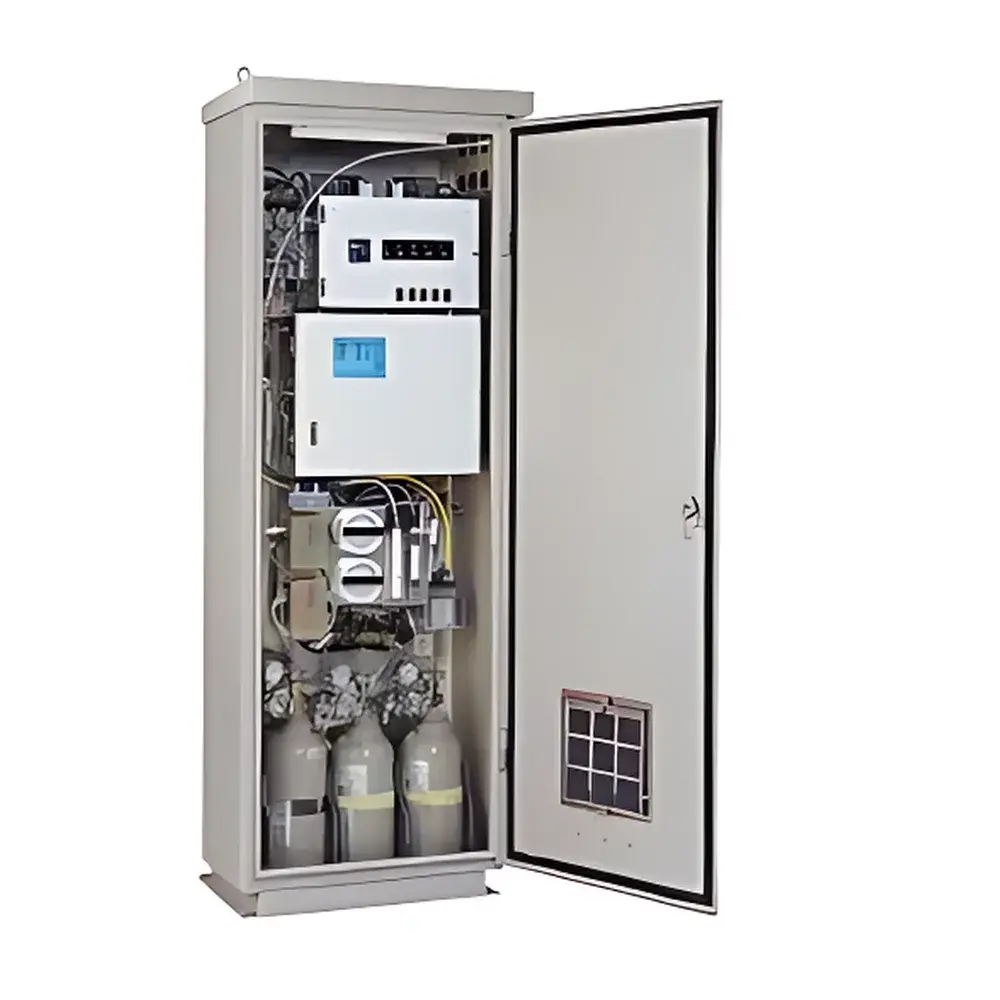
HORIBA ENDA-600ZG Series Continuous Emission Monitoring System (CEMS) for Flue Gas Analysis
| Brand | HORIBA |
|---|---|
| Origin | Japan |
| Model | ENDA-600ZG Series |
| Instrument Type | Continuous Emission Monitoring System (CEMS) |
| Measurement Accuracy | ±1.0 %F.S. |
| Repeatability | ±0.5 %F.S. |
| Response Time (SO₂) | 60–240 s |
| Stability | ±2.0 %F.S./week |
| Measured Gases | SO₂, NO₂, CO₂, CO, O₂ |
| Detection Principle | Alternating Flow NDIR (SO₂, CO, CO₂), Magnetic Pressure (O₂), Chemiluminescence or UV-Vis (NOₓ, depending on configuration) |
| Compliance | Designed for EPA Method 6C, 7E, 10, ISO 12039, EN 15267, and China HJ 75/76 |
Overview
The HORIBA ENDA-600ZG Series is a compact, high-reliability Continuous Emission Monitoring System (CEMS) engineered for real-time, simultaneous quantification of up to five key flue gas constituents—SO₂, NO₂ (or total NOₓ), CO, CO₂, and O₂—in demanding industrial exhaust streams. Unlike conventional multi-analyzer CEMS architectures, the ENDA-600ZG integrates all measurement functions into a single analysis unit, eliminating inter-unit calibration drift and reducing system footprint by 50% compared to prior-generation platforms. Its core detection methodology employs alternating-flow non-dispersive infrared (NDIR) spectroscopy for SO₂, CO, and CO₂—where sample and reference gas streams are sequentially introduced into a common optical cell at 1 Hz frequency—ensuring zero-point stability without mechanical or optical recalibration. Oxygen is measured via magnetic pressure (paramagnetic) detection, which requires no carrier gas (ambient air serves as the reference medium), thereby minimizing consumables, installation complexity, and long-term operating costs. The system’s architecture inherently suppresses baseline drift, eliminates need for periodic optical alignment, and sustains metrological integrity over extended operational cycles—critical for regulatory compliance under EPA PS-11, ISO 12039, and EN 15267-3 certified applications.
Key Features
- Single-unit, five-parameter monitoring (SO₂, NO₂/NOₓ, CO, CO₂, O₂) with integrated interference compensation
- Alternating-flow NDIR design enabling intrinsic zero-stability and automatic in-situ cell cleaning via gas switching
- Magnetic pressure O₂ sensor—no external N₂ supply required; corrosion-resistant, maintenance-free operation
- Touchscreen HMI with intuitive navigation for real-time concentration display, span/zero calibration, alarm history, and conversion factor management
- Modular sampling interface supporting application-specific conditioning: three-stage electronic cooling (primary + dual secondary chillers), SO₃ removal mist eliminators, NH₃ scrubbers (for power plant applications), and Cl₂ traps (for waste incineration)
- Compact footprint: analyzer dimensions reduced to 50% of predecessor models; auto-blowback controller downsized to 350 × 550 × 180 mm (W×H×D), wall-mountable in confined spaces
- Dry SO₂ calibration completed in ≤3 minutes—reducing downtime versus legacy wet-calibration protocols requiring ≥15 minutes
- Automatic 7-day scheduled calibration with traceable audit trail compliant with FDA 21 CFR Part 11 and GLP/GMP data integrity requirements
Sample Compatibility & Compliance
The ENDA-600ZG accommodates highly variable flue gas matrices across thermal, chemical, and particulate load profiles. Its sampling subsystem is configurable per source type: for waste-to-energy plants, integrated chlorine scavengers and low-T₉₀ (<90 s) SO₂-preserving dryers mitigate halogen-induced corrosion and aqueous-phase analyte loss; for coal-fired power stations, optional NH₃ removal modules prevent sulfamic acid formation during SO₂ measurement; for steel reheating furnaces or glass melters, high-efficiency primary filters coupled with heated probe lines preserve volatile species integrity. All configurations adhere to ISO 16000-23 (indoor air), EN 15267-3 (performance certification), and China’s HJ 75–2017 and HJ 76–2017 technical specifications for CEMS. Data output supports MODBUS RTU/TCP, 4–20 mA analog channels (up to 12 configurable outputs), and digital reporting of instantaneous values, O₂-corrected concentrations, and rolling hourly averages—fully traceable for environmental authority submissions.
Software & Data Management
Embedded firmware provides full local control via a 10.4-inch resistive touchscreen with multilingual UI (English, Japanese, Chinese, German). All operational logs—including calibration events, alarm triggers (with pre-alarm diagnostics), sensor health status, and flow/pressure diagnostics—are timestamped and stored internally for ≥12 months. Export is supported via USB or Ethernet to CSV or XML formats. Optional HORIBA CEMS Manager software enables remote supervision, trend analysis, and automated report generation aligned with EU Directive 2010/75/EU (IED) and US EPA 40 CFR Part 60 Appendix B QA/QC protocols. Audit trails record user ID, action timestamp, parameter change, and pre-/post-value—satisfying ALCOA+ principles for regulated environments.
Applications
The ENDA-600ZG is deployed globally in continuous compliance monitoring for stationary combustion sources subject to national and international emission limits. Proven use cases include: steam boiler stacks in petrochemical refineries; municipal solid waste incinerators requiring Cl₂ and dioxin precursor monitoring; coal- and gas-fired power generation units under EU LCP BREF and MATS regulations; sintering belts and coke ovens in integrated steelworks; sulfuric acid production plants where SO₂ recovery efficiency must be verified; and float-glass melting furnaces operating above 1500 °C. Its robustness against condensate carryover, particulate loading (with auto-blowback option), and thermal transients makes it suitable for intermittent or load-following operations without performance degradation.
FAQ
What gases does the ENDA-600ZG measure simultaneously?
SO₂, NO₂ (or total NOₓ), CO, CO₂, and O₂—all within a single analyzer housing.
Is the system certified for regulatory reporting?
Yes—it meets performance criteria defined in ISO 12039, EN 15267-3, EPA Performance Specifications 2, 3, 6C, 7E, and 10, and China’s HJ 75/76 standards.
How often does it require calibration?
Factory-recommended automatic calibration interval is every 7 days; manual verification can be performed at any time using certified span gases.
Does it support O₂ correction for emission reporting?
Yes—real-time O₂-corrected concentrations (e.g., NOₓ @ 3% O₂, SO₂ @ 6% O₂) are calculated and output continuously per regulatory conventions.
Can it operate in high-humidity or corrosive gas streams?
Yes—the modular sampling train includes SO₃-resistant mist eliminators, chloride-scavenging cartridges, and triple-stage electronic cooling to minimize aqueous-phase analyte loss and protect optical components.
What data interfaces are available?
Standard 4–20 mA analog outputs (up to 12 channels), MODBUS RTU/TCP, and USB for data export; optional Ethernet-based remote access via HORIBA CEMS Manager.







