
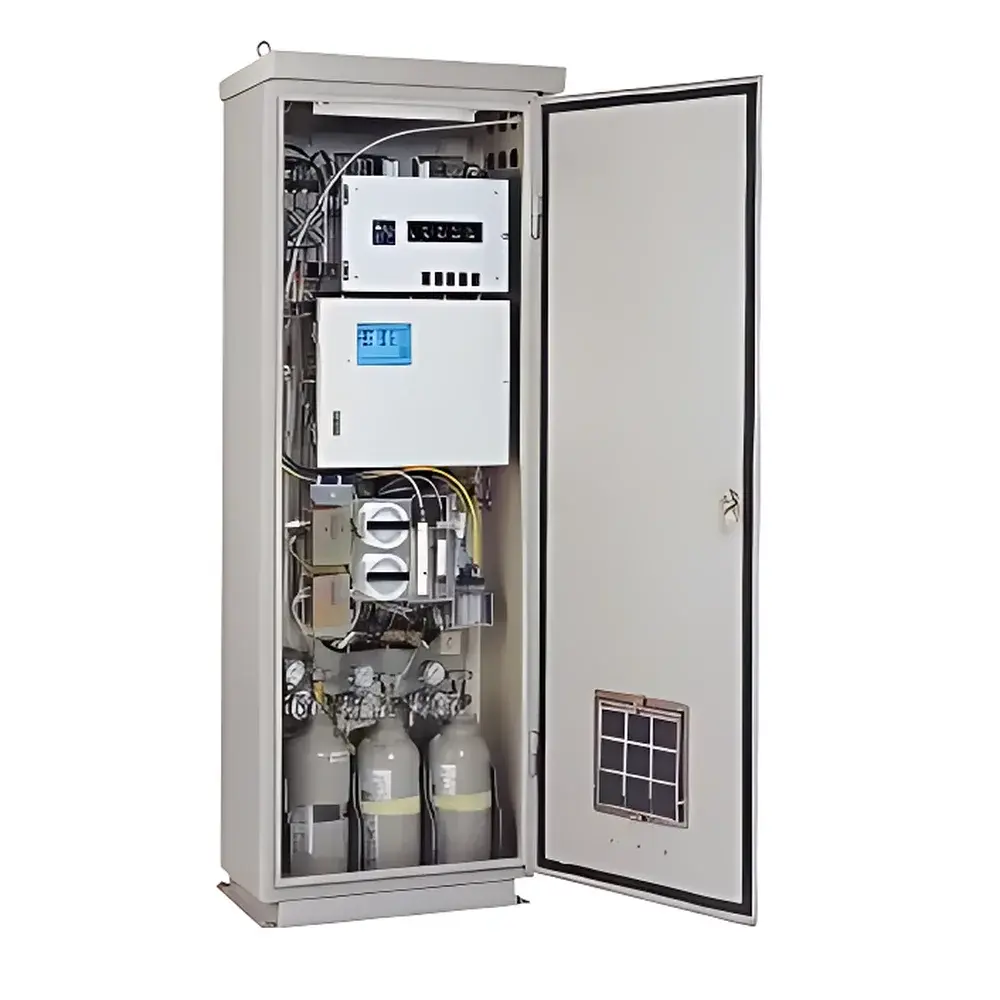
HORIBA ENDA-600ZG Series Continuous Emission Monitoring System (CEMS) for Flue Gas Analysis
| Brand | HORIBA |
|---|---|
| Origin | Japan |
| Model | ENDA-600ZG Series |
| Instrument Type | Continuous Emission Monitoring System (CEMS) |
| Accuracy | ±1.0% F.S. |
| Repeatability | ±0.5% F.S. |
| Response Time (SO₂) | 60–240 s |
| Stability | ±2.0% F.S./week |
Overview
The HORIBA ENDA-600ZG Series is a compact, high-reliability Continuous Emission Monitoring System (CEMS) engineered for real-time, simultaneous measurement of up to five key flue gas constituents: NOx, SO2, CO, CO2, and O2. Designed for regulatory compliance and long-term operational integrity in demanding industrial environments, the system integrates alternating-flow non-dispersive infrared (NDIR) spectroscopy for acidic and combustible gases with paramagnetic oxygen detection—eliminating the need for carrier gas supply. Its core architecture employs dual-beam modulation and periodic reference-sample alternation at 1 Hz, ensuring intrinsic zero-point stability and eliminating optical drift without manual alignment. This physical design principle—rooted in over three decades of HORIBA’s field-proven CEMS deployment across >100,000 installations globally—enables continuous, unattended operation under fluctuating temperature, pressure, and particulate load conditions typical of boiler stacks, waste incinerators, and metallurgical furnaces.
Key Features
- Single-analyzer multi-component capability: Simultaneous quantification of NOx, SO2, CO, CO2, and O2 within one integrated housing—reducing footprint, calibration complexity, and maintenance overhead.
- Zero-drift NDIR detection: Alternating-flow modulation ensures continuous self-cleaning of the measurement cell via periodic sample/reference gas exchange, suppressing span drift and maintaining baseline integrity over extended intervals.
- Paramagnetic O2 sensing: Utilizes ambient air as the reference medium; no external N2 or synthetic carrier gas required—lowering consumable costs and simplifying site infrastructure.
- Interference-compensated optics: Proprietary interference filter arrays correct cross-sensitivity from H2O vapor and CO2, particularly critical for accurate NOx and SO2 reporting in high-moisture streams.
- Reduced physical envelope: Overall analyzer volume reduced by 50% versus prior-generation models; auto-blowback controller dimensions minimized to 350 × 550 × 180 mm—enabling wall-mount installation in space-constrained utility rooms or control cabinets.
- Accelerated dry-gas calibration: SO2 span adjustment completed in ≤3 minutes using certified dry standard gas—contrasting with legacy wet-calibration protocols requiring ≥15 minutes and condensation management.
Sample Compatibility & Compliance
The ENDA-600ZG series accommodates highly variable flue gas matrices through application-specific sampling subsystems. For waste-to-energy facilities, an integrated Cl2 scrubber prevents halogen-induced corrosion; for coal-fired power plants, optional NH3 removal modules mitigate sulfite formation during SO2 analysis. A three-stage electronic cooling system—comprising primary and secondary Peltier coolers plus a mist eliminator—achieves dew point suppression below 4 °C, minimizing aqueous-phase loss of SO2 and NO2. High-dust applications employ a wall-mounted auto-blowback controller (23% smaller than predecessor units) that periodically back-purges the probe filter using instrument-grade compressed air. All configurations comply with ISO 12039, EN 15267, and US EPA Performance Specification 2 (PS-2) for CEMS validation. Data logging and alarm records adhere to GLP/GMP audit-trail requirements per FDA 21 CFR Part 11 when paired with optional secure software licensing.
Software & Data Management
The embedded 7-inch capacitive touchscreen interface supports intuitive navigation across live concentration plots, calibration logs, alarm history, and stoichiometric conversion settings (e.g., O2-corrected emission values per regulatory limits). Up to 12 analog/digital outputs are configurable—including instantaneous component values, 1-hour rolling averages, and dynamically corrected outputs—supporting integration with DCS/SCADA systems. Firmware enables automated 7-day zero/span verification cycles with timestamped results stored locally for ≥12 months. Optional HORIBA CEMS Manager software provides remote diagnostics, spectral validation reports, and export-ready CSV/PDF archives compliant with EU IED reporting templates and China’s HJ 75-2017 technical specifications.
Applications
The ENDA-600ZG series is validated for continuous monitoring in regulated thermal processes where emission fidelity directly impacts environmental permit adherence and carbon accounting. Primary use cases include:
- Coal- and biomass-fired power generation units subject to EU LCP BREF and US MATS standards;
- Municipal solid waste incinerators requiring simultaneous tracking of acid gases (SO2, HCl), NOx, and CO under EU Directive 2000/76/EC;
- Primary steel production (sinter plants, blast furnaces) and non-ferrous smelting (copper, zinc roasters);
- Chemical manufacturing sites (e.g., sulfuric acid plants) where SO2 recovery efficiency must be verified;
- Combined heat and power (CHP) systems and industrial steam boilers operating under local air quality ordinances.
FAQ
What regulatory standards does the ENDA-600ZG meet for CEMS certification?
It satisfies ISO 12039:2000 for SO2/NOx/CO measurement, EN 15267-3 for QA/QC validation, and US EPA PS-2 for relative accuracy testing—subject to site-specific configuration and third-party audit.
How does the system handle high-moisture flue gas without compromising SO2 accuracy?
The triple-stage condensate management system (primary + dual electronic coolers + mist eliminator) maintains sample gas dew point <4 °C while preserving soluble species via rapid phase separation and inertial droplet removal.
Is carrier gas required for O2 measurement?
No. The paramagnetic sensor uses ambient air as its reference medium, eliminating dependency on bottled N2 or synthetic air supplies.
Can the analyzer operate continuously during scheduled maintenance windows?
Yes—its modular front-access design allows all consumables (filters, desiccants, calibration cells) and electronics to be serviced without rear-panel disassembly or system isolation.
What is the maximum particulate loading the sampling probe can tolerate?
With optional auto-blowback control and heated probe assembly, the system sustains reliable operation at inlet dust concentrations up to 10 g/Nm³—verified per EN 15267-3 Annex F test protocols.







