
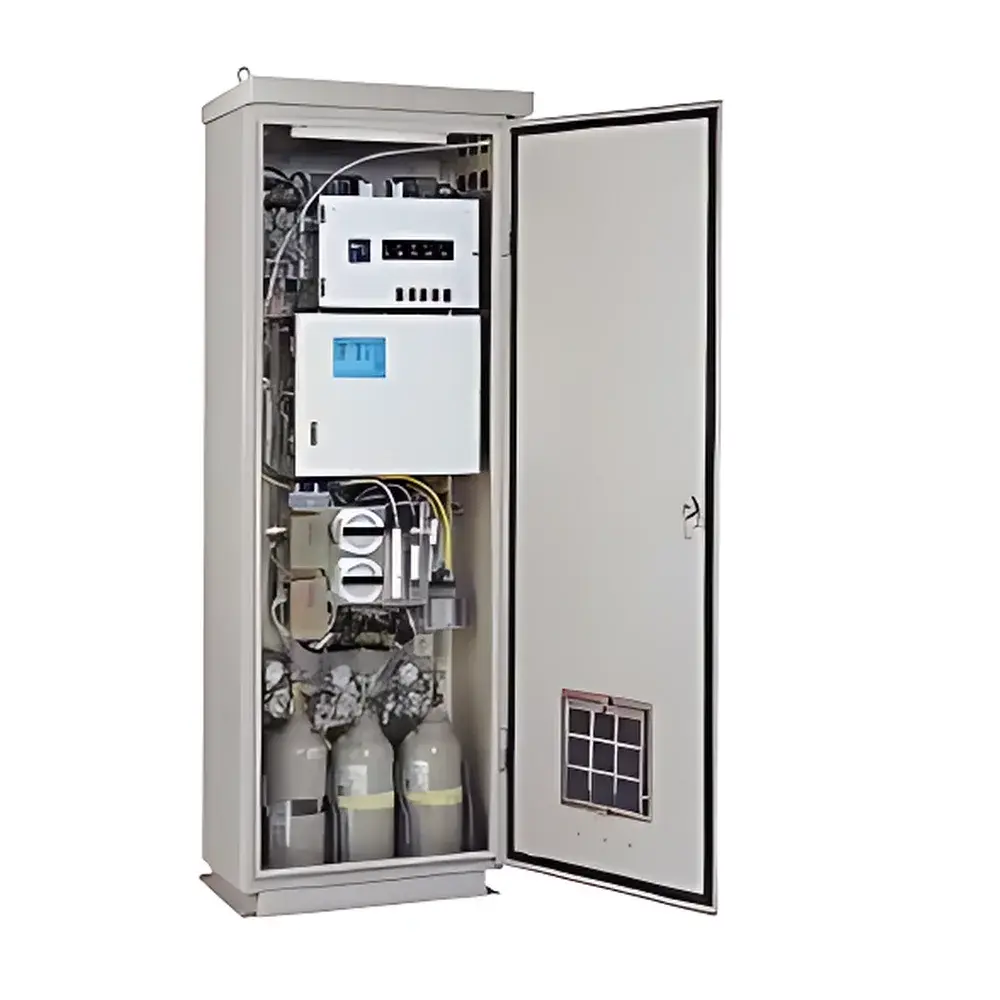
HORIBA ENDA-600ZG Series Continuous Emission Monitoring System (CEMS) for Flue Gas Analysis
| Brand | HORIBA |
|---|---|
| Origin | Japan |
| Model | ENDA-600ZG |
| Instrument Type | Continuous Emission Monitoring System (CEMS) |
| Measurement Accuracy | ±2.0% of reading |
| Repeatability | ±0.5% F.S. |
| Response Time (SO₂) | 60–240 s (T₉₀) |
| Long-term Stability | ±2.0% F.S./week |
| Detection Principle | Alternating Flow NDIR for NOₓ/SO₂/CO/CO₂ |
Overview
The HORIBA ENDA-600ZG Series is a compact, high-integrity Continuous Emission Monitoring System (CEMS) engineered for real-time, simultaneous quantification of up to five critical flue gas components: NOₓ (as NO), SO₂, CO, CO₂, and O₂. Designed for regulatory compliance and long-term operational reliability in demanding industrial environments, the system integrates two core analytical methodologies: alternating-flow non-dispersive infrared (NDIR) spectroscopy for gas species detection and magnetic pressure sensing for oxygen measurement. Unlike conventional dual-beam or single-beam NDIR architectures, the alternating-flow design alternates sample and reference gas streams through a single detection cell at 1 Hz frequency—eliminating optical alignment requirements, suppressing zero drift, and enabling continuous self-cleaning of the optical path. This architecture ensures metrological stability without periodic recalibration or mechanical adjustment, making it suitable for unattended operation under GLP/GMP and EPA Method 6C, 7E, 10, and ISO 12039-compliant monitoring programs.
Key Features
- Single-analyzer platform for simultaneous, continuous measurement of NOₓ, SO₂, CO, CO₂, and O₂—reducing footprint, installation complexity, and lifecycle cost.
- Alternating-flow NDIR technology with integrated interference compensation filters to correct cross-sensitivity from H₂O vapor and CO₂, particularly critical for NOₓ and SO₂ quantification in wet, variable-composition flue streams.
- Magnetic pressure O₂ sensor operating without carrier gas—utilizing ambient air as the reference medium, eliminating nitrogen supply infrastructure and associated maintenance.
- Front-access modular design: All routine maintenance—including filter replacement, calibration verification, and sensor inspection—is performed from the instrument’s front panel; no rear access required.
- Reduced physical envelope: Overall unit volume is 50% smaller than predecessor models (350 W × 550 H × 180 D mm for optional auto-blowback controller), enabling installation in space-constrained ductwork enclosures or retrofit sites where legacy CEMS could not be accommodated.
- Dry calibration protocol for SO₂: Achieves full span validation in ≤3 minutes versus 15 minutes for wet-gas calibration—minimizing downtime and improving QA/QC efficiency.
- Integrated CO₂ correction channel within the NOₓ analyzer module to dynamically compensate for CO₂-induced spectral interference—enhancing accuracy across fuel-switching and load-varying operations.
Sample Compatibility & Compliance
The ENDA-600ZG series is validated for use with flue gases from coal-, oil-, gas-, biomass-, and waste-fired combustion sources, including utility boilers, municipal solid waste incinerators, sintering plants, glass melting furnaces, sulfuric acid production lines, and coke ovens. Its sampling interface supports application-specific conditioning: a three-stage electronic cooling dehydration system (primary + dual secondary coolers) minimizes loss of soluble analytes (e.g., SO₂, NO₂) during condensation; an optional NH₃ scrubber mitigates ammonium sulfate salt formation in SCR-deactivated stacks; and a Cl₂ removal module prevents corrosion in waste-to-energy applications. All configurations comply with EN 15267-3 (QAL1 certification), MCERTS, and US EPA Performance Specification 2 (PS-2) for SO₂/NOₓ, PS-3 for O₂, and PS-4A for CO. The system supports 21 CFR Part 11–compliant audit trails when integrated with HORIBA’s optional data acquisition software.
Software & Data Management
The ENDA-600ZG features an embedded Linux-based control platform with a 10.4-inch resistive touchscreen interface supporting multilingual operation (English, Japanese, Chinese, Korean). Real-time concentration values for all five components are displayed simultaneously with selectable units (ppm, % vol, mg/m³ @ 11% O₂, etc.). The system provides configurable output channels (up to 12 analog/digital outputs) delivering instantaneous readings, O₂-corrected emissions (e.g., NOₓ @ 3% O₂), and rolling 1-hour dynamic averages per EU Directive 2010/75/EU requirements. Internal data logging retains ≥30 days of 1-second resolution records; external USB or Ethernet connectivity enables secure transfer to SCADA or centralized EMS platforms. Firmware updates and remote diagnostics are supported via SSH or HTTPS, with role-based user access control aligned with IEC 62443-3-3 cybersecurity guidelines.
Applications
The ENDA-600ZG is deployed globally in regulated emission monitoring applications requiring high availability and metrological traceability. Primary use cases include continuous compliance reporting for thermal power plants subject to China’s GB 13223-2011, India’s CPCB norms, or the EU Industrial Emissions Directive (IED); process optimization in iron & steel sintering belts where rapid CO/O₂ feedback informs combustion control; and corrosion-sensitive environments such as sulfuric acid contact-process plants, where SO₃ removal in the probe stage prevents downstream analyzer degradation. Its robustness extends to high-dust, high-moisture, and transient-load scenarios—validated through >100,000 field installations across 60+ countries since the ENDA platform’s introduction in 1991.
FAQ
Does the ENDA-600ZG require zero/span gas cylinders for daily operation?
No—its alternating-flow NDIR architecture inherently maintains zero stability; only periodic (e.g., weekly) span verification using certified calibration gases is recommended per QAL2 protocols.
Can the system measure NO₂ directly, or does it rely on catalytic conversion?
The standard configuration measures total NOₓ via high-efficiency molybdenum converter (95%+ NO₂ → NO); optional high-performance converters achieve >98% conversion for low-NO₂ streams.
Is the magnetic O₂ sensor susceptible to paramagnetic interference from CO or hydrocarbons?
No—the sensor operates on differential magnetic susceptibility and is unaffected by common flue gas interferents; no cross-calibration against CO or CH₄ is required.
What is the minimum detectable concentration (MDC) for SO₂ under typical stack conditions?
MDC is application-dependent but typically <2 ppm (at 101.3 kPa, 0% RH, 25°C), verified per ISO 12039 Annex B procedures.
How does the system handle particulate-laden sampling lines?
An optional wall-mounted auto-blowback controller (350 × 550 × 180 mm) delivers timed, pulsed compressed air to the probe filter—reducing manual cleaning frequency by ≥70% in cement kiln or biomass boiler applications.
Related Products







