
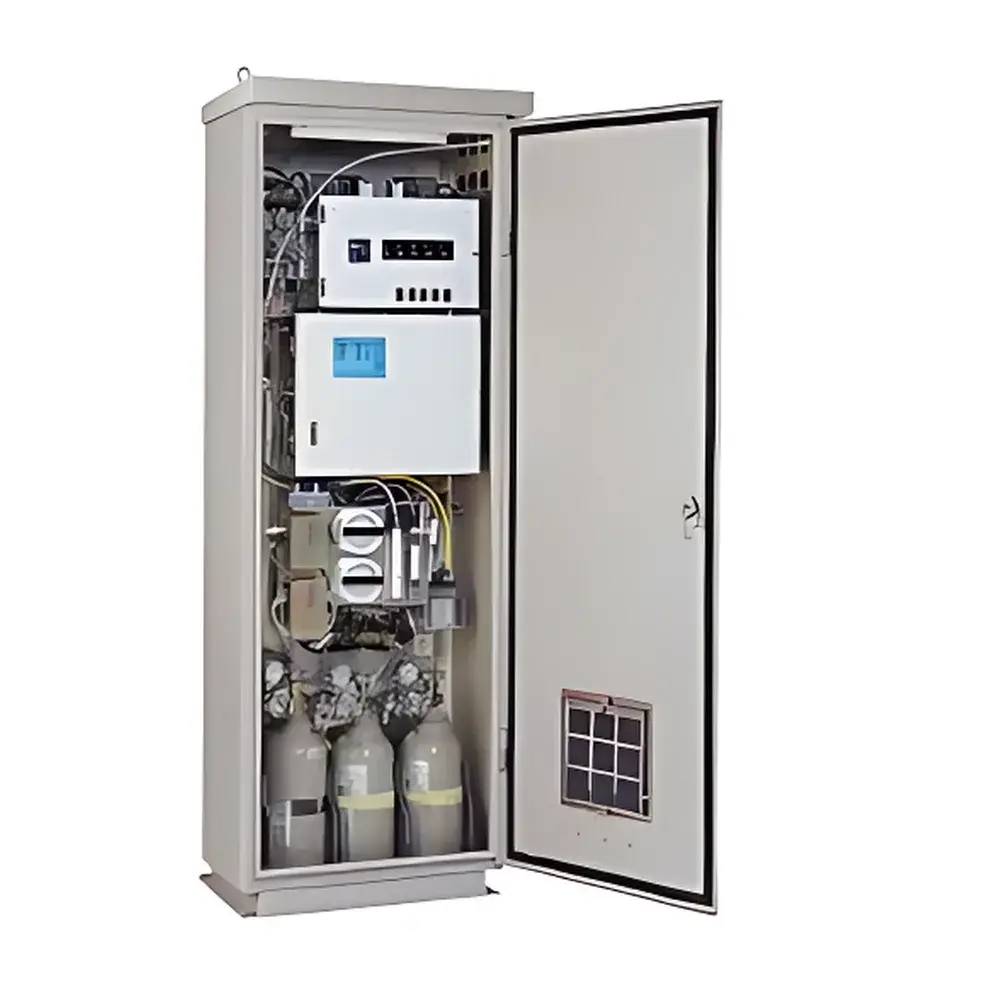
HORIBA ENDA-600ZG Series Continuous Emission Monitoring System (CEMS) for Flue Gas Analysis
| Brand | HORIBA |
|---|---|
| Origin | Japan |
| Model | ENDA-600ZG Series |
| Instrument Type | Continuous Emission Monitoring System (CEMS) |
| Measurement Accuracy | ±1.0 %F.S. |
| Repeatability | ±0.5 %F.S. |
| Response Time (SO₂) | 60–240 s |
| Stability | ±2.0 %F.S./week |
Overview
The HORIBA ENDA-600ZG Series is a compact, high-reliability Continuous Emission Monitoring System (CEMS) engineered for real-time, simultaneous measurement of up to five key flue gas components: NOx, SO2, CO, CO2, and O2. Designed for regulatory compliance and long-term operational integrity in demanding industrial environments, the system integrates alternating-flow non-dispersive infrared (NDIR) spectroscopy for acid gases and paramagnetic pressure detection for oxygen—eliminating the need for carrier gas or optical alignment. Its core architecture employs dual-beam modulation with periodic alternation between sample and reference gas streams at 1 Hz, ensuring intrinsic zero-point stability and eliminating drift without manual recalibration. The system meets international performance requirements for CEMS under ISO 14956, EN 15267, and EPA Performance Specification 3/PS-4/PS-5, supporting continuous compliance reporting in accordance with local environmental regulations.
Key Features
- Single-analyzer multi-component capability: Simultaneous quantification of NOx, SO2, CO, CO2, and O2 within one compact housing—reducing footprint, integration complexity, and maintenance overhead.
- Drift-free NDIR detection: Alternating-flow modulation eliminates optical misalignment risks and enables stable baseline performance over extended periods without mechanical adjustment.
- Paramagnetic O2 sensing: Utilizes ambient air as reference gas; no external N2 supply required—lowering operating cost and simplifying installation logistics.
- Integrated interference compensation: Dedicated interference filters and H2O-compensated detectors mitigate cross-sensitivity from water vapor and CO2, particularly critical in NOx and SO2 channels.
- Reduced physical footprint: Overall analyzer volume reduced by 50% versus prior-generation models; auto-blowback controller dimensions minimized to 350 × 550 × 180 mm (W×H×D), enabling wall-mounting in constrained spaces.
- Optimized calibration efficiency: Dry-gas SO2 span calibration completed in ≤3 minutes—compared to 15 minutes for legacy wet-calibration protocols.
- Low-power design: Power consumption reduced by 200 VA relative to predecessor systems, supporting energy-efficient operation across 24/7 monitoring cycles.
Sample Compatibility & Compliance
The ENDA-600ZG Series accommodates diverse flue gas matrices through application-specific sampling configurations. Standard configurations include primary electronic coolers and triple-stage condensate removal systems—comprising one primary and two secondary coolers—to minimize loss of soluble species (e.g., SO2, NO2) during dewpoint suppression. Optional modules address site-specific challenges: NH3 scrubbers for coal-fired power plant applications; Cl2 removal units for waste incineration; high-efficiency NOx converters for elevated NO2 fractions; and heated probe assemblies with integrated particulate filtration for high-dust environments. All sampling subsystems are designed per ISO 12039 and EN 14181 guidelines for extractive CEMS, with validated T90 response times meeting EU Industrial Emissions Directive (IED) requirements. The analyzer itself is certified to IP54 ingress protection and operates reliably across ambient temperatures of 0–40 °C and relative humidity up to 90% non-condensing.
Software & Data Management
The ENDA-600ZG features an embedded Linux-based control platform with a 10.4-inch capacitive touchscreen interface supporting multilingual operation (English, Japanese, Chinese, Korean). Real-time concentration values for all five measured components are displayed concurrently, alongside O2-corrected emissions (e.g., NOx @ 6% O2), 1-hour rolling averages, and alarm history logs. The system provides twelve configurable analog/digital outputs—including instantaneous values, corrected concentrations, and diagnostic status flags—for integration with DCS, SCADA, or central data acquisition systems. Audit-trail functionality records all calibration events, parameter changes, and fault conditions with timestamped user identification—supporting GLP/GMP traceability and FDA 21 CFR Part 11 compliance when deployed with optional secure authentication modules. Remote diagnostics and firmware updates are supported via Ethernet or optional cellular gateway.
Applications
The ENDA-600ZG Series is validated for continuous regulatory monitoring across thermal process industries requiring precise, auditable emissions data. Primary deployment sectors include utility-scale power generation (coal, biomass, natural gas), municipal solid waste incineration, cement kilns, glass melting furnaces, steel sintering plants, sulfuric acid production facilities, and industrial steam boiler operations. Its robust sampling adaptability supports challenging matrices: high-moisture flue gases from waste-to-energy plants; chloride-rich exhaust from medical waste incinerators; ammonia-laden streams from selective non-catalytic reduction (SNCR) systems; and particulate-laden effluents from iron ore sintering belts. With over 100,000 installed units globally, HORIBA’s field-proven architecture ensures consistent performance under fluctuating load conditions, transient combustion events, and seasonal ambient variations.
FAQ
What regulatory standards does the ENDA-600ZG meet for CEMS certification?
The system complies with ISO 14956, EN 15267-3 (QAL1), and EPA PS-3/PS-4/PS-5 for gaseous pollutants, supporting QAL2/QAL3 validation protocols required for legal compliance reporting.
How does the alternating-flow NDIR method improve long-term stability?
By cycling sample and reference gas through the same optical path at 1 Hz, the system cancels out detector aging effects and thermal drift—eliminating zero-point drift and reducing need for frequent zero/span checks.
Can the ENDA-600ZG operate without external nitrogen supply?
Yes—the O2 module uses ambient air as the reference medium via paramagnetic pressure detection, removing dependency on bottled N2 and associated infrastructure costs.
Is the system suitable for high-humidity or corrosive flue gas streams?
Yes—triple-stage electronic cooling, SO3 mist removal, and optional Cl2/NH3 conditioning modules ensure reliable operation in aggressive sampling environments.
What is the recommended calibration interval under routine operation?
Automated zero/span calibration is programmable up to once per week; however, daily verification using internal check gas or external standard is recommended per EN 14181 QA/QC protocols.
Related Products







