
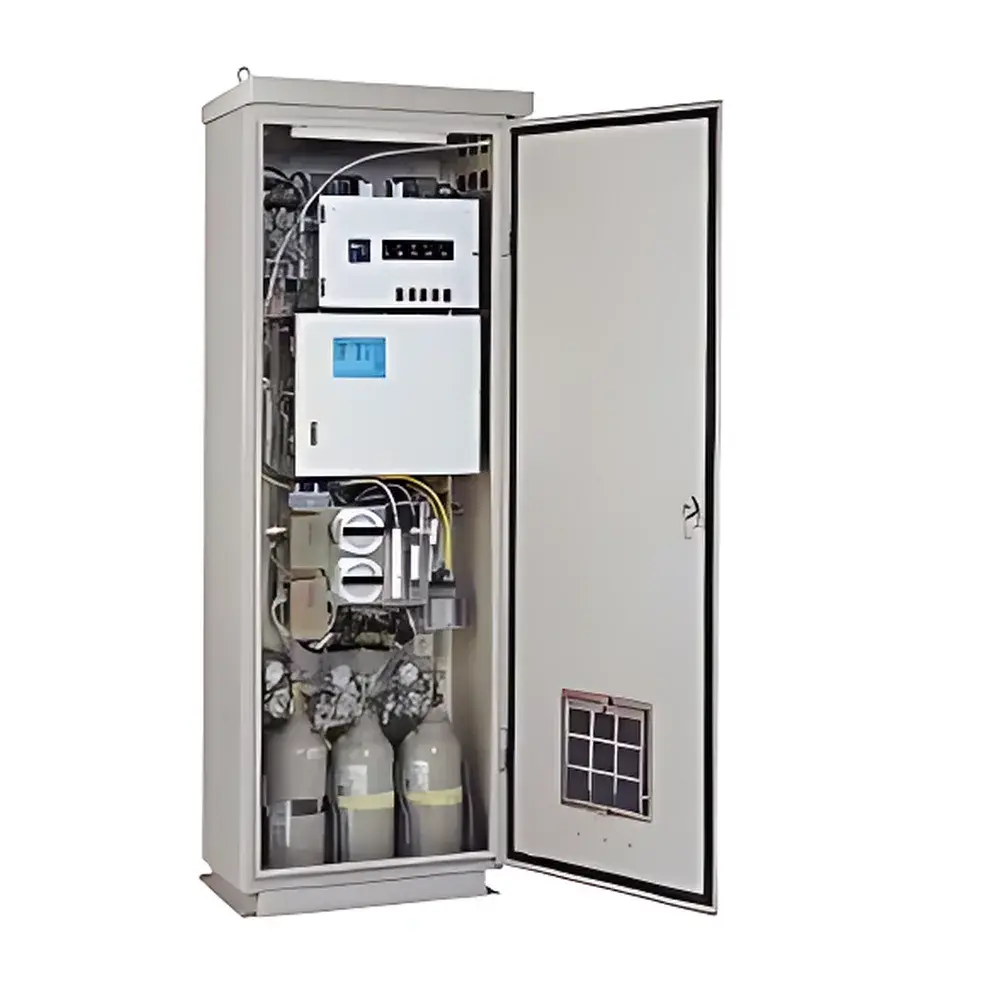
HORIBA ENDA-600ZG Series Continuous Emission Monitoring System (CEMS) for Flue Gas Analysis
| Brand | HORIBA |
|---|---|
| Origin | Japan |
| Model | ENDA-600ZG Series |
| Instrument Type | Continuous Emission Monitoring System (CEMS) |
| Measurement Accuracy | ±1.0% F.S. |
| Repeatability | ±0.5% F.S. |
| Response Time | 60–240 s (T90) |
| Stability | ±2.0% F.S. per week |
| Detection Principle | Alternating Flow NDIR (NOx, SO₂, CO, CO₂), Magnetic Pressure (O₂) |
| Display | Integrated Touchscreen LCD |
| Dimensions (Analyzer) | 50% reduction vs. predecessor |
| Auto-Backflush Controller Dimensions | 350 W × 550 H × 180 D mm |
| Power Consumption | Reduced by 200 VA vs. prior generation |
| Calibration | Dry-gas SO₂ calibration in ≤3 min |
| Output Channels | Up to 12 analog/digital outputs |
Overview
The HORIBA ENDA-600ZG Series is a compact, high-integrity Continuous Emission Monitoring System (CEMS) engineered for regulatory-compliant, long-term flue gas analysis in industrial and energy-generation facilities. It employs alternating flow non-dispersive infrared (NDIR) spectroscopy for simultaneous, real-time quantification of NOx, SO2, CO, and CO2, coupled with magnetic pressure oxygen sensing—eliminating the need for carrier gas or optical alignment. This dual-principle architecture ensures intrinsic zero-point stability, minimal drift, and immunity to mechanical vibration or thermal shock. Designed to meet stringent international performance standards—including ISO 14956, EN 15267, and EPA PS-11—the ENDA-600ZG delivers traceable, auditable measurements suitable for environmental compliance reporting under national CEMS regulations. Its single-analyzer architecture reduces footprint, installation complexity, and lifecycle maintenance burden without compromising analytical robustness.
Key Features
- Single-unit multi-component analysis: Simultaneous monitoring of NOx, SO2, CO, CO2, and O2 within one integrated analyzer housing.
- Alternating flow NDIR detection: Sample and reference gas streams alternate at 1 Hz into dedicated optical cells, enabling continuous self-cleaning of detection paths and eliminating zero drift.
- Magnetic pressure O2 measurement: Contactless sensing using ambient air as reference—no nitrogen supply required, reducing operational cost and gas infrastructure.
- Interference-compensated optics: Proprietary interference filter arrays correct for cross-sensitivity from H2O vapor and CO2 in NOx/SO2 channels.
- Touchscreen HMI: 7-inch capacitive LCD interface supports real-time concentration display, alarm history, calibration logs, and conversion parameter configuration—all accessible via front-panel navigation.
- Modular auto-backflush controller: Compact wall-mount unit (350 × 550 × 180 mm) with programmable purge cycles to maintain filter integrity in high-dust applications.
- Dry-gas SO2 calibration: Achieves full span verification in ≤3 minutes—reducing downtime versus legacy wet-calibration methods requiring 15 minutes.
Sample Compatibility & Compliance
The ENDA-600ZG accommodates diverse flue gas matrices through application-specific sampling system configurations. For waste incineration, integrated Cl2 scrubbers and triple-stage electronic cooling (primary + dual secondary chillers) minimize SO2/NO2 loss due to aqueous dissolution and suppress SO3 condensation in the probe and line. In coal-fired power plants, optional NH3 removal modules prevent sulfation interference during SO2 measurement. High-temperature NOx converters (up to 1000°C) ensure complete NO2→NO reduction where required. All sampling components—including heated probes, particulate filters, and condensate traps—are designed per ISO 12039 and ASTM D6522 guidelines. The system supports GLP/GMP audit trails and complies with data integrity requirements under FDA 21 CFR Part 11 when interfaced with validated SCADA or DCS platforms.
Software & Data Management
Embedded firmware provides configurable output protocols including 4–20 mA analog signals (up to 12 channels), Modbus TCP/RTU, and Ethernet/IP. Standard outputs include raw concentrations, O2-corrected values (per EN 14181), and dynamic 1-hour rolling averages. Internal memory stores ≥30 days of second-by-second data with timestamped calibration events, alarm triggers, and maintenance logs. Remote diagnostics are supported via secure HTTPS interface with role-based access control. Optional HORIBA CEMS Manager software enables centralized fleet monitoring, automated report generation (PDF/CSV), and deviation alerting aligned with EU Directive 2010/75/EU and U.S. EPA 40 CFR Part 60, Appendix B.
Applications
The ENDA-600ZG is deployed across regulated emission sources where space constraints, corrosion resistance, and long-term unattended operation are critical. Proven use cases include steam boiler exhausts in district heating plants; municipal solid waste incinerators with aggressive halogen chemistry; coal- and gas-fired power stations subject to MATS and IED compliance; iron and steel sintering lines; sulfuric acid production off-gas streams; and glass melting furnace ducts. Its reduced volume (50% smaller than predecessor models) enables retrofit installations in legacy control rooms or rooftop enclosures previously deemed unsuitable for CEMS hardware.
FAQ
What gas components does the ENDA-600ZG measure simultaneously?
NOx (as NO), SO2, CO, CO2, and O2—all within a single analyzer module.
Does the system require external nitrogen or other carrier gases?
No. O2 is measured via magnetic pressure method using ambient air as reference; no consumable gases are needed.
How is moisture interference mitigated in SO2 and NO2 measurement?
Through a three-stage electronic cooling system and SO3-rejecting mist eliminators that reduce aqueous-phase solute loss to <1.5% of nominal concentration.
Is the ENDA-600ZG compliant with EPA Performance Specification 11 (PS-11)?
Yes—when installed with certified sampling systems and operated per HORIBA’s QAPP, it meets PS-11 accuracy, precision, and drift requirements for NOx, SO2, and O2.
Can the analyzer be integrated into existing plant DCS networks?
Yes—via standard 4–20 mA outputs, Modbus TCP, or Ethernet/IP; HORIBA provides protocol documentation and configuration support for seamless integration.







