
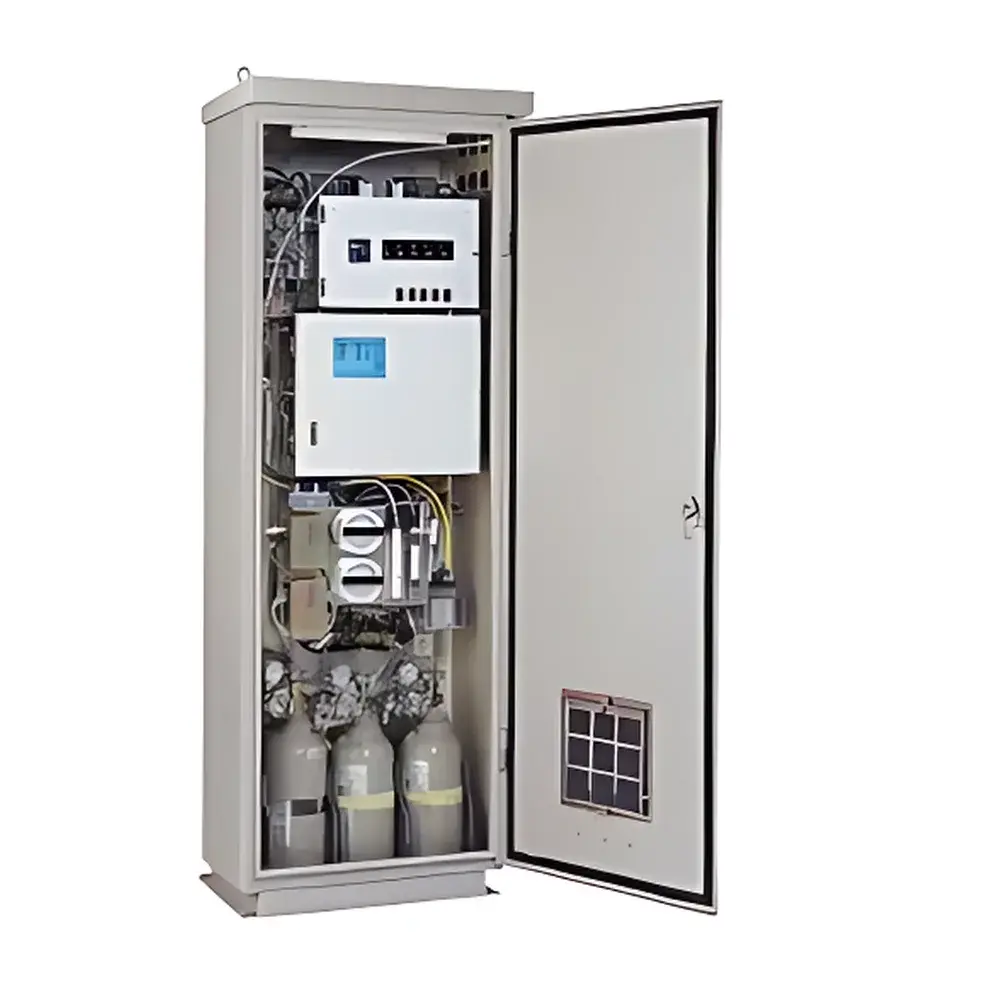
HORIBA ENDA-600ZG Series Continuous Emission Monitoring System (CEMS) for Flue Gas Analysis
| Brand | HORIBA |
|---|---|
| Origin | Japan |
| Model | ENDA-600ZG |
| Instrument Type | Continuous Emission Monitoring System (CEMS) |
| Measurement Accuracy | ±2.0% of reading |
| Repeatability | ±0.5% F.S. |
| Response Time (SO₂) | 60–240 s (T₉₀) |
| Long-Term Stability | ±2.0% F.S./week |
Overview
The HORIBA ENDA-600ZG Series is a compact, high-reliability Continuous Emission Monitoring System (CEMS) engineered for regulatory-compliant, simultaneous online analysis of up to five flue gas components: NOx, SO2, CO, CO2, and O2. Designed and manufactured in Japan, the system integrates alternating-flow non-dispersive infrared (NDIR) spectroscopy for acidic and combustible gases with paramagnetic oxygen detection—eliminating the need for carrier gas and minimizing drift mechanisms inherent in conventional optical or electrochemical platforms. Its core architecture leverages dual-beam modulation, where sample and reference gas streams alternate at 1 Hz through a single detection cell, enabling real-time zero-point referencing and intrinsic immunity to optical misalignment. This design ensures stable baseline performance over extended operational cycles without manual optical recalibration—a critical requirement for unattended, long-term stack monitoring under EPA Method 6C, ISO 12039, and EN 15267-3 certified installations.
Key Features
- Single-analyzer platform for concurrent, continuous measurement of NOx, SO2, CO, CO2, and O2—reducing footprint, integration complexity, and lifecycle maintenance costs.
- Alternating-flow NDIR detection with integrated interference compensation filters to correct cross-sensitivity from H2O, CO2, and other matrix gases—validated per ASTM D6522 and ISO 14956.
- Paramagnetic O2 sensor utilizing ambient air as reference gas—no external N2 supply required, lowering consumables cost and simplifying site logistics.
- Front-access modular design: All routine maintenance—including filter replacement, calibration validation, and sensor inspection—is performed from the instrument’s front panel; unit volume reduced by 50% versus prior-generation ENDA platforms.
- Dry-gas calibration for SO2 completed in ≤3 minutes (vs. 15 min for legacy wet-cal methods), minimizing downtime during QA/QC procedures.
- Integrated CO2 sensor for real-time correction of CO2-induced NOx interference, and dedicated H2O compensation detectors in both NOx and SO2 channels.
- Auto-blowback controller (350 × 550 × 180 mm) with 23% size reduction—wall-mountable and deployable in constrained mechanical rooms or duct-mounted enclosures.
Sample Compatibility & Compliance
The ENDA-600ZG accommodates highly variable flue gas matrices across thermal, chemical, and particulate load profiles. Application-specific sampling subsystems include: triple-stage electronic cooling (primary + dual secondary chillers) for near-complete water vapor removal while minimizing SO2/NO2 dissolution losses; optional NH3 scrubbers for coal-fired power plant applications; Cl2 removal modules for waste-to-energy incinerators; and high-efficiency ceramic probe filtration with direct-mount primary filters. All sampling trains comply with EPA Performance Specification 2 (PS-2) for SO2/NOx analyzers and are compatible with QAL1-certified CEMS validation protocols. The system supports automatic zero/span checks, dynamic range verification, and audit-ready data logging aligned with EU Directive 2010/75/EU (IED) and China’s HJ 75-2017 standard.
Software & Data Management
The embedded touchscreen HMI (10.1″ capacitive LCD) provides intuitive navigation across live concentration plots, calibration logs, alarm history, and conversion parameter configuration (e.g., O2 correction to 6% or 3% reference). Firmware supports up to 12 analog/digital outputs—including instantaneous values, O2-corrected emissions, and rolling 1-hour averages—with configurable update intervals (1–60 s). Data export adheres to MODBUS TCP, RS-485, and optional OPC UA interfaces. Audit trails record all operator actions, calibration events, and fault conditions with timestamped user IDs—fully compliant with FDA 21 CFR Part 11 requirements when deployed in regulated pharmaceutical or biotech manufacturing exhaust streams.
Applications
The ENDA-600ZG is validated for continuous compliance monitoring in diverse industrial emission sources: utility-scale coal- and gas-fired power plants; municipal solid waste (MSW) and hazardous waste incinerators; glass melting furnaces operating above 1,500°C; integrated steelmaking facilities (sinter plants, blast furnaces, coke ovens); sulfuric acid production units; and large-scale steam boiler systems in district heating and industrial process plants. Its robust sampling interface handles particulate concentrations up to 10 g/Nm³ and acid dew points down to −10°C, with proven field performance exceeding 10,000 hours mean time between failures (MTBF) in Class I, Division 2 hazardous locations.
FAQ
What regulatory standards does the ENDA-600ZG meet for CEMS certification?
It complies with EN 15267-3 (QA/QC), EN 14181 (QAL3), ISO 12039 (SO2/NOx), and supports full QAL1 certification when paired with HORIBA’s PS-2–compliant sampling system.
Can the system operate without external nitrogen supply?
Yes—the O2 module uses ambient air as the paramagnetic reference medium, eliminating N2 dependency and associated infrastructure costs.
How does the alternating-flow NDIR design improve long-term stability?
By cycling sample and reference gas through the same optical path at 1 Hz, it cancels out detector drift, window fouling effects, and thermal gradients—achieving <±2.0% F.S./week stability without optical realignment.
Is remote diagnostics supported?
Standard Ethernet connectivity enables secure remote firmware updates, log retrieval, and real-time parameter adjustment via HORIBA’s CEMS Manager software suite.
What maintenance intervals are recommended for routine operation?
Filter replacement every 3 months (or per particulate loading), full calibration verification every 7 days, and annual sensor health check—documented in accordance with ISO/IEC 17025 traceability requirements.







