
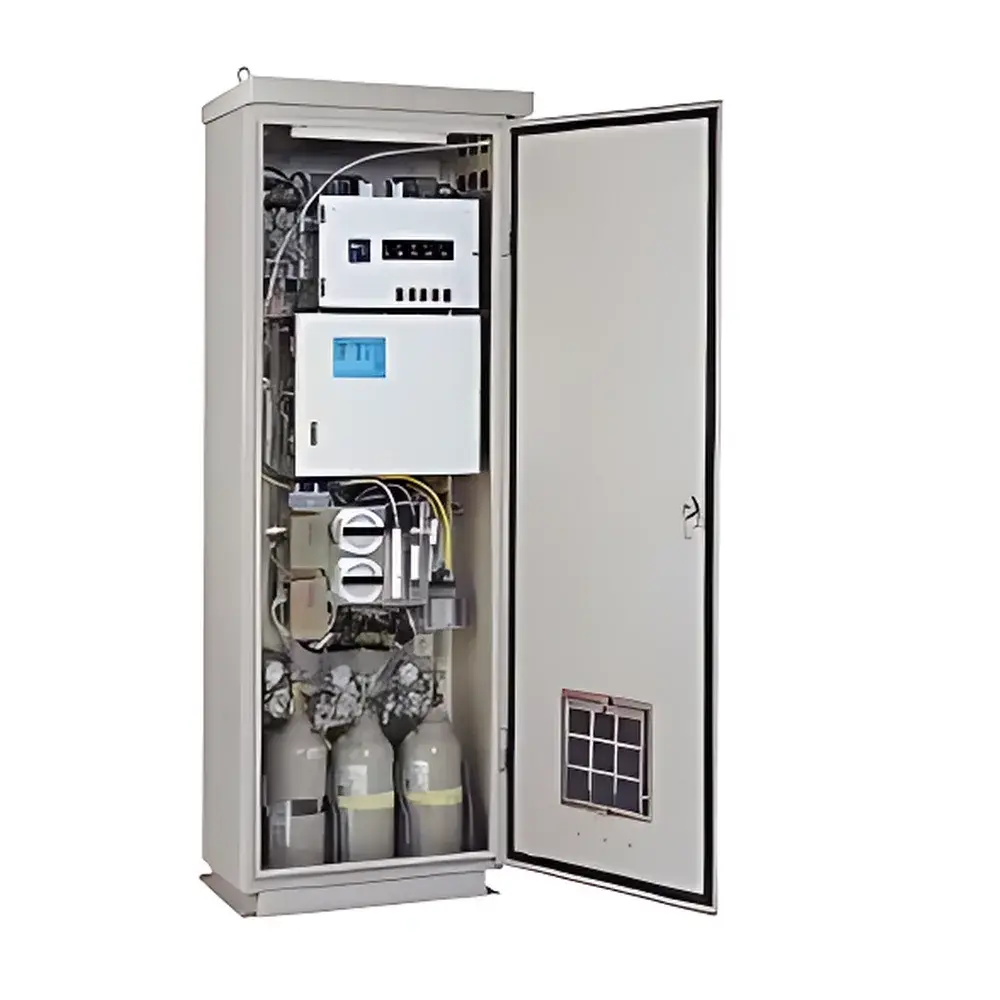
HORIBA ENDA-600ZG Series Continuous Emission Monitoring System (CEMS)
| Brand | HORIBA |
|---|---|
| Origin | Japan |
| Model | ENDA-600ZG Series |
| Instrument Type | Flue Gas Continuous Emission Monitoring System (CEMS) |
| Accuracy | ±1.0 % FS |
| Repeatability | ±0.5 % FS |
| Response Time (SO₂) | 60–240 s |
| Stability | ±2.0 % FS/week |
Overview
The HORIBA ENDA-600ZG Series is a compact, high-integrity Continuous Emission Monitoring System (CEMS) engineered for regulatory-compliant, long-term flue gas analysis in industrial and power generation environments. Designed around dual-principle detection architecture—alternating-flow non-dispersive infrared (NDIR) spectroscopy for NOx, SO2, CO, and CO2, and magnetic pressure (paramagnetic) sensing for O2—the system delivers stable, drift-free measurement without optical alignment or carrier gas dependency. Its alternating sample/reference gas modulation at 1 Hz eliminates zero-point drift and enables continuous self-cleaning of the optical detection cells. With over three decades of field-proven deployment across >100,000 installations globally, the ENDA-600ZG meets stringent international performance standards for CEMS applications, including ISO 14956, EN 15267, and EPA Performance Specification 3 (PS-3) and PS-4A for gaseous pollutants.
Key Features
- Single-analyzer platform simultaneously quantifies up to five regulated flue gas components: NOx, SO2, CO, CO2, and O2—reducing footprint, calibration complexity, and total cost of ownership.
- Alternating-flow NDIR detection eliminates mechanical zero drift and optical misalignment; no periodic optical realignment required after transport, service, or vibration exposure.
- Magnetic pressure O2 sensor operates without external N2 carrier gas—uses ambient air as reference medium, lowering operational cost and eliminating gas supply infrastructure.
- Integrated interference compensation: proprietary interference filter wheels and H2O/CO2-specific correction algorithms minimize cross-sensitivity effects in multi-component analysis.
- Touchscreen HMI with intuitive navigation supports real-time display of all five components, alarm history, calibration logs, and conversion parameter settings—all accessible from a single front-panel interface.
- Physical footprint reduced by 50% versus prior-generation ENDA platforms; analyzer dimensions optimized for constrained plant spaces—full maintenance performed from front access only.
- Auto-blowback controller (350 × 550 × 180 mm) shrunk by 23% in volume; wall-mountable design accommodates tight utility corridors and retrofit installations.
Sample Compatibility & Compliance
The ENDA-600ZG integrates with application-specific sampling systems engineered for harsh flue gas conditions. For waste incineration, a chlorine scrubber and tri-stage electronic cooling (primary + dual secondary coolers) minimizes SO2/NO2 loss due to aqueous dissolution while removing SO3 aerosols via integrated demister filtration. In coal-fired power plants, optional NH3 removal modules prevent sulfation interference during SO2 measurement, and high-efficiency NOx converters ensure complete NO2→NO conversion under elevated NO2 fractions. All sampling trains comply with EN 14181 requirements for QA/QC, and system-level validation supports GLP-aligned audit trails per ISO/IEC 17025. The analyzer meets EU Industrial Emissions Directive (IED) monitoring frequency and data availability mandates (≥90% valid data capture per quarter).
Software & Data Management
Firmware supports automated 7-day calibration cycles with dry-gas SO2 standardization (3-minute completion vs. legacy 15-minute wet calibration), reducing downtime and operator intervention. Data outputs include raw concentration (ppm or %), O2-corrected values (e.g., 6% O2 basis), and dynamic 1-hour rolling averages—transmitted via up to 12 isolated analog (4–20 mA) channels. Digital communication protocols include Modbus RTU/TCP and optional OPC UA integration for SCADA and EMS platforms. Audit-ready data logging includes timestamped calibration events, alarm triggers (pre-alarm and fault), and maintenance logs—with configurable retention policies aligned with EPA 40 CFR Part 60 and EU MRV reporting timelines.
Applications
The ENDA-600ZG is deployed across emission-critical thermal processes requiring continuous regulatory-grade monitoring: utility-scale coal- and gas-fired power plants; municipal solid waste (MSW) and hazardous waste incinerators; primary steelmaking (sinter plants, blast furnaces); sulfuric acid production facilities; glass melting furnaces; and large-scale steam boiler systems. Its robust sampling adaptability—including particulate-laden, high-humidity, and corrosive (Cl2/SO3) streams—enables compliance with local air quality ordinances and transnational frameworks such as the EU LCP BREF and China’s GB 13223–2011. System configuration is validated per site-specific stack geometry, temperature, and contaminant profile during pre-commissioning engineering.
FAQ
Does the ENDA-600ZG require carrier gas for O2 measurement?
No. The magnetic pressure O2 sensor uses ambient air as the reference medium—no external N2 supply is needed.
What is the typical response time for SO2 under high-moisture conditions?
T90 ≤ 240 seconds when SO2 is present alongside water vapor; ≤ 90 seconds with chlorine scrubber installed and no SO2 interference.
How does the system handle NO2 interference in NOx measurement?
A high-efficiency thermal NOx converter ensures ≥95% NO2→NO conversion; CO2 and H2O compensation algorithms further correct residual spectral overlap.
Is the analyzer compliant with EPA PS-4A for SO2 and NOx?
Yes—when configured with certified sampling train, calibration gases traceable to NIST standards, and documented QA/QC procedures per Appendix B of 40 CFR Part 60.
Can historical calibration and alarm data be exported for regulatory reporting?
Yes—CSV export via USB port or network interface; all events are time-stamped and cryptographically logged to support 21 CFR Part 11–aligned audit trails.







