
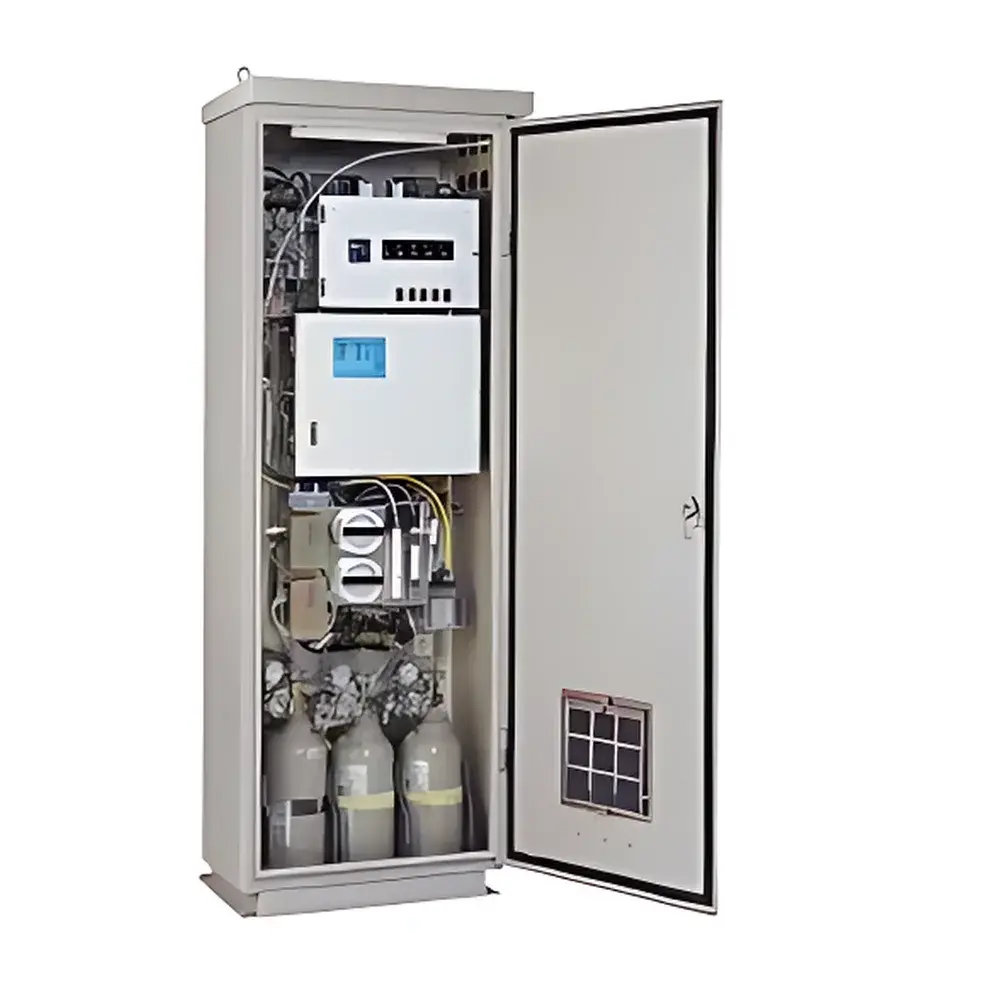
HORIBA ENDA-600ZG Series Flue Gas Continuous Emission Monitoring System (CEMS)
| Brand | HORIBA |
|---|---|
| Origin | Japan |
| Model | ENDA-600ZG |
| Instrument Type | Flue Gas CEMS |
| Accuracy | ±1.0% F.S. |
| Repeatability | ±0.5% F.S. |
| Response Time (SO₂) | 60–240 s |
| Stability | ±2.0% F.S./week |
Overview
The HORIBA ENDA-600ZG Series is a compact, high-reliability flue gas continuous emission monitoring system (CEMS) engineered for precise, long-term in-situ measurement of up to five key combustion gases—NOx, SO2, CO, CO2, and O2—in demanding industrial exhaust streams. Leveraging HORIBA’s proprietary alternating-flow non-dispersive infrared (NDIR) detection technology for acid gases and CO/CO2, combined with magnetic pressure (paramagnetic) O2 sensing, the system eliminates optical drift, zero-point shift, and carrier gas dependency. Unlike dual-beam or conventional single-beam NDIR architectures, the ENDA-600ZG employs a time-multiplexed sample/reference gas alternation at 1 Hz within a single detection cell—enabling continuous self-cleaning of the optical path and intrinsic compensation for window fouling, condensation, and thermal drift. This architecture delivers metrological stability compliant with ISO 14956, EN 15267, and EPA Performance Specification 3 (PS-3) for CEMS validation. Designed for unattended operation over extended maintenance intervals, the system meets GLP/GMP data integrity expectations through hardware-embedded audit trails and timestamped calibration logs.
Key Features
- Single-analyzer platform for simultaneous, real-time monitoring of NOx, SO2, CO, CO2, and O2—reducing footprint, integration complexity, and lifecycle cost.
- Alternating-flow NDIR detection: Sample and reference gas streams alternate into one common optical cell at 1-second intervals, ensuring automatic optical path cleaning and eliminating need for manual alignment or zero adjustment.
- Magnetic pressure O2 sensor: Measures O2 without consumable carrier gas (e.g., N2); ambient air serves as reference medium—lowering operating cost and simplifying installation.
- Integrated interference compensation: Dedicated H2O and CO2 correction channels mitigate cross-sensitivity in NOx and SO2 measurements per ISO 12039 and ASTM D6522 protocols.
- Touch-enabled 10.4-inch TFT LCD interface: Front-panel operation supports real-time multi-parameter display, alarm history, calibration status, and conversion factor configuration without external PC.
- 50% reduced physical volume vs. predecessor models (350 × 550 × 180 mm for auto-blowback controller; analyzer cabinet depth minimized for wall-mount or tight-space deployment).
- Dry SO2 calibration completed in ≤3 minutes—contrasting with legacy wet-calibration methods requiring ≥15 minutes—enhancing operational uptime and QA/QC efficiency.
Sample Compatibility & Compliance
The ENDA-600ZG accommodates highly variable flue gas matrices across thermal, chemical, and particulate load profiles. Its modular sampling subsystem includes application-specific configurations: chloride removal units for waste incineration (T90 ≤ 90 s for Cl2-free SO2 measurement), NH3 scrubbers for coal-fired power plants, and high-efficiency three-stage electronic cooling (primary + dual secondary chillers) to suppress SO2/NO2 dissolution losses during dew point suppression. A direct-coupled heated probe and replaceable primary filter minimize maintenance downtime. All sampling components comply with EN 14181 requirements for QAL1–QAL3 certification and support full traceability under EU Industrial Emissions Directive (IED) reporting mandates. The system’s documented stability (±2.0% F.S./week) and repeatability (±0.5% F.S.) satisfy EPA Method 7E, ISO 10849, and JIS B 7982 verification criteria.
Software & Data Management
Embedded firmware supports configurable analog (4–20 mA) and digital (RS-485 Modbus RTU, optional Ethernet TCP/IP) outputs—up to 12 independent signals including instantaneous concentrations, O2-corrected values (per EN 14792), and rolling 1-hour dynamic averages. Calibration events, alarm triggers (pre-alarm and fault), and sensor diagnostics are time-stamped and stored internally for ≥30 days. Data export via USB or optional SD card enables offline compliance reporting aligned with FDA 21 CFR Part 11 (electronic signature readiness) and EU Annex 11 (data integrity). Remote monitoring is supported via secure HTTP(S) interface with role-based access control—facilitating centralized fleet management across multi-site installations.
Applications
The ENDA-600ZG is validated for continuous regulatory-grade monitoring in diverse high-temperature, high-humidity, and corrosive emission sources—including utility-scale power boilers, municipal solid waste (MSW) incinerators, coke ovens, sulfuric acid production lines, glass melting furnaces, and integrated steelmaking facilities. Its robust sampling design mitigates SO3 condensation-induced corrosion, while low-power electronics (200 VA reduction vs. prior generation) enable deployment in remote or energy-constrained locations. Field-proven performance exceeds 100,000 installed units globally—supporting compliance with national emission limits (e.g., China’s GB 13223, Japan’s JIS B 7982, EU IED BAT conclusions) and carbon accounting frameworks requiring certified CO2 mass flow data.
FAQ
What gas components can the ENDA-600ZG measure simultaneously?
NOx, SO2, CO, CO2, and O2—all within a single analyzer unit.
Does the system require external carrier gas for O2 measurement?
No. It uses ambient air as the reference medium via magnetic pressure detection—eliminating N2 supply infrastructure.
How is moisture interference managed for SO2 and NO2 accuracy?
Through a three-stage electronic cooling system that achieves deep dew point suppression while minimizing aqueous-phase dissolution losses.
What calibration standards does the ENDA-600ZG support?
Certified span gases per ISO 6141 and zero gas (N2 or synthetic air); dry calibration protocol reduces SO2 calibration time to ≤3 minutes.
Is the system compliant with international CEMS certification requirements?
Yes—it meets EN 15267-3, ISO 14956, EPA PS-3, and JIS B 7982 for type approval and ongoing QAL3 verification.
Related Products







