
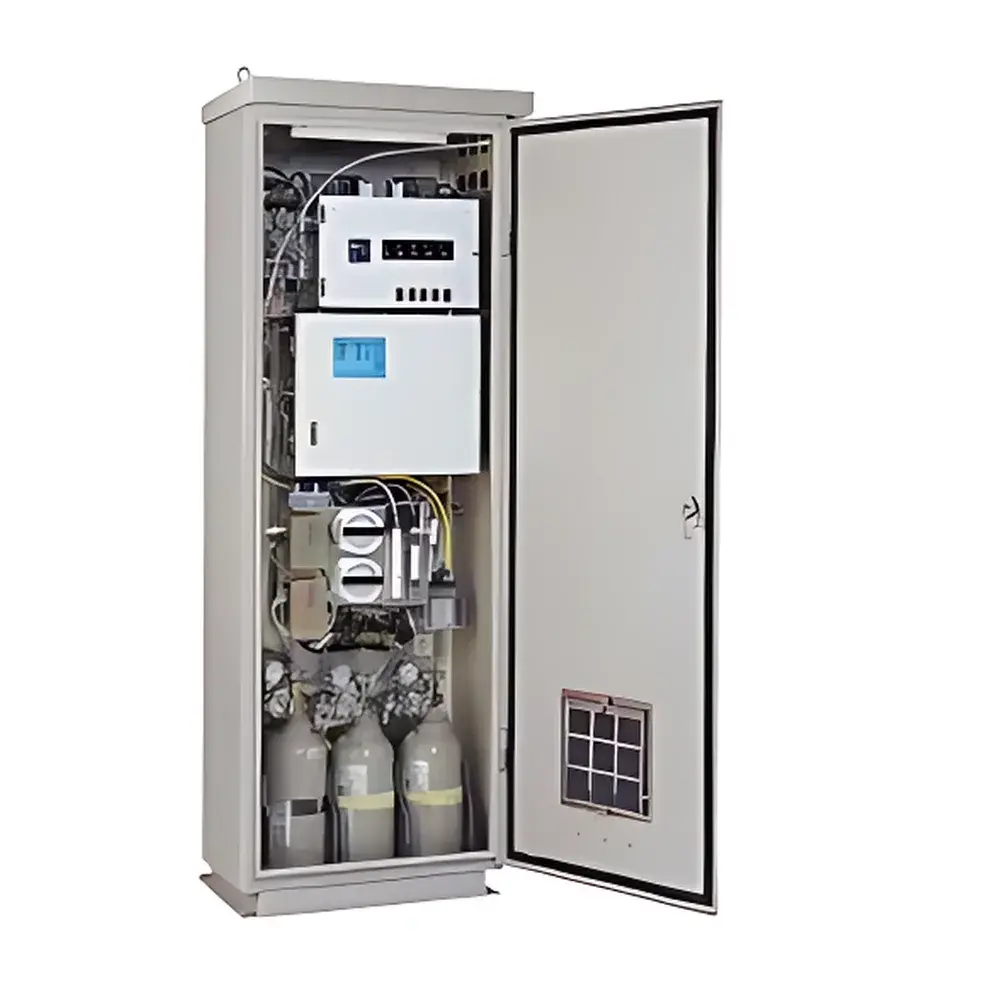
HORIBA ENDA-600ZG Series Flue Gas Continuous Emission Monitoring System (CEMS)
| Brand | HORIBA |
|---|---|
| Origin | Japan |
| Model | ENDA-600ZG Series |
| Instrument Type | Continuous Emission Monitoring System (CEMS) |
| Measurement Principle | Alternating Flow NDIR for NOx/SO₂/CO/CO₂ |
| Accuracy | ±1.0 %F.S. |
| Repeatability | ±0.5 %F.S. |
| Response Time (SO₂) | 60–240 s (T₉₀) |
| Stability | ±2.0 %F.S./week |
| Display | Integrated Touchscreen LCD |
| Dimensions (Analyzer) | 50 % reduction vs. predecessor |
| Auto-Backflush Controller Dimensions | 350 W × 550 H × 180 D mm |
| Power Consumption | Reduced by 200 VA vs. prior generation |
| Calibration | Dry-gas SO₂ calibration in ≤3 min |
| Compliance Support | Designed for ASTM D6522, ISO 12039, EN 15267, JIS B 7982, and EPA Methods 6C, 7E, 10, 21, 3A, and applicable GLP/GMP data integrity requirements |
Overview
The HORIBA ENDA-600ZG Series is a compact, high-reliability flue gas continuous emission monitoring system (CEMS) engineered for regulatory-grade, multi-component measurement of NOx, SO2, CO, CO2, and O2 in industrial exhaust streams. Unlike conventional CEMS architectures requiring separate analyzers per gas species, the ENDA-600ZG integrates all five measurements into a single analyzer unit using dual physical detection principles: alternating-flow non-dispersive infrared (NDIR) spectroscopy for NOx, SO2, CO, and CO2; and magnetic pressure (paramagnetic) detection for O2. This hybrid architecture eliminates the need for carrier gases (e.g., N2) in oxygen analysis and avoids optical realignment during routine operation or after mechanical disturbance — a key differentiator from dual-beam or single-beam NDIR systems. The alternating flow design ensures intrinsic zero-point stability by cycling sample and reference gas through the same detection cell at 1 Hz, thereby canceling drift caused by thermal or detector aging effects. With over three decades of field deployment across >100,000 installations globally, the ENDA-600ZG reflects HORIBA’s deep domain expertise in stack gas metrology under demanding conditions — including high-humidity, high-dust, and corrosive matrices typical of waste incineration, power generation, and metallurgical processes.
Key Features
- Single-unit, five-parameter CEMS: Simultaneous real-time quantification of NOx, SO2, CO, CO2, and O2 without external gas chromatographs or secondary analyzers.
- Zero-drift NDIR architecture: Alternating flow modulation eliminates optical alignment requirements and enables long-term baseline stability (<±2.0 %F.S./week).
- Magnetic pressure O2 sensor: No consumable carrier gas required; ambient air serves as reference medium, reducing operational cost and footprint.
- Integrated interference compensation: Dedicated H2O and CO2 correction algorithms embedded in NOx and SO2 measurement channels to minimize cross-sensitivity.
- Touchscreen human-machine interface (HMI): 7-inch capacitive LCD with intuitive navigation for calibration, alarm review, concentration conversion, and historical trend access — all accessible from the front panel.
- Modular, front-access maintenance: 50 % smaller analyzer volume vs. prior-generation ENDA platforms; all service points (filters, valves, sensors) reachable without rear-panel disassembly.
- Optimized dry-calibration protocol: SO2 span adjustment completed in ≤3 minutes using certified dry standard gas — eliminating time-consuming wet-bench procedures.
Sample Compatibility & Compliance
The ENDA-600ZG is compatible with diverse flue gas matrices across regulated industrial sectors. Its sampling subsystem is configurable per application-specific challenges: for waste-to-energy plants, integrated Cl2 scrubbers and triple-stage electronic coolers (primary + dual secondary) minimize SO2/NO2 loss due to aqueous absorption; for coal-fired power stations, optional NH3 removal modules prevent sulfamic acid formation during SO2 analysis; for high-dust environments (e.g., sintering belts or glass furnaces), wall-mounted auto-backflush controllers (350 × 550 × 180 mm) mitigate filter clogging with programmable purge cycles. All configurations comply with international performance standards including ISO 12039 (stationary source emissions — determination of mass concentration of SO2, NOx, CO, CO2, O2), EN 15267 (CEMS type approval), and U.S. EPA Performance Specifications PS-2, PS-3, PS-4, PS-5, and PS-15. Data handling supports 21 CFR Part 11-compliant audit trails when paired with HORIBA’s optional data acquisition software (DAQ-Link), ensuring traceability for GLP/GMP and environmental regulatory audits.
Software & Data Management
The ENDA-600ZG embeds firmware with native support for multiple output protocols (4–20 mA analog, RS-232/485, Modbus TCP/IP) and up to twelve configurable output channels. These include instantaneous concentrations, O2-corrected values (e.g., NOx @ 3 % O2), and dynamic rolling averages (1-hour mean). Internal memory logs >30 days of second-by-second raw and processed data with timestamped event markers (calibration, alarm, maintenance). Optional DAQ-Link software provides remote configuration, real-time dashboard visualization, automated report generation (PDF/CSV), and secure role-based user access control. All calibration events, alarm acknowledgments, and parameter modifications are recorded with operator ID, timestamp, and pre-/post-change values — fulfilling ALCOA+ data integrity principles and enabling full compliance with FDA 21 CFR Part 11 electronic records requirements.
Applications
The ENDA-600ZG is deployed across emission-critical industrial facilities where space constraints, maintenance accessibility, and regulatory reporting accuracy converge. It is routinely specified for continuous monitoring of steam boilers (biomass, natural gas, coal), municipal solid waste incinerators (MSWI), combined-cycle gas turbines (CCGT), blast furnace off-gas trains, sulfuric acid production lines, flat-glass melting furnaces, and coke oven batteries. Its compact footprint enables installation in retrofit scenarios where legacy CEMS cabinets occupied excessive floor area — particularly valuable in brownfield sites with limited mezzanine or rooftop space. The system’s resistance to SO3 condensation (via integrated mist eliminators) and chloride-induced corrosion (via optional Cl2 traps) extends service intervals in aggressive flue gas environments. Field-proven reliability in ambient temperatures ranging from −20 °C to +50 °C and relative humidity up to 95 % RH (non-condensing) ensures consistent operation across global climatic zones.
FAQ
What detection technologies does the ENDA-600ZG use for each gas component?
It employs alternating-flow NDIR for NOx, SO2, CO, and CO2; and magnetic pressure (paramagnetic) detection for O2.
Does the system require external carrier gas for O2 analysis?
No — ambient air is used as the reference medium for the magnetic pressure O2 sensor, eliminating the need for bottled N2 or other carrier gases.
How is interference from water vapor mitigated during SO2 and NOx measurement?
The system incorporates dedicated H2O interference compensation detectors and applies real-time algorithmic correction based on measured moisture content.
Can the ENDA-600ZG meet U.S. EPA PS-15 requirements for NOx CEMS?
Yes — when configured with EPA-certified sampling components (e.g., heated probe, PTFE-lined sample line, permeation dryer) and validated per PS-15 test protocols, it satisfies performance criteria for relative accuracy, precision, and calibration drift.
What is the maximum recommended particulate loading for the standard sampling probe?
For applications exceeding 10 g/Nm³ dust concentration, HORIBA recommends integration of the optional wall-mounted auto-backflush controller with programmable purge timing.
Related Products







