
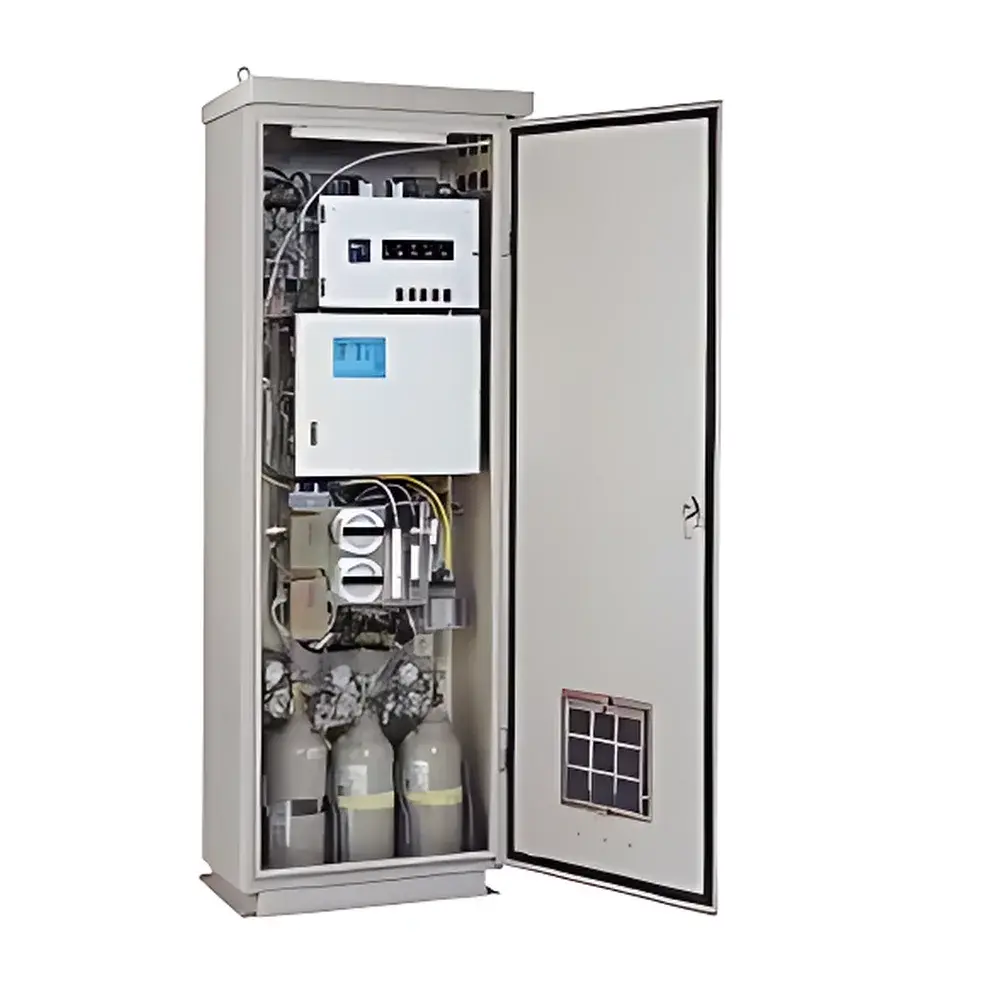
HORIBA ENDA-640ZG Series Flue Gas Continuous Emission Monitoring System (CEMS)
| Brand | HORIBA |
|---|---|
| Origin | Japan |
| Model | ENDA-640ZG Series |
| Instrument Type | Flue Gas CEMS |
| Accuracy | ±1.0% F.S. |
| Repeatability | ±0.5% F.S. |
| Response Time (SO₂) | 60–240 s |
| Stability | ±2.0% F.S./week |
Overview
The HORIBA ENDA-640ZG Series is a compact, high-reliability flue gas continuous emission monitoring system (CEMS) engineered for precise, long-term measurement of up to five key combustion gases—NOx, SO2, CO, CO2, and O2—in industrial exhaust streams. Designed for compliance with international emissions reporting standards—including ISO 14064, EN 15267, and EPA Performance Specification 3/PS-4—the system employs dual physical detection principles: alternating-flow non-dispersive infrared (NDIR) spectroscopy for NOx, SO2, CO, and CO2, and paramagnetic oxygen detection (magnetopneumatic method) for O2. Unlike conventional dual-beam NDIR systems requiring optical alignment and frequent zero calibration, the ENDA-640ZG’s alternating-flow architecture ensures intrinsic zero-point stability by cycling sample and reference gas through a single detection cell at 1 Hz frequency. This eliminates mechanical drift, removes the need for periodic optical realignment, and sustains metrological integrity over extended operational cycles—critical for unattended, 24/7 CEMS deployments in regulated environments.
Key Features
- Single-analyzer multi-component capability: Simultaneous real-time quantification of NOx, SO2, CO, CO2, and O2 without external gas switching valves or multiple detector modules.
- Interference-compensated NDIR detection: Integrated interference filter technology corrects cross-sensitivity from H2O vapor and CO2—particularly critical for accurate NOx measurement under high-moisture conditions.
- Paramagnetic O2 sensing: Eliminates consumable carrier gas (e.g., N2) requirements; ambient air serves as the reference medium, reducing operating cost and footprint.
- Compact modular architecture: Overall instrument volume reduced by 50% versus prior-generation ENDA platforms; front-access maintenance design enables full service—including filter replacement, calibration, and sensor inspection—without rear-panel disassembly.
- Optimized SO2 calibration protocol: Dry-gas calibration completes in ≤3 minutes, compared to 15 minutes required for legacy wet-calibration procedures—minimizing downtime during QA/QC verification.
- Integrated anti-fouling strategy: Includes primary electronic cooler, dual-stage secondary coolers (triple-stage dehydration), SO3 mist removal, Cl2 scrubbing (optional), and NH3 removal (optional) to preserve analytical fidelity across diverse stack chemistries.
Sample Compatibility & Compliance
The ENDA-640ZG accommodates highly variable flue gas matrices—from low-sulfur coal-fired boiler effluents to high-chlorine waste incinerator exhausts—via application-specific sampling system configurations. Standard probe assemblies integrate heated filtration (≤180 °C) and direct-coupled primary particulate traps. For chlorine-rich streams (e.g., MSW incineration), optional NaOH-based Cl2 scrubbers reduce corrosion risk and extend component service life. In high-NO2 applications (e.g., SCR-deactivated boilers), high-efficiency NOx converters ensure stoichiometric conversion to NO prior to detection. All sampling subsystems comply with EN 14181 requirements for automated performance checks and are validated per QAL1 (Quality Assurance Level 1) protocols under EN 15267-3. The analyzer itself meets CE marking directives, RoHS compliance, and IEC 61000-6-2/6-4 immunity/emission standards.
Software & Data Management
The embedded touchscreen HMI supports intuitive navigation across live concentration plots, calibration logs, alarm history, and configuration menus—all accessible without external PCs. Data output includes analog (4–20 mA) channels (up to 12 configurable signals), Modbus TCP/IP, and optional Profibus DP interfaces. All concentration values are timestamped and stored locally with ≥30 days of buffered memory. Audit-trail functionality records operator actions, calibration events, and fault conditions in accordance with FDA 21 CFR Part 11 and EU Annex 11 expectations for regulated CEMS installations. Optional HORIBA CEMS Manager software provides remote diagnostics, trend analysis, and automated report generation aligned with national regulatory templates (e.g., China’s HJ 75/76, US EPA 75/76).
Applications
The ENDA-640ZG is deployed globally across emission-critical thermal processes including coal- and gas-fired power plants, municipal solid waste (MSW) and hazardous waste incinerators, glass melting furnaces, integrated steel mills, sulfuric acid production facilities, and industrial steam boilers. Its robust sampling adaptability supports challenging matrices: high-dust cement kilns (with auto-blowback controller), low-oxygen biomass combustion, and high-acid gas streams from metallurgical roasters. The system’s compactness enables retrofit installation where space constraints previously precluded CEMS deployment—particularly in brownfield sites or modular skid-mounted packages.
FAQ
What detection principles does the ENDA-640ZG use for each gas?
NOx, SO2, CO, and CO2 are measured via alternating-flow NDIR; O2 is determined using paramagnetic pressure differential detection.
Is the system compliant with EPA PS-3 and PS-4?
Yes—the ENDA-640ZG meets all technical requirements for PS-3 (O2) and PS-4 (SO2/NOx) when configured with QAL1-certified sampling and calibrated per EPA Method 7E/6C.
How often is calibration required?
Automatic zero/span verification is performed every 7 days; manual calibration is recommended quarterly or after maintenance events.
Can the system operate without external nitrogen supply?
Yes—ambient air serves as both reference gas for NDIR and carrier medium for O2 detection, eliminating dependency on bottled N2.
What is the maximum allowable particulate loading at the probe inlet?
With standard heated probe and primary filter, the system supports continuous operation at ≤10 g/Nm³; optional auto-blowback controller extends viability to ≥50 g/Nm³.







