
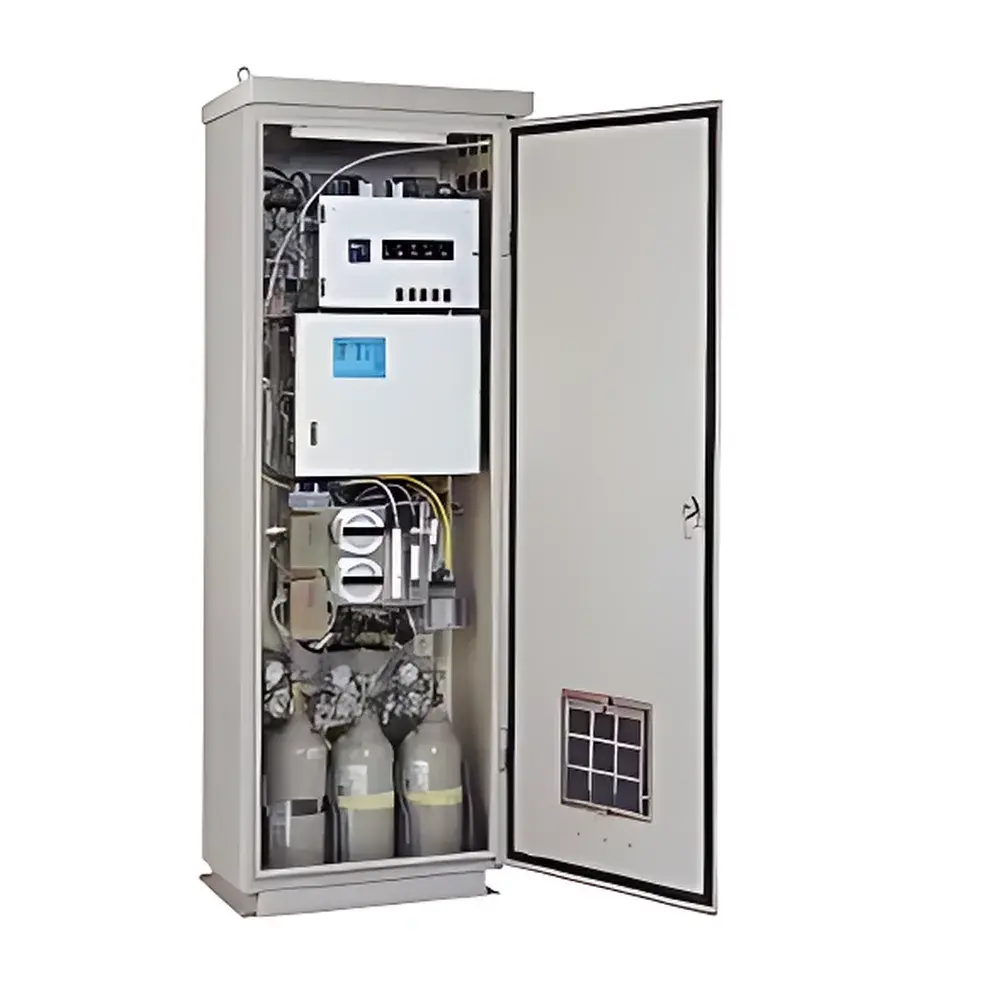
HORIBA ENDA-640ZG Series Online Flue Gas Analyzer
| Brand | HORIBA |
|---|---|
| Origin | Japan |
| Model | ENDA-640ZG |
| Instrument Type | Continuous Emission Monitoring System (CEMS) |
| Measurement Accuracy | ±1.0 %F.S. |
| Repeatability | ±0.5 %F.S. |
| Response Time (SO₂) | 60–240 s |
| Long-Term Stability | ±2.0 %F.S. |
Overview
The HORIBA ENDA-640ZG Series is a compact, high-reliability online flue gas analyzer engineered for continuous, simultaneous measurement of up to five key combustion-related gas components: NOx, SO2, CO, CO2, and O2. Designed for regulatory compliance and industrial process control, the system integrates alternating-flow non-dispersive infrared (NDIR) spectroscopy for acidic and combustible gases with magnetic pressure (paramagnetic) detection for oxygen—eliminating the need for carrier gas and minimizing drift. Its core architecture leverages dual-beam modulation and reference-sample alternation at 1 Hz frequency, ensuring zero-point stability without optical realignment over extended operational periods. With over three decades of field-proven deployment across 100,000+ installations globally, the ENDA-640ZG meets stringent international performance requirements for CEMS applications under ISO 14956, EN 15267, and EPA Performance Specification 3/4/6C, supporting both stack-mounted and extractive sampling configurations.
Key Features
- Single-analyzer multi-component capability: Simultaneous real-time quantification of NOx, SO2, CO, CO2, and O2 within one compact chassis.
- Drift-free NDIR detection: Alternating-flow modulation eliminates zero drift and reduces sensitivity to optical contamination; no periodic optical recalibration required.
- Magnetic pressure O2 sensor: Uses ambient air as reference medium—no external N2 supply needed—reducing consumables, footprint, and operating cost.
- Interference compensation optics: Proprietary interference filter technology mitigates cross-sensitivity from H2O vapor and other spectral interferents in SO2 and NOx channels.
- Reduced physical footprint: Overall analyzer volume reduced by 50% versus prior-generation ENDA systems; auto-blowback controller dimensions reduced to 350 × 550 × 180 mm (W×H×D), enabling wall-mount installation in space-constrained environments.
- Accelerated calibration: Dry-gas SO2 span calibration completed in ≤3 minutes—reducing downtime versus legacy 15-minute wet-calibration protocols.
- Integrated CO2-based NOx correction: Onboard CO2 sensor enables dynamic stoichiometric compensation during NOx analysis, improving accuracy under variable combustion conditions.
Sample Compatibility & Compliance
The ENDA-640ZG supports extractive sampling from diverse industrial sources including coal-fired and gas-fired power plants, waste-to-energy incinerators, glass melting furnaces, steel reheating furnaces, sulfuric acid production lines, and industrial steam boilers. Its modular sampling interface accommodates application-specific pretreatment: integrated chlorine removal for municipal solid waste (MSW) flue gas, NH3 scrubbing for selective catalytic reduction (SCR) slip monitoring, and triple-stage electronic cooling (primary + dual secondary chillers) to minimize aqueous-phase loss of SO2 and NO2. All sampling probes feature direct-coupled primary filtration with tool-free cartridge replacement. The system complies with EU Industrial Emissions Directive (IED) monitoring requirements and supports audit-ready data integrity per FDA 21 CFR Part 11 and ISO/IEC 17025 when paired with validated data acquisition software.
Software & Data Management
The ENDA-640ZG features an embedded 10.1-inch capacitive touchscreen HMI with intuitive navigation and multilingual support (English, Japanese, Chinese, German). Real-time concentration trends for all five components are displayed concurrently, with configurable views for calibration logs, alarm history, O2-corrected emissions (e.g., NOx @ 6% O2), and rolling 1-hour dynamic averages. Up to 12 analog outputs (4–20 mA) are configurable for instantaneous or corrected values. Internal memory stores ≥30 days of second-by-second data; optional Ethernet/IP or Modbus TCP connectivity enables integration with DCS, SCADA, or centralized CEMS databases. Firmware includes automatic 7-day zero/span verification scheduling, event-triggered data capture, and GLP-compliant electronic signature workflows for calibration validation.
Applications
The ENDA-640ZG is deployed across regulated and non-regulated emission monitoring scenarios requiring long-term stability and low maintenance. Typical use cases include: continuous compliance reporting for thermal power stations subject to national CEMS mandates; process optimization in glass manufacturing where rapid O2/CO feedback improves combustion efficiency; corrosion mitigation in sulfuric acid plants via precise SO2/O2 ratio control; and post-combustion monitoring in MSW incinerators equipped with acid gas abatement systems. Its robust design accommodates high-dust, high-moisture, and chloride-laden streams when configured with optional hot-wet sampling and corrosion-resistant probe materials (e.g., Hastelloy C-276).
FAQ
What gas components can the ENDA-640ZG measure simultaneously?
NOx (as NO), SO2, CO, CO2, and O2—all measured continuously and independently within a single analyzer unit.
Does the system require external carrier gas for O2 measurement?
No. The magnetic pressure O2 sensor uses ambient air as the reference medium, eliminating dependency on bottled N2 or other carrier gases.
How does the analyzer handle water vapor interference in SO2 and NOx channels?
Proprietary interference-filter-equipped detectors compensate for H2O absorption bands, supported by integrated dew point monitoring and triple-stage condensate management.
Is the ENDA-640ZG certified for regulatory CEMS use?
Yes—it is type-approved per EN 15267-3 for QAL1 certification and supports QAL2/QAL3 validation protocols required for legal compliance in EU member states and other jurisdictions adopting equivalent standards.
What maintenance intervals are recommended for routine operation?
Filter replacement every 3–6 months depending on dust loading; full optical path inspection annually; calibration verification every 7 days (automated) and full span calibration quarterly or per local regulatory schedule.
Related Products







