
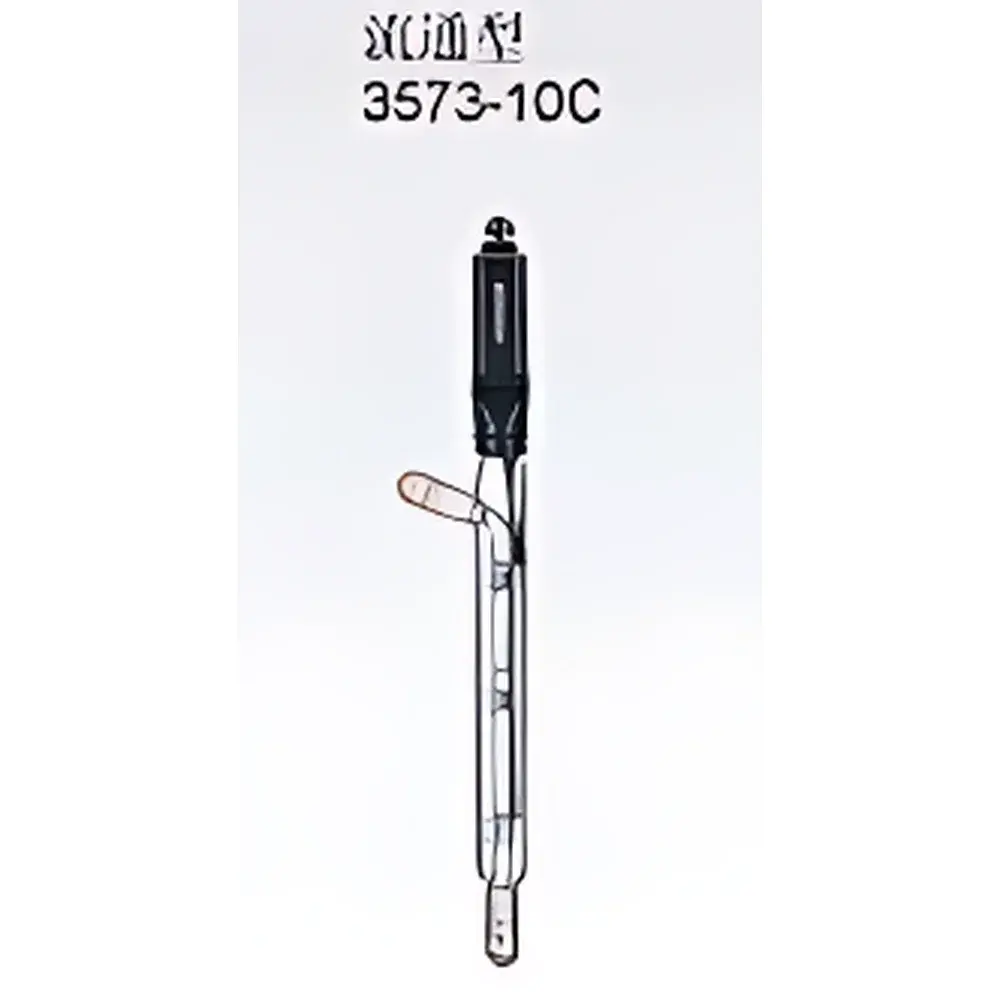
HORIBA Flow-Through Conductivity Electrode Model 3573-10C
| Brand | HORIBA |
|---|---|
| Origin | Japan |
| Model | 3573-10C |
| Cell Constant | 1000 m⁻¹ (10 cm⁻¹) |
| Conductivity Range | 1 mS/cm to 100 S/cm (10 μS/cm to 1 S/cm) |
| Minimum Sample Volume | 4 mL |
| Operating Temperature Range | 0–60 °C |
| Electrical Connection | BNC or DIN-compatible analog output |
| Material | Platinum electrodes, PEEK body, EPDM or Viton O-rings (standard configuration) |
Overview
The HORIBA Flow-Through Conductivity Electrode Model 3573-10C is a precision-engineered sensor designed for continuous, real-time measurement of electrical conductivity in liquid process streams and laboratory flow cells. Based on the four-electrode (tetrapolar) AC excitation principle, this electrode eliminates polarization effects and minimizes errors from electrode fouling or surface contamination—critical for long-term stability in demanding industrial or regulatory environments. With a nominal cell constant of 1000 m⁻¹ (10 cm⁻¹), it is optimized for high-conductivity applications including concentrated acid/base solutions, brines, electroplating baths, seawater desalination reject streams, and pharmaceutical buffer preparation. Its compact flow-cell geometry enables integration into inline manifolds, recirculating loops, or peristaltic pump-driven analytical systems without requiring sample diversion or large hold-up volumes.
Key Features
- Four-electrode (tetrapolar) AC measurement architecture ensures stable, drift-free readings across wide dynamic ranges—particularly essential for high-conductivity media where two-electrode sensors suffer from polarization and coating artifacts.
- Robust flow-through design with 4 mL minimum sample volume requirement, enabling rapid response time (<15 s typical τ₉₀) and compatibility with low-flow-rate applications such as microfluidic QC lines or small-batch formulation systems.
- Chemically resistant construction: platinum sensing elements embedded in a high-purity PEEK (polyether ether ketone) housing; standard sealing with EPDM elastomers (Viton optional for aggressive solvents or elevated temperature).
- Temperature-compensated output: integrated Pt1000 RTD (Class B, IEC 60751) located adjacent to the electrode array for accurate, simultaneous temperature measurement and automatic linear or non-linear (e.g., ISO 7888) conductivity compensation.
- Standard analog interface (BNC or DIN 43650) supports direct connection to HORIBA’s LAQUA twin series, LAQUAtouch, or third-party PLCs, DAQ systems, and SCADA platforms via 4–20 mA or 0–5/10 V outputs (with external transmitter or built-in signal conditioning module).
Sample Compatibility & Compliance
The 3573-10C is validated for use with aqueous electrolytes, strong acids (e.g., H₂SO₄ ≤ 50 % w/w), caustic solutions (NaOH ≤ 30 % w/w), saline matrices, and conductive organic solvents (e.g., methanol/water mixtures). It is not intended for non-polar solvents, molten salts, or gas-phase measurements. The electrode meets material compatibility requirements under ASTM D1125 (Standard Test Methods for Electrical Conductivity of Water) and supports method validation per USP for purified water and water for injection (WFI) conductivity testing—when paired with a compliant transmitter and calibrated traceably to NIST-traceable standards. Its design facilitates cleaning-in-place (CIP) protocols using dilute nitric or citric acid, and it is compatible with steam sterilization (SIP) at ≤121 °C for durations ≤30 min when equipped with Viton seals.
Software & Data Management
When used with HORIBA’s LAQUA Studio software or third-party platforms supporting Modbus RTU/TCP or OPC UA, the 3573-10C enables full audit trail functionality, electronic signature support, and 21 CFR Part 11–compliant data logging—including timestamped conductivity, temperature, and diagnostic status (e.g., electrode impedance, sensor fault flags). Calibration history, drift monitoring, and predictive maintenance alerts are programmable via configurable thresholds. Raw analog outputs may be archived in CSV or .tdms formats aligned with GLP/GMP documentation workflows.
Applications
- In-line monitoring of conductivity during chemical synthesis, catalyst recovery, and solvent recycling in fine chemical manufacturing.
- Real-time control of rinse conductivity in semiconductor wafer cleaning lines (e.g., post-etch or post-CMP rinses).
- Continuous verification of deionized water loop integrity and regeneration endpoint detection in power plant boiler feedwater systems.
- Batch release testing of conductive excipients and final formulations in biopharmaceutical downstream processing.
- Environmental compliance monitoring of effluent discharge conductivity per EPA Method 120.1 and EU Directive 2000/60/EC.
FAQ
What is the recommended calibration frequency for the 3573-10C in continuous operation?
Calibration should be performed at least daily for GMP-regulated processes or after any maintenance event; weekly calibration is acceptable for non-critical industrial monitoring when supported by documented system suitability checks.
Can this electrode be used in pressurized lines?
Yes—it is rated for continuous operation up to 6 bar (87 psi) at 25 °C; pressure rating decreases linearly to 4 bar at 60 °C. A pressure-rated version with stainless steel end caps is available upon request.
Is the cell constant factory-certified and traceable?
Each unit ships with a certificate of conformance listing its individually measured cell constant (±2 % uncertainty), traceable to JCSS (Japan Calibration Service System) and cross-referenced to NIST SRM 3198.
How does temperature compensation work with this electrode?
The integrated Pt1000 RTD provides real-time temperature input to the connected transmitter, which applies either linear (α = 2.0 %/°C default) or non-linear compensation algorithms per ISO 7888 or user-defined polynomial coefficients.
What maintenance procedures are required to ensure long-term accuracy?
Routine cleaning with 0.1 M HNO₃ followed by DI water rinse is recommended after exposure to scaling or organic residues; periodic verification against certified KCl standards (e.g., 0.01 mol/kg, 0.1 mol/kg) is advised every 3 months in high-usage environments.





