
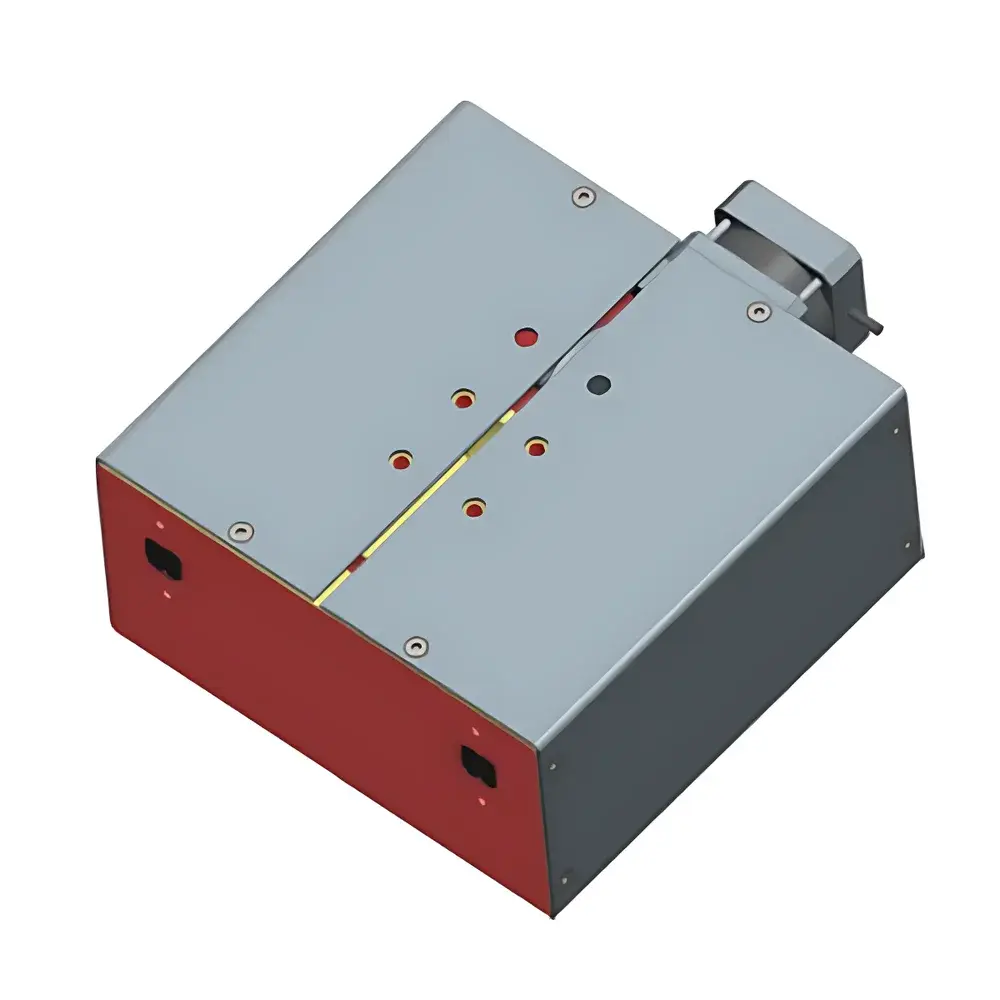
HORIBA H1034 Dual-Stage Imaging Monochromator
| Brand | HORIBA |
|---|---|
| Origin | France |
| Manufacturer Type | Original Equipment Manufacturer (OEM) |
| Product Origin | Imported |
| Model | H1034 (Dual-Stage) |
| Grating Configuration | Dual Grating |
| Spectral Resolution | ≤5 nm (with 100 µm slit) |
| Wavelength Range | 200–1200 nm (optional blaze wavelengths: 250 nm, 350 nm, 500 nm) |
| F/# | F/2.8 |
| Stray Light | < 0.1% (typical) |
Overview
The HORIBA H1034 Dual-Stage Imaging Monochromator is an OEM-optimized optical instrument engineered for high-fidelity spectral selection in low-light imaging and scanning applications. Based on aberration-corrected concave holographic grating optics, the H1034 employs a dual-stage Czerny–Turner configuration to achieve enhanced wavelength isolation while preserving spatial coherence across the focal plane. Unlike conventional single-stage monochromators, its cascaded design significantly suppresses higher-order diffraction artifacts and improves out-of-band rejection—critical for fluorescence excitation/emission separation, time-resolved spectroscopy, and quantitative spectral imaging where signal-to-noise ratio and spectral purity are paramount. The system operates over a broad UV–NIR range (200–1200 nm), with interchangeable blazed gratings enabling optimization for specific spectral regions (250 nm, 350 nm, or 500 nm blaze). Its F/2.8 optical speed supports high photon throughput, making it suitable for integration into automated platforms such as microplate readers, HPLC detectors, and hyperspectral imaging systems.
Key Features
- Dual-stage Czerny–Turner architecture with aberration-corrected concave holographic gratings for minimized optical distortion and improved imaging fidelity
- ≤5 nm spectral resolution at 100 µm input/output slit width—validated under ISO 17025 traceable calibration conditions
- Stray light performance < 0.1% (typical), meeting stringent requirements for fluorescence and weak-signal detection per ASTM E275 and IEC 61223-3-5
- Integrated 3-position external filter wheel with TTL-compatible drive electronics for synchronized spectral bandpass control
- Precision 4-phase stepper motor coupled to a 90:1 worm-gear reduction stage—factory-aligned and encoder-calibrated for repeatability better than ±0.05 nm over full scan range
- Onboard photodiode sensors with NIST-traceable reference hardware for real-time intensity monitoring and wavelength verification
- Modular mechanical interface (standard 30 mm cage system compatibility) and software-agnostic control protocol (RS-232 & USB 2.0)
Sample Compatibility & Compliance
The H1034 is designed for use with standard fiber-coupled, free-space, or direct-imaging optical interfaces. It accommodates input beam diameters up to 12 mm and supports both collimated and focused illumination geometries. As an OEM component, it complies with CE marking directives (2014/30/EU EMC and 2014/35/EU LVD) and meets RoHS 2011/65/EU material restrictions. Its optical design adheres to ISO 10110-7 surface quality standards for all internal coated optics. When integrated into regulated analytical platforms, the H1034 supports audit-ready operation when paired with compliant host software that implements FDA 21 CFR Part 11 electronic signature and data integrity controls.
Software & Data Management
The H1034 communicates via ASCII-based serial command set (RS-232/USB), enabling seamless integration with LabVIEW™, Python (PySerial), MATLAB®, and third-party DAQ environments. No proprietary drivers are required. All motor position, grating selection, filter wheel state, and sensor readouts are timestamped and loggable. For GLP/GMP-compliant deployments, users may implement external data acquisition frameworks that enforce secure user authentication, change tracking, and electronic audit trails—consistent with ISO/IEC 17025 clause 7.7 and USP analytical instrument qualification guidelines.
Applications
- Fluorescence microplate readers requiring tunable excitation and emission monochromation
- HPLC and UHPLC UV–Vis detectors with programmable wavelength scanning
- Endpoint detection in chemical synthesis and bioprocess monitoring
- Diffraction efficiency mapping of optical coatings and thin-film stacks
- Field-deployable environmental sensors for water quality (nitrate, chlorophyll-a) and soil nutrient analysis
- Food safety screening via absorption and fluorescence fingerprinting (e.g., aflatoxin, polyphenols)
FAQ
Can the H1034 be operated in standalone mode without external software?
Yes—the unit includes front-panel manual controls for coarse wavelength positioning and filter selection, though full spectral scanning functionality requires host-command initiation.
Is wavelength calibration performed at the factory?
Yes—each unit undergoes wavelength calibration using mercury-argon and deuterium lamp lines, with certificate of conformance provided per ISO/IEC 17025.
What is the maximum scan speed across the full 200–1200 nm range?
At 1 nm step size and default acceleration profile, full-range unidirectional scan takes approximately 180 seconds; speed is configurable via host command parameters.
Are custom gratings or modified slit assemblies available?
HORIBA Scientific offers OEM customization including alternative blaze profiles, coated substrates (e.g., Al+MgF₂ for deep UV), and motorized slit width adjustment—subject to minimum order quantities and lead time agreement.
Does the H1034 support synchronization with external triggers (e.g., camera shutter or laser pulse)?
Yes—TTL-compatible trigger input/output ports enable hardware-level synchronization with pulsed light sources and gated detectors, supporting time-resolved spectral acquisition protocols.
Related Products




