
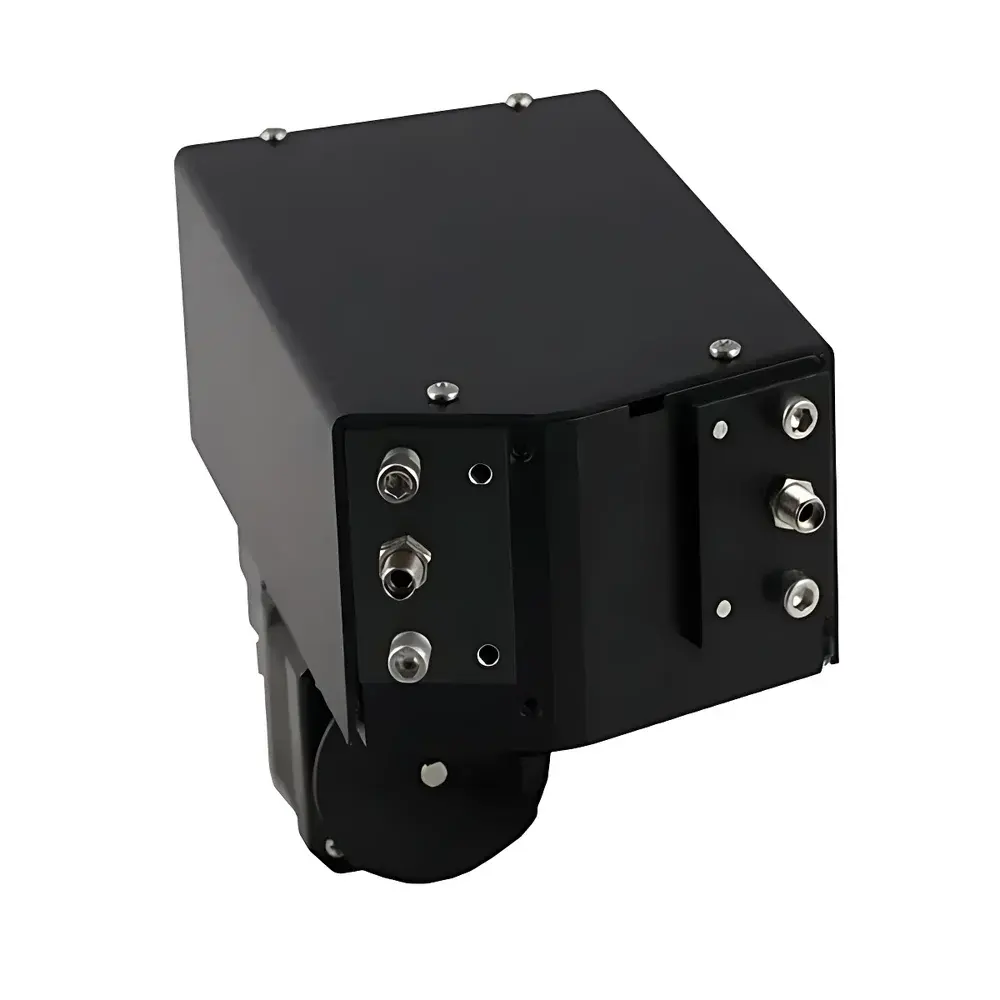
HORIBA H1034 Imaging Scanning Monochromator (Single-Stage)
| Brand | HORIBA |
|---|---|
| Origin | France |
| Manufacturer Type | Original Equipment Manufacturer (OEM) |
| Product Origin | Imported |
| Model | H1034 (Single-Stage) |
| Grating Mount | Motorized 3-Grating Turret |
| Spectral Resolution | ≤5 nm (with 100 µm slit) |
| Wavelength Range | 200–1200 nm (optional blaze wavelengths: 250 nm, 350 nm, 500 nm) |
| F-number | F/2.8 |
| Stray Light | < 0.1% (typical) |
Overview
The HORIBA H1034 Imaging Scanning Monochromator is a single-stage, aberration-corrected concave holographic grating monochromator engineered for high-throughput spectral imaging in low-light applications. Unlike conventional Czerny–Turner or Paschen–Runge configurations, the H1034 employs an optimized off-axis concave holographic grating that simultaneously corrects spherical and coma aberrations across its full spectral range—enabling diffraction-limited image quality at the exit plane without auxiliary optics. Its optical architecture supports both excitation wavelength selection and emission scanning in fluorescence instrumentation, leveraging high first- and second-order diffraction efficiency (>75% typical at blaze wavelength) to maximize signal-to-noise ratio in photon-starved conditions. Designed as an OEM module, the H1034 integrates seamlessly into custom spectroscopic systems—including microplate readers, HPLC detectors, and portable environmental analyzers—where spatial fidelity, radiometric stability, and mechanical repeatability are critical.
Key Features
- Aberration-corrected concave holographic grating providing diffraction-limited imaging performance across 200–1200 nm
- F/2.8 optical speed ensures high étendue and throughput, especially beneficial for weak-signal detection in UV–NIR
- Motorized 3-position external filter wheel with TTL-compatible control interface for synchronized spectral filtering
- 4-phase stepper motor coupled to a precision 90:1 worm-gear reduction stage, factory-aligned and encoded for sub-pixel wavelength positioning accuracy
- Integrated dual photodiode array with onboard calibration hardware for real-time intensity monitoring and wavelength verification
- Stray light suppression < 0.1% (typical), achieved through optimized baffling, grating groove geometry, and blackened internal surfaces compliant with ISO 17025 optical cleanliness requirements
Sample Compatibility & Compliance
The H1034 operates as a modular optical engine compatible with fiber-coupled, free-space, or direct-imaging sample interfaces. It accepts standard SMA905 or FC/PC fiber inputs and features a 26.5 mm × 10.5 mm rectangular exit port optimized for CCD/CMOS line-scan or area-array detectors. The instrument complies with CE marking directives (2014/30/EU EMC and 2014/35/EU LVD), RoHS 2011/65/EU, and meets IEC 61000-4 immunity standards for laboratory environments. While not certified as standalone medical device hardware, its design supports integration into Class I or IIa diagnostic platforms compliant with ISO 13485 and FDA 21 CFR Part 11 when embedded within validated system architectures. All optical coatings and grating substrates are traceable to NIST-traceable reference materials per ISO/IEC 17025 calibration protocols.
Software & Data Management
The H1034 communicates via RS-232 or USB 2.0 (virtual COM port) using a deterministic ASCII command set supporting absolute wavelength positioning, filter wheel indexing, and photodiode readout polling. HORIBA provides SDK libraries for Windows/Linux (C/C++, Python bindings) enabling integration with LabVIEW, MATLAB, or custom acquisition software. Firmware supports non-volatile memory storage of up to 16 user-defined wavelength presets with ±0.05 nm repeatability over 10⁵ scan cycles. Audit trail functionality—including timestamped command logs, motor position history, and sensor calibration metadata—is available when deployed with HORIBA’s optional SpectraManager™ OEM firmware extension, satisfying GLP/GMP data integrity requirements under Annex 11 and ALCOA+ principles.
Applications
- Fluorescence microplate reading: simultaneous excitation selection and emission scanning in HTS assays
- HPLC/UV-Vis detector modules requiring high dynamic range and low baseline drift
- Portable NIR spectrometers for agricultural soil analysis and food authenticity screening
- Environmental monitoring systems performing multi-wavelength absorbance measurements in water quality sensors
- Custom Raman excitation sources where narrowband tunability and low stray light prevent laser line bleed-through
- Quantum dot characterization setups demanding stable, repeatable monochromatic illumination across UV–NIR
FAQ
What wavelength calibration standards are supported?
The H1034 supports user-loaded calibration tables referencing mercury-argon, neon, or holmium oxide emission lines; factory calibration uses NIST-traceable tungsten-halogen and deuterium lamp references.
Can the grating turret be upgraded in the field?
No—grating selection is fixed at time of order; however, three grating options (250 nm, 350 nm, and 500 nm blaze) are pre-aligned and encoded during manufacturing for optimal efficiency across UV, visible, and NIR bands.
Is vacuum or purged operation supported?
The housing includes optional O-ring sealed ports for nitrogen purging below 10% RH to minimize ozone generation and UV absorption below 220 nm; vacuum operation is not recommended due to thermal expansion mismatch in the holographic grating substrate.
What is the maximum scan speed and positional repeatability?
At full motor step resolution (0.001° encoder count), wavelength scanning achieves 10 nm/s with ±0.03 nm RMS repeatability over 1,000 consecutive scans at constant ambient temperature (±0.5 °C).





