
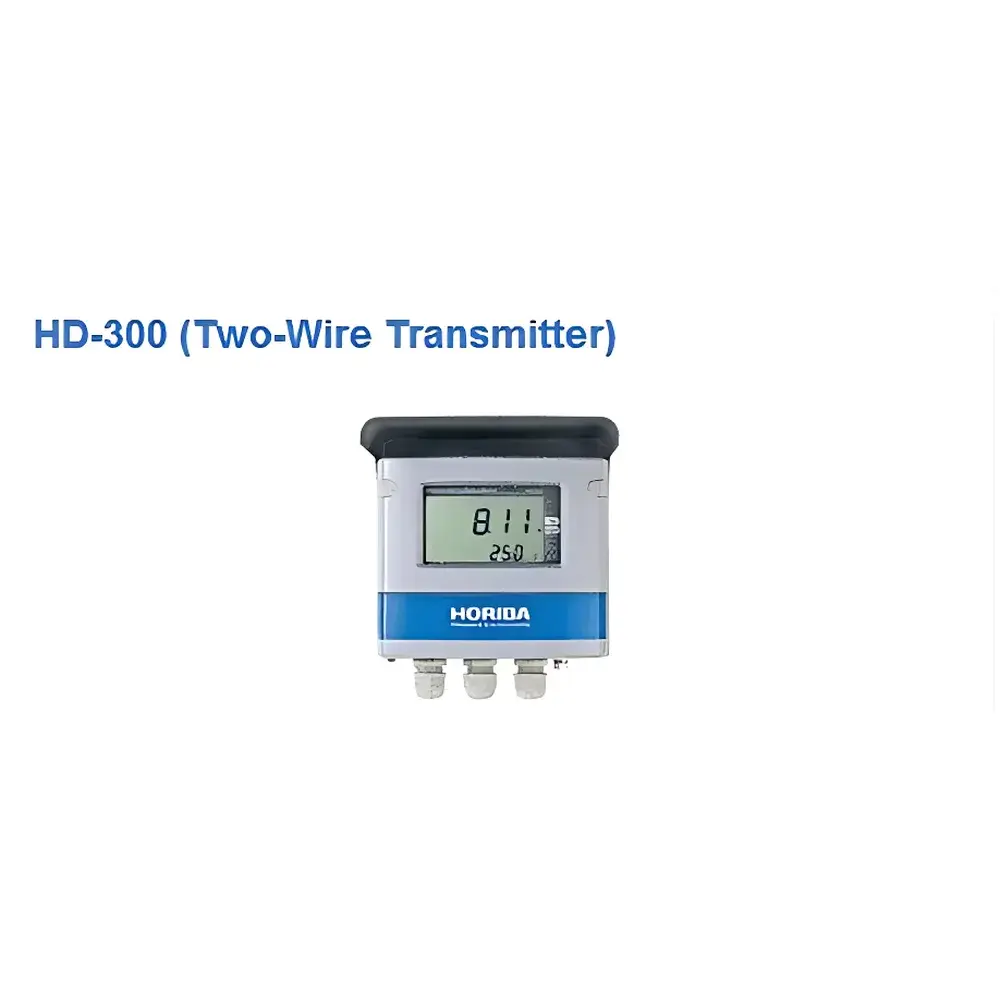
HORIBA HD-300 Industrial Online Dissolved Oxygen Monitor
| Brand | HORIBA |
|---|---|
| Origin | Japan |
| Model | HD-300 |
| Measurement Principle | Clark-type Polarographic Membrane Sensor |
| DO Range | 0–20 mg/L (resolution: 0.01 mg/L) |
| Saturation Range | 0–200% (resolution: 1%) |
| Temperature Range | 0–50 °C (resolution: 0.1 °C) |
| Repeatability | ±0.5% FS (DO), ±0.5 °C (temperature) |
| Linearity | ±0.5% FS (DO), ±0.5 °C (temperature) |
| Output | Isolated 4–20 mA DC (max. load: 600 Ω) |
| Digital Interface | RS-485 (2-wire, input/output isolated) |
| Power Supply | 24 V DC (21–32 V DC operating range), max. 0.6 W |
| Enclosure Rating | IP65 |
| Ambient Operating Temperature | −20 to +60 °C |
| Housing Material | Aluminum alloy |
| Mounting | Wall or 50A pipe column |
| Compatible Probes | DO-1100 (integrated Pt1000 temperature sensor) |
| Compliant Standards | CE, FCC, RoHS, WEEE |
Overview
The HORIBA HD-300 is an industrial-grade, outdoor-rated online dissolved oxygen (DO) monitor engineered for continuous, reliable measurement in demanding water quality monitoring applications. Utilizing the Clark-type polarographic membrane sensor principle, the HD-300 detects oxygen diffusion through a gas-permeable membrane onto a cathode, generating a current proportional to the partial pressure of dissolved molecular oxygen. This electrochemical method ensures stable, low-drift performance across fluctuating flow conditions and variable water matrices—critical for effluent discharge compliance, biological treatment process control, and recirculating cooling water systems. Designed as part of HORIBA’s H-1 series of field-deployable analyzers, the HD-300 integrates seamlessly into distributed SCADA architectures while maintaining full operational autonomy under harsh environmental exposure.
Key Features
- Rugged IP65-rated aluminum enclosure with stainless steel (SUS304) mounting hardware—engineered for long-term outdoor deployment in industrial zones, wastewater plants, and remote pumping stations.
- Large-format backlit LCD display providing simultaneous real-time readouts of DO concentration (mg/L), saturation (%), and temperature (°C), with intuitive menu navigation and on-device status indicators.
- Integrated self-diagnostic capability: continuously monitors electrode polarization stability, membrane integrity, electrolyte level, and internal circuit health; alerts users via display codes and configurable relay outputs upon deviation from calibration baselines or sensor fault conditions.
- Flexible calibration protocols: supports both air-saturation (100% O₂ at local barometric pressure) and zero-oxygen (sodium sulfite) or saturated aqueous solution (100% O₂) reference methods—enabling traceable, repeatable field verification per ISO 5814 and ASTM D888 standards.
- Galvanically isolated 4–20 mA analog output with configurable range scaling and fail-safe behavior (e.g., signal hold or NAMUR-compliant alarm states); compatible with legacy PLCs and modern DCS platforms without external signal conditioning.
- RS-485 Modbus RTU interface enables bidirectional communication for remote configuration, firmware updates, historical calibration log retrieval, and multi-parameter synchronization in networked H-1 series installations.
Sample Compatibility & Compliance
The HD-300 is validated for continuous operation in municipal wastewater influent/effluent, activated sludge basins, aerobic digesters, industrial cooling towers, and surface water intake channels. Its DO-1100 probe features a Teflon®-based hydrophobic membrane and Ag/AgCl reference system optimized for fouling resistance in suspended solids-rich media (up to 10,000 mg/L TSS). Temperature compensation employs an embedded Pt1000 sensor conforming to IEC 60751 Class B tolerances, ensuring accurate compensation across the full 0–50 °C measurement range. The analyzer complies with electromagnetic compatibility directives (CE, FCC Part 15 Subpart B), environmental stewardship regulations (RoHS Directive 2011/65/EU, WEEE Directive 2012/19/EU), and carries CE marking for use in Zone 2 hazardous locations per ATEX/IECEx guidelines when installed with appropriate conduit sealing.
Software & Data Management
While the HD-300 operates autonomously without host software, its RS-485 interface supports integration with HORIBA’s optional Water Quality Management Platform (WQMP) v3.x—a web-based supervisory application compliant with FDA 21 CFR Part 11 for audit-trail-enabled data logging, electronic signatures, and role-based access control. All calibration events—including date/time stamps, operator ID, reference values, slope/offset diagnostics, and post-calibration verification results—are stored locally in non-volatile memory for ≥12 months. Data export formats include CSV and XML, facilitating import into LIMS environments supporting ISO/IEC 17025 workflows and GLP/GMP documentation requirements.
Applications
- Real-time DO optimization in activated sludge and SBR bioreactors to maintain nitrification efficiency and minimize energy consumption in blower systems.
- Compliance monitoring of treated effluent discharge limits per national regulatory frameworks (e.g., EPA NPDES permits, EU Urban Wastewater Treatment Directive).
- Early detection of hypoxic conditions in reservoirs and riverine receiving waters to support adaptive management strategies.
- Process assurance in pharmaceutical purified water (PW) and water-for-injection (WFI) distribution loops, where DO levels must remain below 30 ppb—leveraging the HD-300’s high-resolution analog output for closed-loop deaeration control.
- Integration into multi-parameter H-1 series cabinets measuring concurrent pH, ORP, conductivity, turbidity, and free chlorine—providing holistic water quality context for predictive maintenance analytics.
FAQ
What sensor technologies are supported by the HD-300?
The HD-300 is exclusively compatible with HORIBA’s DO-1100 polarographic probe, which incorporates an integrated Pt1000 temperature sensor and proprietary electrolyte formulation optimized for long-term stability in industrial wastewater.
Does the HD-300 support automatic temperature compensation?
Yes—automatic compensation is performed in real time using the built-in Pt1000 sensor; no external temperature transmitter is required.
Can the 4–20 mA output be configured for dual-range or split-range operation?
No—the analog output is fixed to a single linear span (e.g., 0–20 mg/L = 4–20 mA); range reconfiguration requires parameter adjustment via RS-485.
Is the HD-300 suitable for potable water applications?
It meets material safety requirements for contact with drinking water (NSF/ANSI 61 certified components), though final system validation must follow local utility protocols.
How often does the DO-1100 probe require membrane replacement and electrolyte refill?
Under typical municipal wastewater conditions, membrane and electrolyte service intervals are recommended every 3–6 months; extended life is achievable with scheduled cleaning and storage in humidified buffer solution between deployments.







