
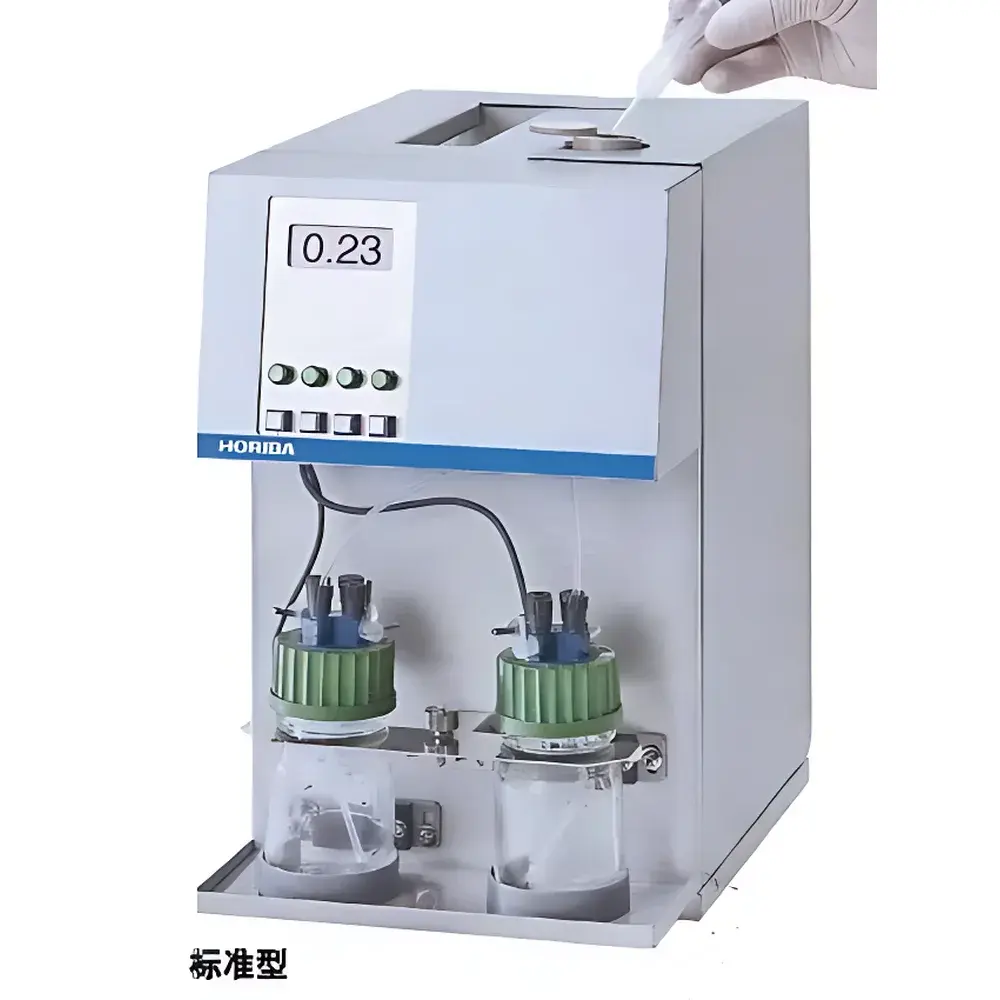
HORIBA HM-100 Benchtop Heavy Metals Analyzer
| Brand | HORIBA |
|---|---|
| Origin | Japan |
| Model | HM-100 |
| Measurement Principle | Anodic Stripping Voltammetry (ASV) with Boron-Doped Diamond (BDD) Electrode |
| Detection Range | Zn: 0–2000 ppb |
| Cu | 0–2000 ppb (Semiconductor-grade Cu: 0–20.0 ppb) |
| As | 0–200 ppb |
| Cd | 0–500 ppb |
| Required Reagents | Acetate buffer solution, Deionized water (for rinsing), 3.3 M KCl solution (for reference electrode electrolyte exchange) |
| Portability | Benchtop with integrated carry handle for field deployment |
Overview
The HORIBA HM-100 Benchtop Heavy Metals Analyzer is a compact, electrochemical instrumentation platform engineered for rapid, on-site quantification of trace heavy metal ions in environmental and agricultural matrices. Unlike optical or plasma-based techniques (e.g., ICP-OES or AAS), the HM-100 employs anodic stripping voltammetry (ASV) — a potentiostatic electroanalytical method — coupled with a boron-doped diamond (BDD) working electrode. This electrode architecture delivers exceptional chemical inertness, wide potential window (−1.5 V to +2.5 V vs. Ag/AgCl), low background current, and resistance to fouling—critical attributes for reproducible ppb-level detection in complex, unfiltered samples such as soil leachates, surface water, rice extracts, and vegetable homogenates. The instrument operates without vacuum systems, high-temperature plasma sources, or compressed gas supplies, enabling true field-deployable operation while maintaining laboratory-grade data integrity.
Key Features
- Boron-doped diamond (BDD) electrode system optimized for ASV, ensuring stable baseline response and minimal passivation during repeated analysis of organic-rich or particulate-laden samples.
- Integrated benchtop design with ergonomic carry handle and shock-absorbing chassis, certified for transport under IEC 60068-2-64 (vibration) and IEC 60068-2-27 (shock), supporting mobile lab and field station deployments.
- Pre-programmed, matrix-specific calibration protocols for Zn, Cu, As, and Cd—including dedicated low-range Cu mode (0–20.0 ppb) compliant with SEMI F57 specifications for ultrapure water monitoring in semiconductor fabrication facilities.
- Automated multi-step electrode conditioning, deposition, and stripping sequence controlled via embedded microprocessor; typical analysis time ≤ 5 minutes per sample, including rinse and recalibration steps.
- Onboard temperature-compensated conductivity and pH sensors (±0.1 °C, ±0.02 pH units) for real-time matrix correction, enhancing accuracy across variable ionic strength conditions (10 µS/cm to 2 mS/cm).
Sample Compatibility & Compliance
The HM-100 accepts direct liquid samples (aqueous extracts, filtered environmental waters, acid-digested soils, and enzymatic plant tissue digests) without dilution or pre-concentration in most cases. It supports ASTM D3559-22 (lead in water), ISO 11969:2016 (arsenic in soil), and JIS K 0312:2020 (cadmium in food crops) methodologies when paired with validated sample preparation workflows. All measurement records include timestamped metadata (operator ID, ambient temperature, electrode status, reagent lot numbers), satisfying GLP audit requirements under OECD Principles of Good Laboratory Practice (ENV/MC/CHEM(98)17). Data export complies with FDA 21 CFR Part 11 through optional password-protected user roles and electronic signature logging.
Software & Data Management
The HM-100 runs HORIBA’s proprietary HM-Link v3.2 firmware, featuring a 7-inch capacitive touchscreen interface with multilingual support (English, Japanese, Chinese, Spanish). Raw voltammograms, peak integration parameters, and calibration curves are stored locally in encrypted SQLite databases. Export options include CSV (ASTM E1482-compliant format), PDF analytical reports (with embedded NIST-traceable calibration certificates), and direct USB transfer to LIMS via HL7-compatible XML schema. Remote diagnostics and firmware updates are supported via secure TLS 1.3 connection to HORIBA’s authorized service portal—no cloud storage or third-party telemetry enabled by default.
Applications
- Regulatory compliance testing of drinking water sources for EPA Method 200.8 elements (As, Cd, Cu, Zn) at sub-ppb levels without ICP-MS infrastructure.
- Routine screening of paddy rice and leafy vegetables for cadmium accumulation in agricultural zones adjacent to legacy mining sites.
- In-process monitoring of rinse water effluents from printed circuit board (PCB) manufacturing lines, targeting copper breakthrough detection at <20 ppb.
- Soil risk assessment following industrial site remediation, using sequential extraction protocols aligned with BCR (European Community Bureau of Reference) fractionation schemes.
- Academic research in environmental electrochemistry, including ligand-binding studies and redox speciation modeling of arsenic(III)/arsenic(V) interconversion kinetics.
FAQ
What electrode maintenance is required between analyses?
The BDD electrode undergoes automatic electrochemical cleaning (cyclic voltammetric scan in 0.1 M H₂SO₄) prior to each measurement cycle; no manual polishing or replacement is needed for ≥500 consecutive runs under standard operating conditions.
Can the HM-100 quantify mercury (Hg) or lead (Pb)?
No—HM-100 is factory-configured for Zn, Cu, As, and Cd only. Pb and Hg require different deposition potentials and interferent management strategies; HORIBA offers the HM-200 variant for expanded elemental coverage.
Is method validation documentation available?
Yes—HORIBA provides a complete Validation Package (VP-HM100-2024) including precision/recovery data per ISO/IEC 17025:2017 Annex A.3, limit of detection (LOD) verification per ICH Q2(R2), and interlaboratory comparison results from JCSS-accredited reference labs.
How is calibration traceability ensured?
All factory calibrations use NIST SRM 3198 (Zn), SRM 3199 (Cu), SRM 3200 (As), and SRM 3201 (Cd) stock solutions; certificate of analysis includes uncertainty budgets calculated per GUM (JCGM 100:2008).







