
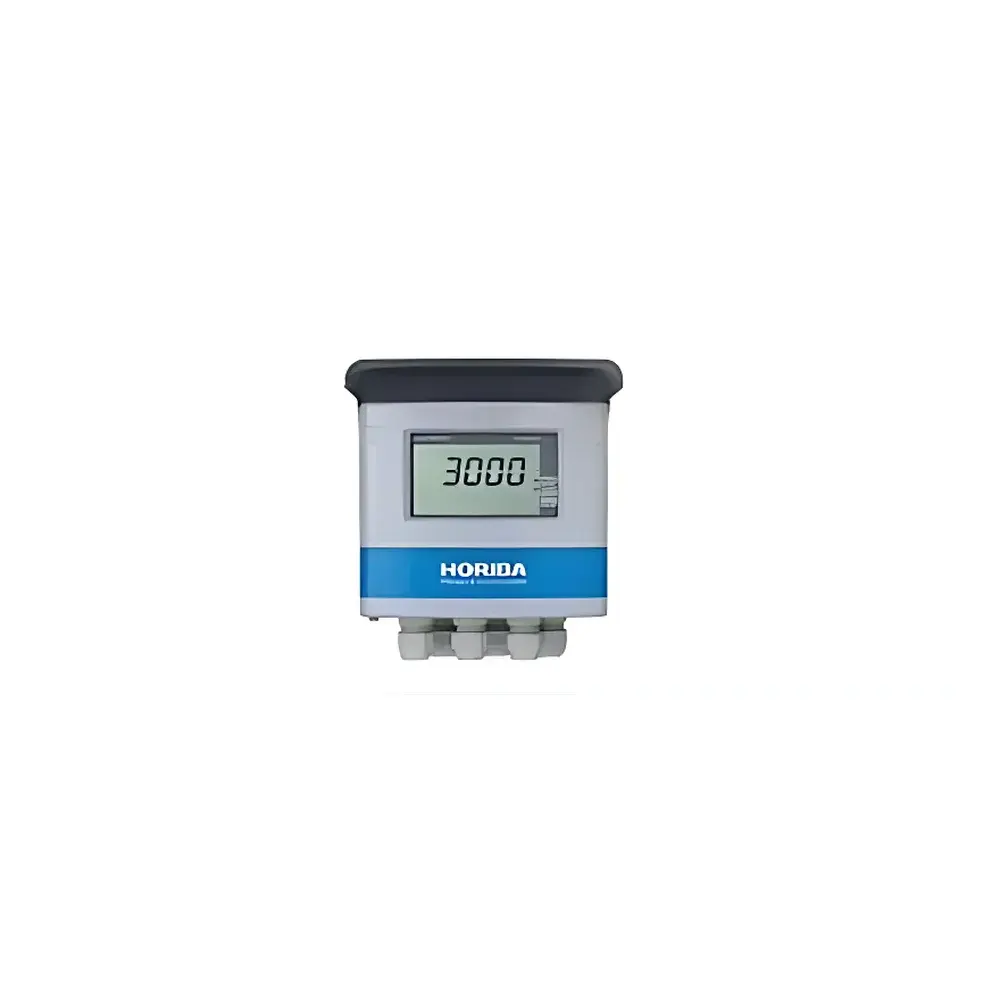
HORIBA HU-200SS Online Suspended Solids Monitor
| Brand | HORIBA |
|---|---|
| Origin | Japan |
| Model | HU-200SS |
| Measurement Principle | Optical Transmission (Infrared LED Light Path) |
| Measuring Range (MLSS) | 0–20,000 mg/L |
| Resolution | 1 mg/L (0–10,000 mg/L), 10 mg/L (10,000–22,000 mg/L) |
| Accuracy | ±3% of reading or ±10 mg/L (whichever is greater) |
| Output | Isolated 4–20 mA DC (max. load 900 Ω) |
| Relay Outputs | 3 SPDT dry contacts (configurable for alarm, cleaning, fault) |
| Digital Interface | RS-485 (2-wire, input/output isolated) |
| Enclosure Rating | IP65 |
| Ambient Operating Temperature | −20 °C to +55 °C |
| Power Supply | 90–264 V AC, 50/60 Hz, ≤35 VA |
| Weight | Approx. 4.5 kg |
| Compliance | CE, FCC, RoHS, WEEE |
Overview
The HORIBA HU-200SS is an industrial-grade, outdoor-rated online suspended solids (SS) monitor engineered for continuous, real-time measurement of mixed liquor suspended solids (MLSS), inorganic sludge, and turbid suspensions in wastewater treatment plants, industrial effluent streams, and process water systems. Unlike conductivity- or capacitance-based proxies, the HU-200SS employs a robust optical transmission method using infrared LED light sources and precision photodetectors to quantify light attenuation caused by particulate matter—enabling direct, non-invasive correlation with gravimetrically determined SS concentration. Its rugged aluminum housing, IP65 ingress protection, and wide operating temperature range (−20 °C to +55 °C) ensure stable performance in unconditioned outdoor environments—including exposed manholes, pump stations, and open-channel flows. Designed as part of HORIBA’s H-1 series of modular water quality analyzers, the HU-200SS integrates seamlessly into existing SCADA or DCS architectures via analog and digital interfaces while maintaining full compliance with international electromagnetic compatibility (EMC) and environmental directives (CE, FCC, RoHS, WEEE).
Key Features
- Optical transmission sensing principle with infrared LED light path—minimizes fouling sensitivity and eliminates electrode drift associated with electrochemical methods
- Dual-range resolution: 1 mg/L resolution up to 10,000 mg/L; 10 mg/L resolution from 10,000–22,000 mg/L—optimized for both low-concentration influent monitoring and high-solids activated sludge basins
- Configurable calibration modes: zero-point adjustment using deionized water; span calibration via empirical coefficient input, supporting traceable correlation to laboratory gravimetric analysis (ISO 11923:1997)
- Three programmable SPDT relay outputs—assignable to upper/lower concentration alarms, scheduled cleaning activation, or system fault indication—with fail-safe logic (normally closed on power loss)
- Integrated self-diagnostic suite: continuous verification of optical path integrity, temperature sensor functionality, and converter electronics—logging diagnostic events to internal memory with timestamped error codes
- Large-format backlit LCD display showing real-time SS value, temperature, calibration history, and active alarm status—designed for rapid visual verification without handheld tools
- Field-serviceable mechanical design: screw-type terminal blocks prevent wire dislodgement; stainless steel (SUS304) mounting hardware; pole-mount (50A pipe) or wall-mount adaptable
Sample Compatibility & Compliance
The HU-200SS is validated for use in municipal and industrial wastewater matrices containing organic biomass (e.g., activated sludge), inorganic sediments (e.g., clay, silt), and mixed suspensions typical of secondary clarifier underflows, digester feed lines, and membrane bioreactor (MBR) sidestreams. It is not intended for highly abrasive slurries (>200 µm particle median diameter) or chemically aggressive media exceeding pH 2–12. The instrument meets CE marking requirements per Directive 2014/30/EU (EMC) and 2014/35/EU (LVD), complies with FCC Part 15 Subpart B for radiated emissions, and adheres to RoHS Directive 2011/65/EU restrictions on hazardous substances. Its design supports operational alignment with ISO 5667-3 (water sampling) and ISO/IEC 17025:2017 traceability frameworks when used within documented QA/QC procedures.
Software & Data Management
While the HU-200SS operates autonomously without embedded firmware updates or cloud connectivity, its RS-485 Modbus RTU interface enables bidirectional communication with PLCs, RTUs, or centralized data acquisition systems. All configuration parameters—including measurement range selection (MLSS / clay / inorganic sludge), alarm thresholds, relay behavior, and calibration coefficients—are programmable via Modbus registers (function codes 03h/06h). The 4–20 mA analog output is fully isolated and linearly scaled to the configured measurement span, supporting integration into legacy analog control loops. Internal event logging records up to 100 calibration actions and diagnostic faults with date/time stamps—accessible via serial interrogation. No proprietary software is required; configuration may be performed using standard Modbus master utilities compliant with MODBUS Organization specifications.
Applications
- Real-time MLSS monitoring in aerobic and anoxic bioreactors to optimize aeration energy consumption and maintain target F/M ratios
- Sludge blanket level estimation in secondary clarifiers through longitudinal SS profiling across multiple HU-200SS units
- Feed-forward control of polymer dosing in dewatering centrifuges based on influent solids concentration
- Compliance reporting for discharge consent limits requiring continuous SS surveillance (e.g., EPA NPDES permits, EU Urban Wastewater Treatment Directive Annex I)
- Process troubleshooting in membrane filtration systems—detecting early-stage fouling via abnormal SS trend deviations
- Validation of manual grab sampling protocols by comparing field instrument readings against lab-reported gravimetric results (per ASTM D5907)
FAQ
Does the HU-200SS require periodic optical window cleaning?
Yes—while the optical path is less prone to fouling than contact electrodes, long-term exposure to oily or biofilm-forming streams necessitates scheduled mechanical or ultrasonic cleaning. The unit includes a dedicated clean-output relay to automate solenoid valve actuation.
Can the HU-200SS differentiate between organic and inorganic suspended solids?
No—it reports total suspended solids concentration as a bulk optical attenuation value. However, users may select between preloaded calibration curves for “activated sludge” or “inorganic mud” to improve correlation with lab results for specific matrix types.
Is the 4–20 mA output intrinsically safe for hazardous area installation?
No—the HU-200SS is rated for general-purpose outdoor use (IP65) but does not carry ATEX, IECEx, or UL Class I Div 2 certification. Installation in classified locations requires external intrinsic safety barriers.
What is the recommended calibration frequency under continuous operation?
HORIBA recommends zero calibration every 7 days and span verification every 30 days when deployed in municipal WWTP applications; more frequent checks are advised for high-fouling industrial streams.
Does the device support MODBUS TCP or only RS-485?
Only RS-485 (2-wire, half-duplex, Modbus RTU protocol). Ethernet or wireless connectivity requires an external protocol converter.
Related Products







