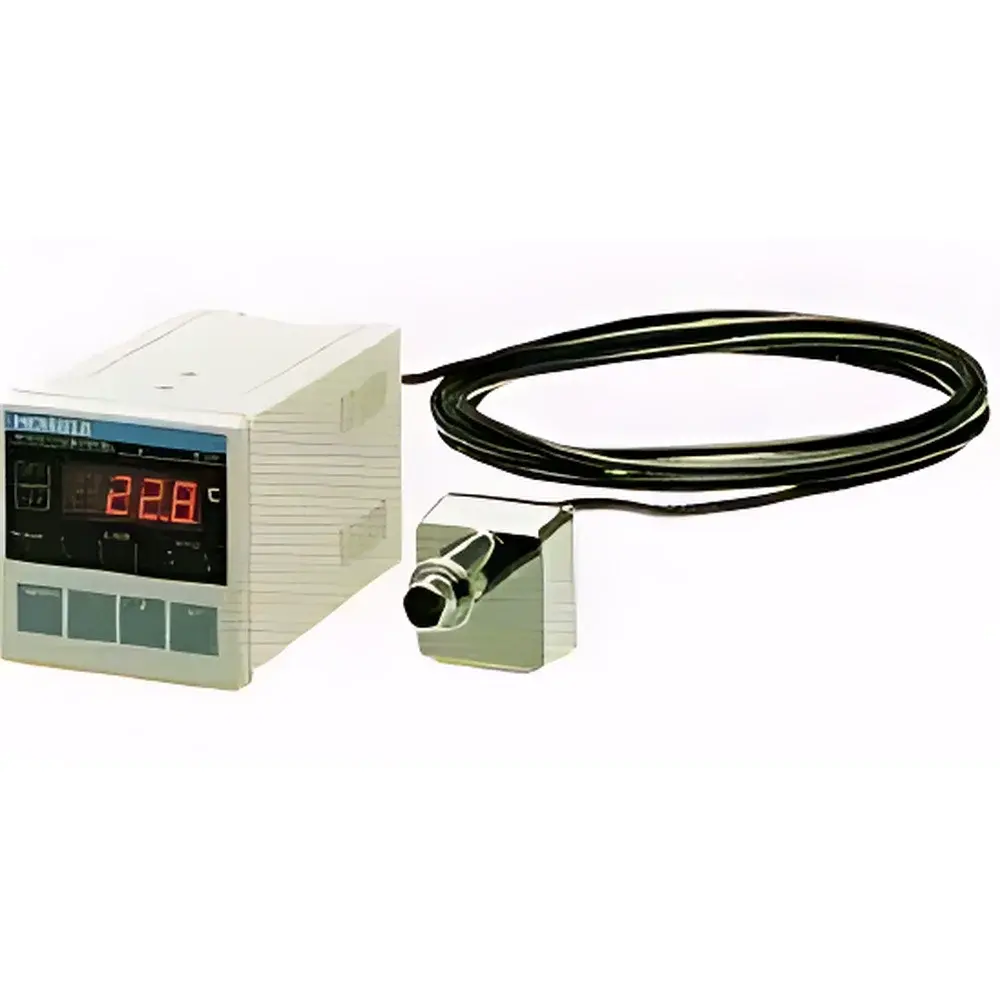
HORIBA IT-230 Non-Contact Infrared Thermometer
| Brand | HORIBA |
|---|---|
| Origin | Japan |
| Model | IT-230 |
| Temperature Range | 0–300 °C |
| Output | Analog (4–20 mA or 0–10 V selectable) |
| Alarm Outputs | Dual independent relay outputs |
| Mounting | Benchtop / Fixed-installation compatible |
| Compliance | CE marked, RoHS compliant |
| Enclosure Rating | IP65 (front panel) |
Overview
The HORIBA IT-230 is a benchtop non-contact infrared thermometer engineered for stable, high-reproducibility surface temperature measurement in industrial process monitoring and quality assurance environments. Utilizing calibrated short-wavelength infrared detection (typically centered near 8–14 µm spectral band), the IT-230 measures emitted thermal radiation without physical contact—eliminating sensor wear, contamination risk, or thermal disturbance to the target. Its fixed-focus optical design ensures consistent spot size and measurement geometry across the full 0–300 °C range, making it suitable for continuous monitoring of moving parts, hot metal surfaces, polymer extrudates, coated substrates, and other thermally sensitive or inaccessible targets. The device operates on the principle of Planck’s law of blackbody radiation, with factory calibration traceable to NIST-traceable reference sources. Designed for integration into factory automation systems, the IT-230 delivers real-time analog output and discrete alarm signaling without requiring host PC dependency.
Key Features
- Non-contact measurement with no emissivity adjustment required for standard industrial materials (default ε = 0.95; optional user-settable emissivity from 0.10 to 1.00 in 0.01 increments)
- Optical resolution of 50:1 (spot diameter ≈ 20 mm at 1 m distance), enabling precise targeting on small or spatially constrained features
- Response time ≤ 250 ms (95% step response), supporting dynamic thermal profiling of fast-moving production lines
- Dual independent relay outputs configurable as high/low alarms, latching/non-latching, or process fault indicators—each with programmable threshold and hysteresis
- Configurable analog output (4–20 mA or 0–10 V DC) with linear scaling across the full measurement span; supports connection to PLCs, DCS, or SCADA systems
- Robust aluminum die-cast housing rated IP65 for dust and water jet resistance; front-panel LCD with backlight for local readout and menu navigation
- Internal temperature compensation and ambient drift correction algorithms ensure long-term stability under varying environmental conditions (operating ambient: 0–50 °C)
Sample Compatibility & Compliance
The IT-230 is validated for use on opaque, solid, or semi-solid surfaces—including oxidized metals, ceramics, painted or anodized finishes, rubber, plastics, and composite laminates. Surface contamination such as oil film, light dust, or minor scratches does not significantly affect measurement accuracy due to its optimized signal-to-noise ratio and spectral filtering. It is not intended for transparent or highly reflective materials (e.g., bare polished aluminum, glass, or mirrors) without appropriate surface treatment or emissivity correction. The instrument complies with IEC 61326-1 (EMC for industrial environments), IEC 61000-4 series immunity standards, and meets CE marking requirements under the EU Low Voltage and EMC Directives. While not certified for intrinsic safety, it is widely deployed in Class 1 Div 2 and ATEX Zone 2 environments when installed per manufacturer-specified separation distances and cable routing guidelines.
Software & Data Management
The IT-230 operates as a standalone field instrument with no embedded firmware update capability or USB connectivity. Configuration is performed locally via push-button interface and on-screen menu system. All settings—including emissivity, alarm thresholds, analog output scaling, and relay logic—are stored in non-volatile memory and retained during power cycling. For auditability in regulated industries (e.g., automotive Tier-1 manufacturing, medical device component processing), users may log output signals externally using compatible data acquisition systems. While the device itself does not support FDA 21 CFR Part 11 electronic signatures or audit trails, its analog and relay outputs are fully compatible with third-party systems that implement such compliance frameworks. Calibration certificates issued by authorized HORIBA service centers include uncertainty budgets per ISO/IEC 17025 and reference to JIS Z 8703 or ASTM E1256 standards.
Applications
- Real-time temperature verification of solder paste reflow profiles on PCB assembly lines
- Monitoring extrusion die temperatures in plastic and rubber processing
- Surface temperature validation during heat treatment of machined components (annealing, tempering)
- Thermal uniformity checks on conveyor-belt-cured coatings and adhesives
- Preventive maintenance screening of motor windings, bearings, and electrical busbars
- Quality gate inspection for molded parts exiting cooling tunnels or ovens
FAQ
Does the IT-230 require periodic recalibration?
Yes. HORIBA recommends annual calibration against traceable blackbody sources, especially in applications demanding metrological confidence or subject to regulatory review.
Can the IT-230 measure through glass or plastic windows?
No. Standard optical windows attenuate infrared radiation; measurements must be taken directly on the target surface unless using specialized IR-transparent materials (e.g., germanium or zinc selenide) with known transmission characteristics.
Is emissivity compensation mandatory for accurate readings?
It is strongly recommended for materials deviating significantly from ε = 0.95 (e.g., bare copper, stainless steel, or aluminum). Default setting suffices for painted, oxidized, or matte-finish surfaces.
What is the minimum measurable spot size?
At 1 meter working distance, the optical spot diameter is approximately 20 mm; reducing distance improves spatial resolution but must remain within the specified minimum focus distance of 150 mm.
Can the analog output be scaled to a custom temperature subrange?
Yes. Users may define arbitrary linear spans (e.g., 100–200 °C mapped to 4–20 mA) via the configuration menu, preserving full measurement resolution within the selected interval.