
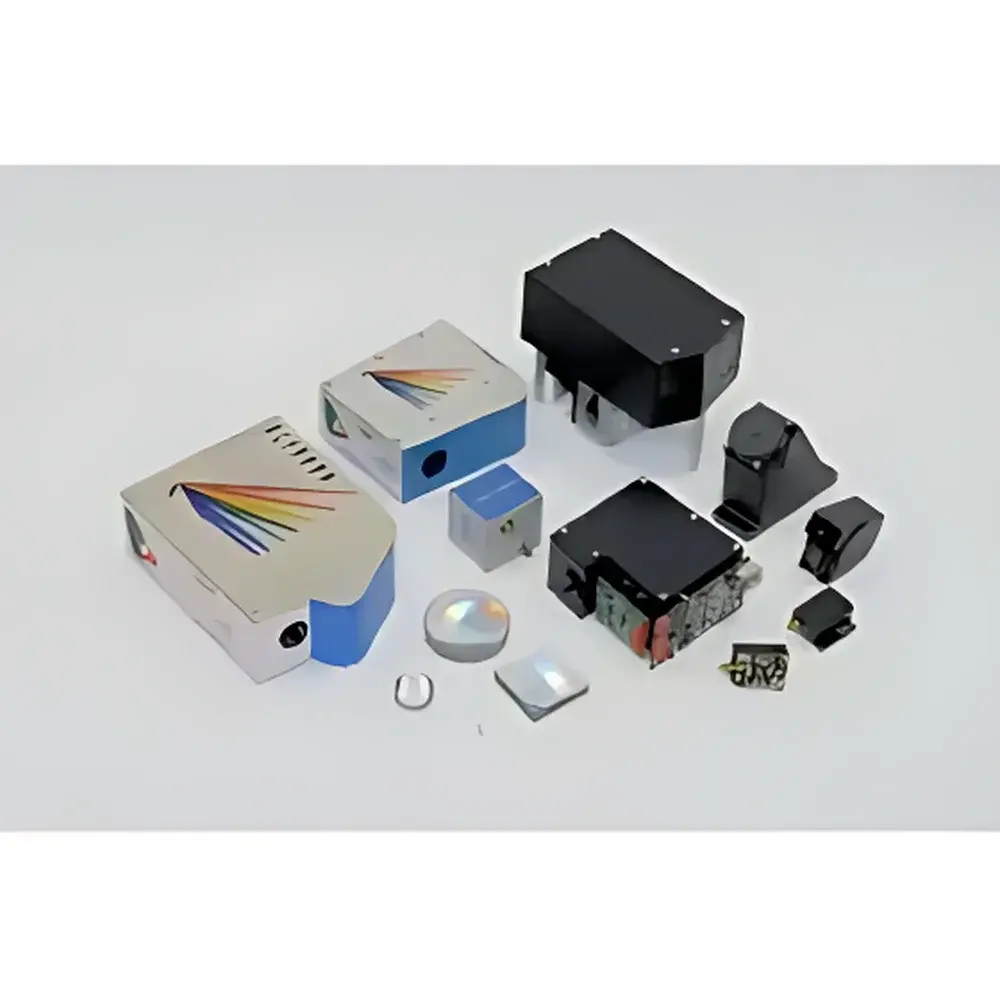
HORIBA Jobin Yvon OEM Custom Spectrograph & Monochromator
| Brand | HORIBA |
|---|---|
| Origin | France |
| Type | OEM Custom Spectrograph/Monochromator |
| Spectral Range | 190–2100 nm |
| Focal Length | 20–140 mm |
| Resolution | 10–1 nm |
| Detector Options | Single-Channel PMT, Linear/2D Array, CCD, CMOS, NMOS, PDA, InGaAs |
| Optical Design | Monolithic Aberration-Corrected Platform |
| Grating Type | Type-4 Achromatic Grating |
| Compliance | Designed for Integration into CE/FCC-Compliant Analytical Systems |
| Manufacturing | High-Volume Production with Lot-to-Lot Performance Traceability |
Overview
The HORIBA Jobin Yvon OEM Custom Spectrograph and Monochromator is a purpose-engineered optical core module designed exclusively for integration into third-party analytical instrumentation platforms. Leveraging over five decades of heritage in high-performance spectroscopic system development — including Raman, fluorescence, UV-Vis-NIR, and LIBS systems — this OEM platform delivers metrologically traceable spectral performance while maintaining architectural flexibility for system-level differentiation. Unlike off-the-shelf spectrometers, this solution employs a monolithic optical bench architecture, minimizing mechanical drift and thermal hysteresis across extended operational cycles. Its optical path is optimized using Type-4 achromatic gratings, enabling simultaneous correction of spherical aberration, coma, and astigmatism across the full 190–2100 nm spectral range. The design adheres to fundamental principles of Czerny-Turner and crossed-beam configurations, with focal lengths scalable from 20 mm (compact portable modules) to 140 mm (high-resolution laboratory-grade units), supporting both scanning and array-based detection paradigms.
Key Features
- Monolithic optical platform engineered for long-term mechanical and thermal stability — critical for field-deployable and GMP-compliant instruments
- Type-4 achromatic diffraction grating providing intrinsic correction of third-order optical aberrations without auxiliary optics or software interpolation
- Modular detector interface supporting standardized electrical and mechanical footprints for PMT, linear/2D CCD/CMOS arrays, InGaAs NIR sensors, and multi-channel PDA systems
- Resolution tunability from 10 nm (broadband screening) to ≤1 nm (molecular fingerprinting), calibrated per NIST-traceable reference sources
- OEM-dedicated engineering support: optical layout co-design, spectral calibration file generation (wavelength & intensity), and firmware API documentation for host-system integration
- Production-controlled alignment and coating processes — each unit undergoes spectral responsivity mapping and stray-light characterization prior to shipment
Sample Compatibility & Compliance
This spectrograph module is compatible with liquid, solid, gaseous, and fiber-coupled sample interfaces. It integrates seamlessly with HPLC-UV/Vis detectors, portable Raman probes (785 nm/1064 nm excitation), fluorometers, gas-phase emission analyzers, and inline water quality monitors. All optical coatings meet ISO 9022-3 environmental durability standards; housing materials comply with RoHS 2011/65/EU and REACH Annex XVII requirements. Units intended for medical device integration are supplied with full material declarations (IMDS), biocompatibility documentation (ISO 10993-1 upon request), and optional FDA 21 CFR Part 11–compliant calibration audit trails. Final instrument-level compliance (e.g., IEC 61010-1, EN 61326-1) remains the responsibility of the integrating manufacturer.
Software & Data Management
HORIBA provides OEM partners with a comprehensive integration toolkit: DLL-based SDKs for Windows/Linux, Python bindings, and register-level communication protocols (UART, SPI, USB 2.0). Calibration data — including pixel-to-wavelength mapping, relative spectral response (RSR), dark current profiles, and linearity coefficients — are delivered in HDF5 format with embedded metadata conforming to ASTM E131-22 spectral data exchange conventions. Firmware supports user-defined region-of-interest (ROI) readout, hardware-triggered acquisition, and on-board non-uniformity correction (NUC) for array detectors. Audit logs capture calibration date, operator ID, environmental conditions (via optional integrated thermistor/hygrometer), and firmware revision — enabling GLP/GMP traceability when embedded in regulated instruments.
Applications
- Biochemical & Clinical Diagnostics: Integrated into automated immunoassay platforms and microplate readers for absorbance/fluorescence endpoint and kinetic assays (USP & CLSI compliant workflows)
- Environmental Monitoring: Core engine for continuous water quality analyzers (COD, TOC, nitrate, phosphate) and open-path atmospheric gas sensors (NOx, SO2, CH4)
- Pharmaceutical QC: Used in dissolution testing systems and raw material identification via UV-Vis spectral library matching (aligned with USP and Ph. Eur. 2.2.25)
- Industrial Light Source Metrology: Embedded in LED/Laser spectral radiance testers meeting CIE S 025/E:2015 and IES LM-79-19 requirements
- Food Safety Screening: Enables rapid contaminant detection (melamine, pesticides) via handheld Raman and fluorescence fingerprinting systems
FAQ
What level of customization is supported beyond standard optical parameters?
Optical layout reconfiguration (e.g., input/output port orientation, fiber coupling NA optimization), custom coating stacks (enhanced UV reflectivity, deep-NIR anti-reflection), and mechanical housing redesign (IP65 enclosure, thermal stabilization blocks) are available under NRE agreement.
Do you provide spectral calibration certificates with NIST traceability?
Yes — each production lot undergoes wavelength and photometric calibration using NIST SRM 2031 (mercury-argon lamp) and SRM 2032 (tungsten halogen standard); certificates include expanded uncertainty budgets per GUM (JCGM 100:2008).
Can the module be qualified for use in Class I, Division 2 hazardous locations?
The base optical module is intrinsically safe; explosion-proof certification requires integration-level evaluation by a Nationally Recognized Testing Laboratory (NRTL) — HORIBA provides mechanical drawings, thermal profiles, and power dissipation data to support such assessments.
What is the typical lead time for volume orders (≥500 units/year)?
Standard lead time is 14–16 weeks from PO release, inclusive of first-article inspection and spectral verification; JIT delivery schedules and consignment inventory options are available under annual supply agreements.
Related Products




