
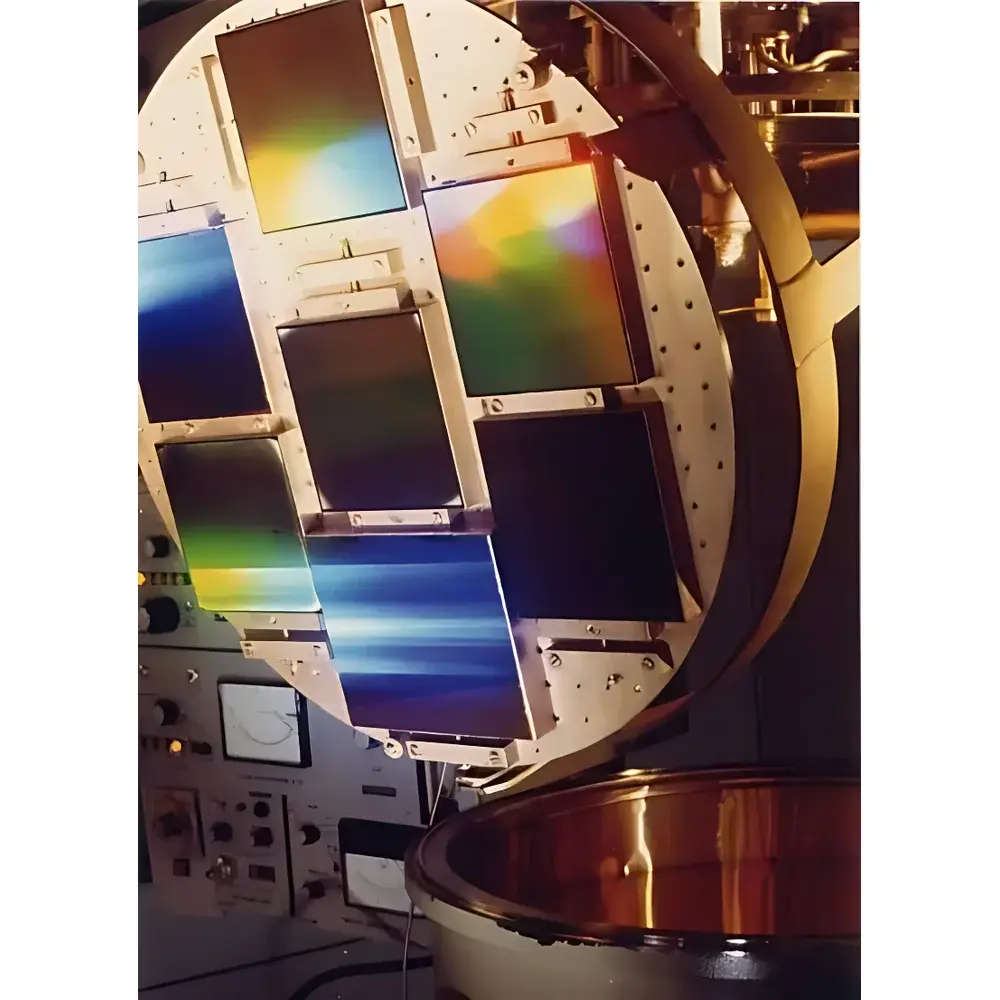
HORIBA Jobin Yvon Standard Plane Grating
| Brand | HORIBA |
|---|---|
| Origin | France |
| Manufacturer Type | Original Equipment Manufacturer (OEM) |
| Import Status | Imported |
| Model | Standard Plane Grating |
| Pricing | Upon Request |
| Type | Replicated Grating |
| Dimensions | 120 × 140 mm |
| Spectral Range | 100 nm – 45 µm |
| Groove Density | 20 – 5670 grooves/mm |
| Diffraction Efficiency | 30% – 90% |
| Substrate Materials | Fused Silica, Heat-Resistant Glass, Zerodur®, Metal |
| Coating Options | Aluminum, Gold, Platinum, Magnesium Fluoride |
Overview
The HORIBA Jobin Yvon Standard Plane Grating is a precision optical component engineered for high-fidelity spectral dispersion in laboratory and industrial spectroscopic systems. As a replicated plane diffraction grating, it operates on the principle of constructive interference of light waves scattered from periodic groove structures—enabling wavelength-selective separation across ultraviolet (UV), visible (VIS), near-infrared (NIR), mid-infrared (MIR), and far-infrared (FIR) regions. Designed and manufactured in France by HORIBA Scientific—a global leader in optical instrumentation since its foundational work in holographic grating development beginning in 1968—the grating leverages decades of metrological expertise in groove profile control, replication fidelity, and coating uniformity. Its planar geometry ensures minimal wavefront distortion and compatibility with both Czerny–Turner and Paschen–Runge optical configurations, making it suitable for monochromators, spectrometers, Fourier-transform instruments, and custom optical benches requiring stable, repeatable dispersion performance.
Key Features
- Replicated construction ensures high groove-to-groove consistency and long-term stability under thermal and mechanical stress.
- Two primary fabrication methodologies: mechanically ruled gratings for high efficiency in UV–VIS and holographically recorded gratings optimized for low stray light and high resolution in VIS–NIR applications.
- Ion-etched holographic variants available for enhanced blaze performance and extended efficiency bandwidths in demanding MIR/FIR setups.
- Substrate options include fused silica (for deep-UV transmission), heat-resistant borosilicate glass (for cost-sensitive VIS applications), Zerodur® (ultra-low expansion microcrystalline glass for high-stability interferometric use), and metal substrates (for high-power laser or vacuum-ultraviolet environments).
- Customizable reflective coatings—including protected aluminum (broadband UV–NIR), gold (optimized for NIR–FIR), platinum (oxidation-resistant FIR), and MgF₂ overcoated aluminum (enhanced UV durability)—ensure spectral response alignment with system-level optical design requirements.
- Ruggedized surface treatments mitigate environmental degradation: anti-oxidation layers prevent aluminum oxidation; hydrophobic and anti-fungal coatings extend service life in humid or uncontrolled lab environments.
Sample Compatibility & Compliance
HORIBA standard plane gratings are compatible with a wide range of optical platforms, including but not limited to Raman spectrometers, X-ray fluorescence (XRF) monochromators, plasma emission analyzers, and tunable laser cavity optics. All gratings undergo rigorous ISO 10110-compliant surface inspection, including wavefront error mapping (< λ/10 PV at 633 nm), groove spacing uniformity verification (±0.05% RMS deviation), and coating adhesion testing per ASTM D3359. Manufacturing traceability includes full lot documentation compliant with GLP and GMP audit frameworks. While not medical devices, these components support analytical instrumentation referenced in USP , ISO/IEC 17025, and IEC 61000-4 electromagnetic compatibility standards where integrated into certified systems.
Software & Data Management
Grating specifications—including groove density, blaze angle (where applicable), coating reflectance curves, and polarization-dependent efficiency maps—are provided in standardized ASCII and CSV formats for integration into optical design software such as Zemax OpticStudio, CODE V, and FRED. HORIBA supplies calibrated efficiency data measured using NIST-traceable reference detectors across the full 100 nm–45 µm range. For users implementing automated wavelength calibration routines, grating serial numbers are linked to digital certificates containing metrological history, enabling version-controlled configuration management in LIMS or ELN environments. No proprietary firmware or driver software is required; physical mounting follows ANSI/ISO 10110-7 mechanical interface conventions.
Applications
- High-resolution atomic emission spectroscopy in ICP-OES and spark-OES systems.
- UV–VIS–NIR absorbance and reflectance measurements in pharmaceutical QC labs.
- Low-stray-light Raman signal isolation in confocal microspectroscopy.
- Wavelength calibration references in astronomical spectrographs and synchrotron beamlines.
- Beam combiners and pulse compressors in ultrafast laser systems (Ti:sapphire, OPA).
- Gas-phase IR absorption monitoring in environmental emissions analyzers (e.g., FTIR-based stack testing).
FAQ
What distinguishes a replicated grating from a master grating?
Replicated gratings are produced by casting an epoxy or UV-curable resin layer onto a high-precision master grating, then separating and metallizing the replica. This process preserves groove fidelity while enabling cost-effective volume production and substrate flexibility—unlike direct ruling or holography, which require expensive, single-use masters.
Can this grating be used in vacuum or UHV environments?
Yes—when fabricated on low-outgassing substrates (e.g., Zerodur® or oxygen-free copper) and coated with non-hygroscopic metals (e.g., platinum or bare gold), these gratings meet ASTM E595 total mass loss (TML) & collected volatile condensable materials (CVCM) thresholds for UHV-compatible optics.
Is groove density uniform across the entire 120 × 140 mm aperture?
Yes—HORIBA employs interferometric null testing and phase-measuring profilometry to verify groove density uniformity within ±0.03% across the full active area, ensuring consistent dispersion without spatial wavelength drift.
How is diffraction efficiency validated?
Efficiency is measured using double-monochromator setups traceable to NIST SRM 2036 (aluminum-coated mirrors) and calibrated thermopile detectors, with angular alignment controlled to ±0.5 arcsec repeatability.
Do you offer custom groove profiles or anomalous dispersion designs?
Yes—HORIBA provides bespoke blazed, sinusoidal, and echelette profiles, including off-plane mount geometries and dual-band coatings, subject to minimum order quantities and engineering review.




