
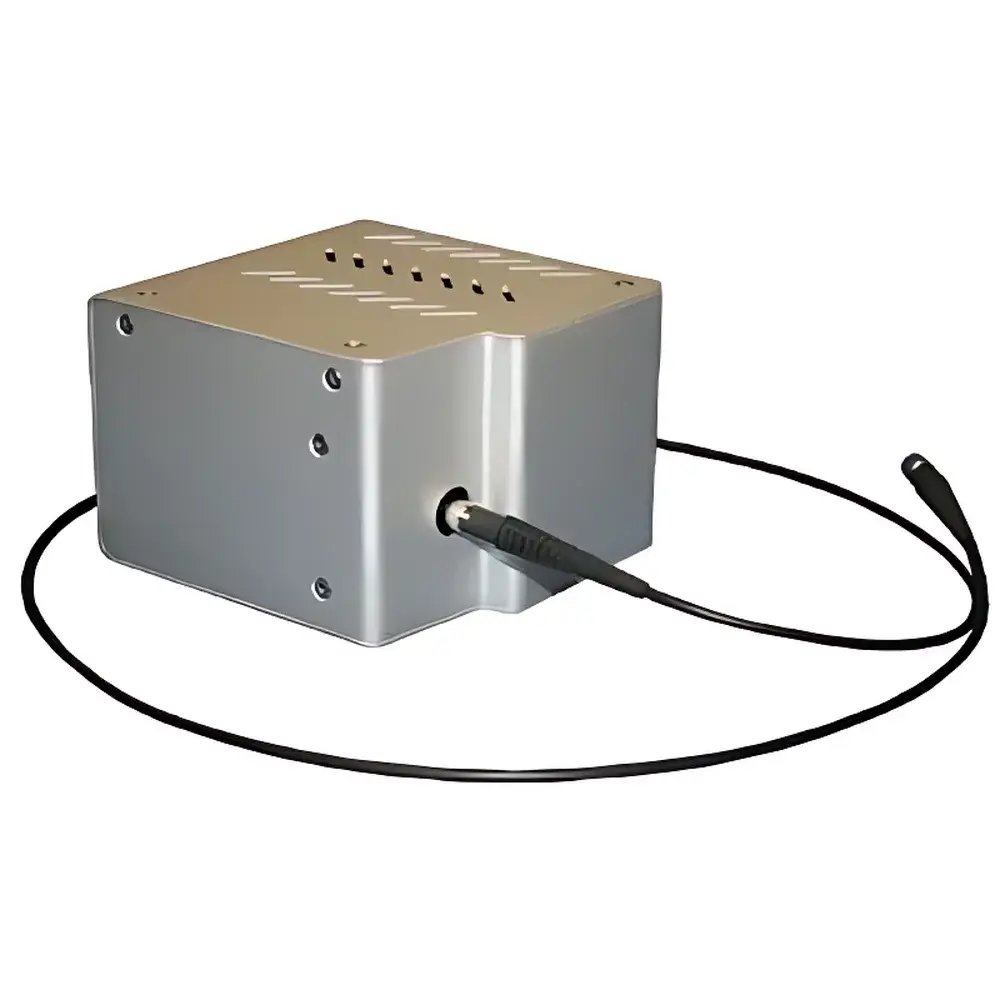
HORIBA Jobin Yvon VS7000+ OEM Fiber Optic Spectrometer
| Brand | HORIBA |
|---|---|
| Origin | France |
| Manufacturer Type | Original Equipment Manufacturer (OEM) |
| Product Category | Imported Instrument |
| Model | VS7000+ |
| Detector Type | Back-Illuminated CCD |
| Spectral Range | 200 nm – 1050 nm |
| Spectral Resolution (UV-Vis) | 2.7 nm @ 75 µm slit, 2048-pixel array |
| Numerical Aperture | f/2.8 |
| Stray Light Suppression | ≤ 0.08% (max) |
| Dynamic Range | 7000:1 |
| Quantum Efficiency | >65% at 250 nm, >70% at 650 nm, >55% at 850 nm |
| Readout Speed | up to 223 spectra/s (ultra-fast mode, zero exposure) |
| A/D Conversion | 16-bit, 500 kHz |
| Dark Current | 2.8 counts/ms @ 20°C |
| Read Noise | ≤45 e⁻ (sensitive mode), ≤90 e⁻ (high full-well mode) |
| Linearity Error (factory corrected) | <0.4% (sensitive mode), <0.8% (high full-well mode) |
| On-board Linearization & Wavelength Calibration | Yes |
| Interface | USB 2.0 |
| Optical Design | Monolithic aberration-corrected Czerny–Turner with Type-4 flat-field concave holographic grating |
| Compliance | CE, RoHS, ISO 9001-manufactured |
Overview
The HORIBA Jobin Yvon VS7000+ is a high-performance, compact, monolithic fiber optic spectrometer engineered specifically for original equipment manufacturers (OEMs) integrating spectral detection into analytical instrumentation. Based on an optimized modified Czerny–Turner optical architecture, it employs a single-piece, aberration-corrected Type-4 concave holographic grating that delivers flat-field imaging across the entire detector array—eliminating the need for complex refocusing or external collimation optics. This design ensures high optical throughput (f/2.8), exceptional stray light suppression (65% at 250 nm—significantly outperforming front-illuminated and low-cost back-illuminated alternatives in both UV sensitivity and near-infrared etaloning suppression.
Key Features
- Monolithic optical path with integrated Type-4 flat-field concave grating—no moving parts, no shutters, no alignment drift
- Back-illuminated CCD detector with factory-calibrated linearity correction, on-board wavelength calibration, and dual-gain readout modes (4 e⁻/count and 8 e⁻/count)
- High dynamic range (7000:1 in sensitive mode) and low read noise (≤45 e⁻) enabling quantitative absorption, fluorescence, and reflectance measurements under low-light conditions
- Configurable spectral resolution via 10 standard slit widths (12–200 µm); typical resolution of 2.7 nm FWHM in UV-Vis configuration with 75 µm slit and 2048-pixel array
- USB 2.0 interface with guaranteed data integrity and deterministic timing—fully compatible with real-time control in LabVIEW™, Python, C/C++, and MATLAB® environments
- On-board signal processing including dark current subtraction, boxcar averaging, pixel/wavelength/wavenumber scaling, and absorbance/transmittance calculation
- Robust thermal management: stable dark current performance across ambient temperatures; optional thermoelectric cooling available for extended integration times
Sample Compatibility & Compliance
The VS7000+ is designed for seamless integration into instruments requiring regulatory-compliant spectral acquisition—including those deployed in pharmaceutical QC labs (aligned with USP , EP 2.2.25), environmental monitoring (EPA Method 418.1, ISO 7027), and clinical diagnostics (IVDR Annex I essential requirements). Its optical path supports standard 600 µm core diameter fibers (1.5 m length), with optional 1 mm-height CCD variants accommodating 800–1000 µm fibers for enhanced étendue matching. All units are manufactured under ISO 9001-certified processes and comply with CE marking directives (EMC 2014/30/EU, LVD 2014/35/EU) and RoHS 2011/65/EU. While the spectrometer itself does not carry FDA 21 CFR Part 11 certification, its raw data output (16-bit linear counts), audit-trail-capable software drivers (DLLs/VIs), and deterministic USB communication enable traceable integration into validated systems meeting GLP/GMP data integrity requirements.
Software & Data Management
HORIBA provides comprehensive OEM integration tools: native LabVIEW™ 2011-compatible VIs, C/C++ DLLs, and Python wrappers supporting Windows and Linux platforms. The included acquisition software grants direct access to uncorrected linear CCD data and factory-applied nonlinearity corrections—enabling users to implement custom calibration routines or apply proprietary chemometric models. All spectral data can be exported in ASCII (.txt) or Excel (.xlsx) formats with metadata headers (wavelength, exposure time, gain, temperature). On-board firmware implements real-time dark subtraction, spectral averaging, and pixel-to-wavelength mapping using third-order polynomial coefficients stored per unit during final calibration. No LabVIEW runtime license is required to execute precompiled applications; development requires LabVIEW 2011 or later.
Applications
- Fluorescence spectroscopy in microplate readers and flow cytometers
- UV-Vis absorbance quantification in HPLC detectors and enzymatic assay analyzers
- Reflectance and transmittance measurement in material science and thin-film characterization
- NIR spectroscopy for food quality assessment (moisture, fat, protein) and agricultural product screening
- LED and laser diode spectral characterization in manufacturing QA
- Portable Raman spectrometer engines leveraging high UV sensitivity and low stray light
- Gas and water quality sensors utilizing differential optical absorption spectroscopy (DOAS)
FAQ
Is the VS7000+ suitable for regulatory-compliant analytical instrumentation?
Yes—its deterministic data acquisition, traceable calibration, and compatibility with audit-trail-enabled host software allow integration into systems compliant with FDA 21 CFR Part 11, EU Annex 11, and ISO/IEC 17025 requirements.
Can I replace the standard CCD with a CMOS detector?
HORIBA offers select CMOS-based variants upon request; however, the VS7000+ reference configuration uses a back-illuminated CCD optimized for UV quantum efficiency and low read noise.
What is the minimum integration time supported?
Zero-exposure multi-spectrum acquisition enables effective integration times down to 4.5 ms per spectrum in ultra-fast mode.
Do I need a LabVIEW license to operate the spectrometer?
No—precompiled executables run without a LabVIEW license. Development and modification of VIs require LabVIEW 2011 or newer.
Is thermal stabilization included as standard?
The base model operates at ambient temperature with passive thermal management. Active thermoelectric cooling is available as a customization option for long-integration or high-stability applications.



