
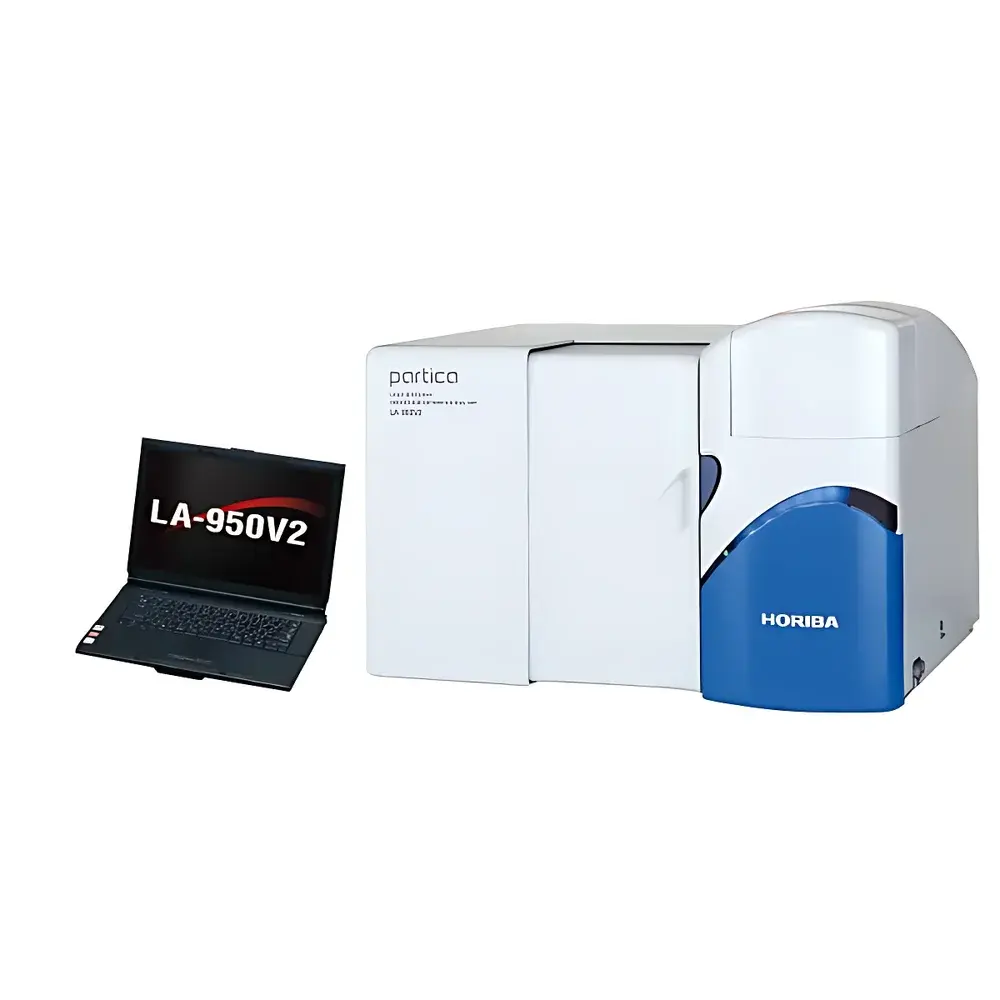
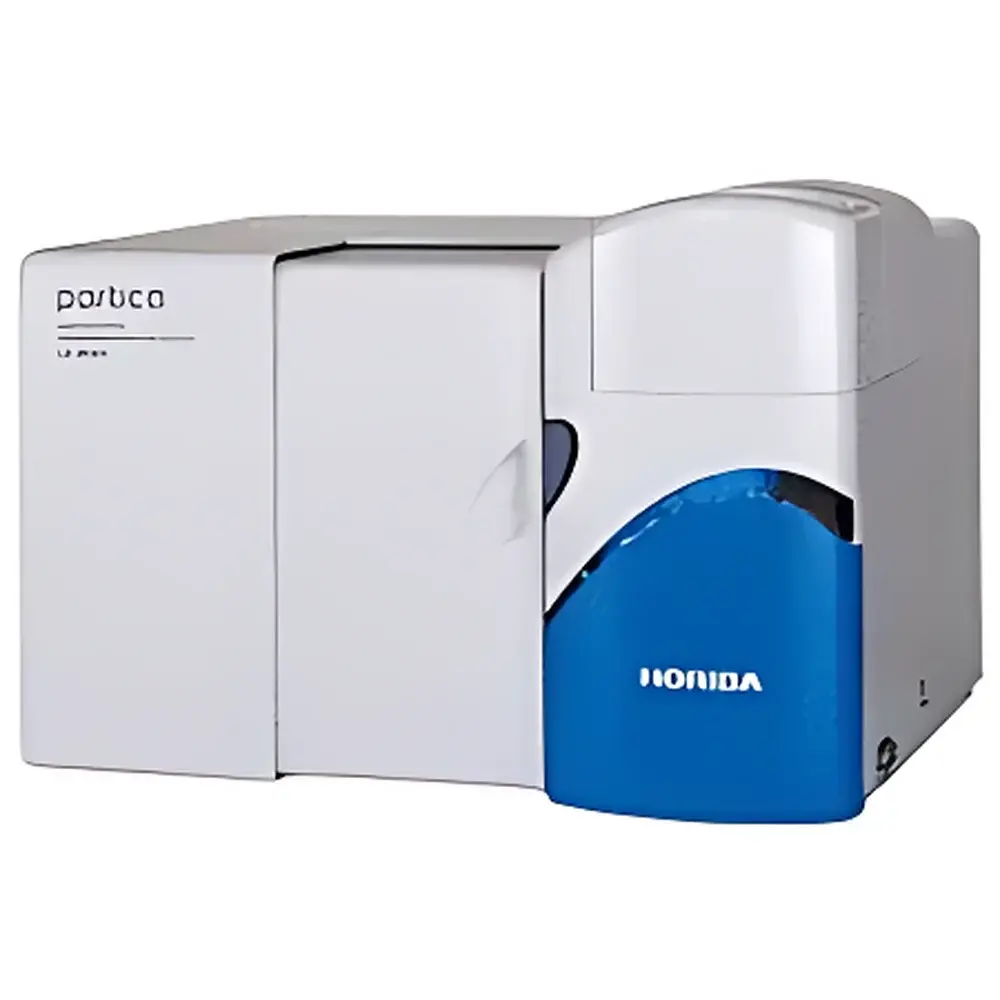
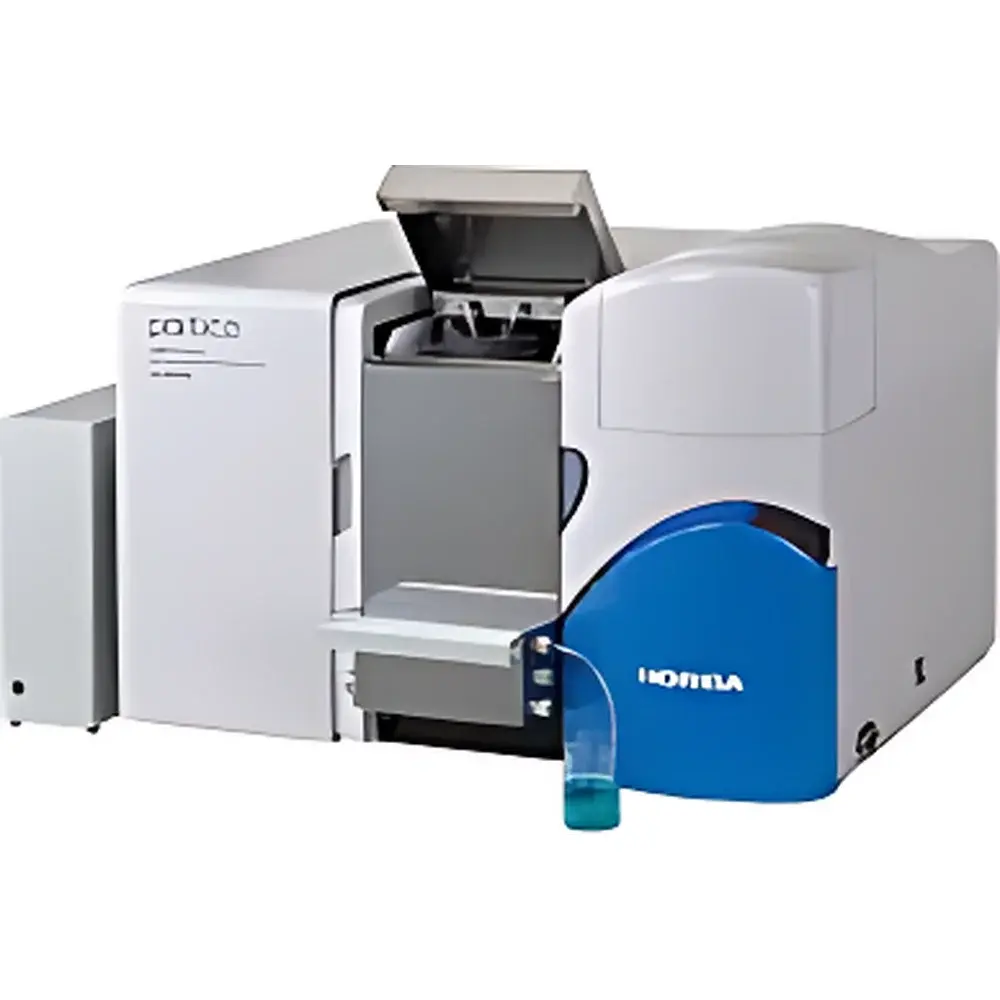
HORIBA LA-960 V2 Laser Diffraction Particle Size Analyzer
| Brand | HORIBA |
|---|---|
| Origin | Japan |
| Model | LA-960 |
| Dispersion Method | Dry & Wet Dispersion |
| Measurement Range | 10 nm – 5 mm |
| Repeatability | ≤0.06% |
| Measurement Time | <1 min |
Overview
The HORIBA LA-960 V2 Laser Diffraction Particle Size Analyzer is an advanced, research-grade instrument engineered for high-precision particle size distribution (PSD) analysis across an unprecedented dynamic range—from 10 nanometers to 5 millimeters—using first-principles Mie scattering theory. Unlike empirical or approximate optical models, Mie theory provides a rigorous solution to Maxwell’s electromagnetic equations, enabling quantitative interpretation of angular light scattering intensity for particles of arbitrary size, refractive index, and absorption characteristics. This theoretical foundation ensures traceable accuracy and robustness in complex matrices, making the LA-960 V2 suitable for demanding applications in nanomaterials development, battery electrode formulation, pharmaceutical dry powder inhalers, ceramic sintering feedstocks, and regulatory-compliant quality control environments governed by GLP, GMP, and ISO 13320.
Key Features
- Single-Range Ultra-Wide Detection: Achieves 0.01 µm–5000 µm coverage without lens switching or range segmentation—eliminating operator-induced variability and calibration discontinuities.
- Dual-Wavelength Solid-State Illumination: Integrates a 650 nm laser diode (5 mW) for stable, long-life primary scattering and a 405 nm LED (3 mW) to enhance sensitivity to sub-100 nm particles via increased Rayleigh scattering cross-section.
- 87-Channel Logarithmic Detector Array: Features overlapping forward-, side-, and ultra-wide-angle (up to 155°) detection geometry with no angular gaps—maximizing resolution and minimizing lower detection limits.
- Overlapped Inverse Fourier Optical Design: HORIBA’s proprietary optical architecture extends effective scattering path length by 4× within compact footprint, improving signal-to-noise ratio while maintaining mechanical stability on rigid cast-aluminum baseplate.
- Fully Automated Fluidic System: Includes integrated centrifugal pump (10 L/min), ultrasonic disperser (30 W, 20 kHz, 7-step adjustable), auto-dosing peristaltic pump, and real-time concentration monitoring—reducing dispersion medium volume to 180–250 mL and sample consumption to 10 mg–5 g.
- High-Speed Data Acquisition: Captures 5000 scattering patterns per second, resolving transient agglomeration, shear-induced breakage, or sedimentation dynamics during measurement.
Sample Compatibility & Compliance
The LA-960 V2 accommodates both wet and dry dispersion protocols, supporting aqueous, organic, and non-volatile suspensions as well as aerosolized powders. Its Mie-based algorithm accepts complex refractive index inputs—including imaginary components—to accurately characterize absorbing materials such as carbon black, metal oxides, and pigmented polymers. The system meets ISO 13320:2020 requirements for laser diffraction methodology validation and supports full audit trails compliant with FDA 21 CFR Part 11 when operated with optional secure software modules. Built-in SOP navigator enables consistent execution of GLP/GMP workflows across multi-site laboratories.
Software & Data Management
HORIBA’s proprietary Particle Analysis Software (PAS) v4.x delivers intuitive workflow guidance through step-by-step SOP navigation—ideal for training new users and minimizing procedural deviations. Real-time preliminary PSD preview allows immediate assessment of dispersion stability prior to formal measurement. All raw scattering data, instrument parameters, and metadata are stored in vendor-neutral HDF5 format, ensuring long-term accessibility and third-party interoperability. Reporting templates conform to ISO, USP , and ASTM E2910 standards, with customizable export options for CSV, PDF, and XML. Optional electronic signature and role-based access control modules support regulated environments requiring full traceability.
Applications
- Nanoparticle synthesis R&D (e.g., quantum dots, liposomes, exosomes)
- Electrode slurry characterization for Li-ion and solid-state batteries
- Ceramic green body homogeneity assessment pre-sintering
- Pharmaceutical API and excipient grading per USP
- Pigment dispersion stability in coatings and inks
- Food powder flowability and reconstitution behavior
- Environmental particulate matter (PM2.5/PM10) reference standard verification
FAQ
Does the LA-960 V2 require manual optical alignment?
No—the entire optical train is factory-aligned and mounted on a vibration-damped cast-aluminum base. No user adjustment is necessary throughout the instrument’s service life.
Can it measure highly absorbing or opaque particles?
Yes—by entering complex refractive index values (real + imaginary components), the Mie calculation engine fully accounts for absorption effects, enabling accurate sizing of carbon-based, metallic, and heavily dyed particles.
How does the system ensure measurement repeatability across operators?
Through automated SOP execution, closed-loop concentration control, and elimination of manual alignment or lens changes—reducing inter-operator variability to ≤0.06% RSD.
Is compliance with 21 CFR Part 11 supported?
Yes—when configured with validated PAS software, electronic signatures, and audit trail logging, the LA-960 V2 meets FDA requirements for electronic records and signatures in regulated pharmaceutical and biotech settings.
What maintenance is required for long-term performance stability?
Annual calibration verification using NIST-traceable polystyrene standards is recommended; no routine optical recalibration or detector replacement is needed due to solid-state design and thermal/mechanical stabilization.



