
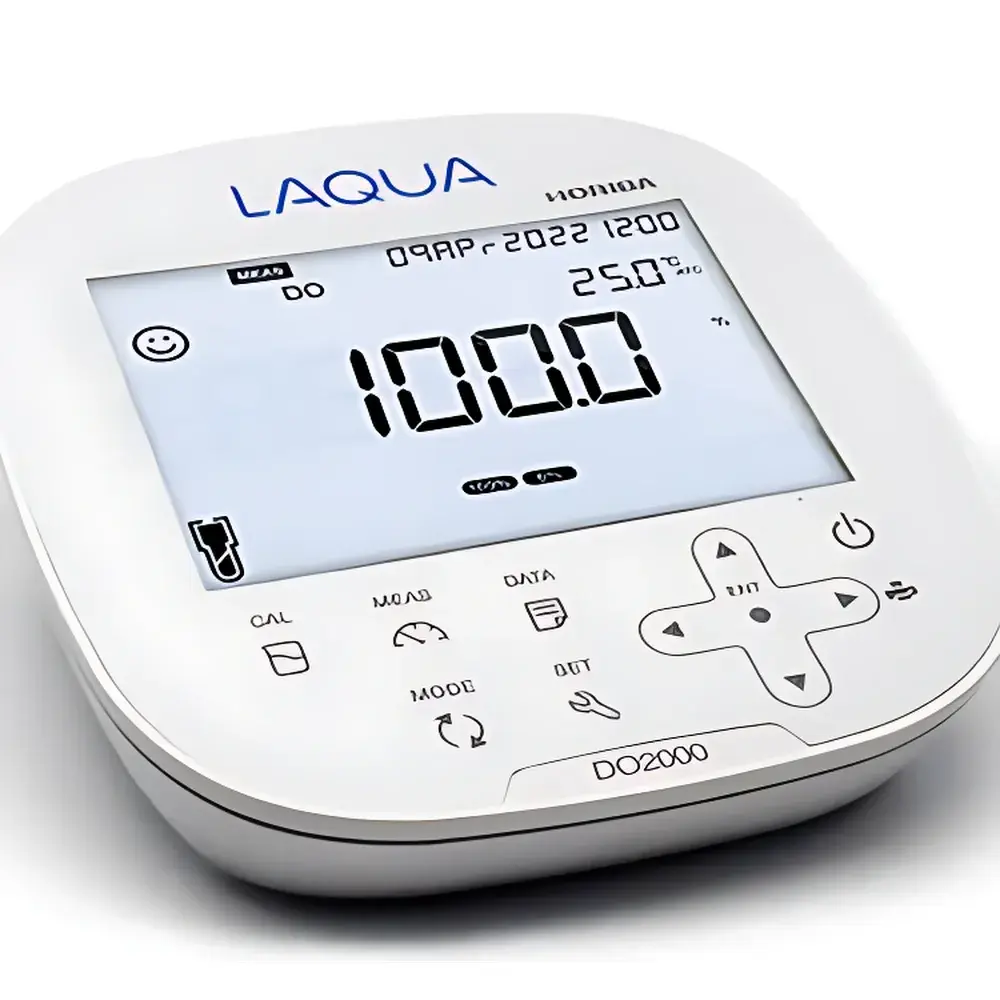
HORIBA LAQUA DO2000 Benchtop Dissolved Oxygen and BOD Meter
| Brand | HORIBA |
|---|---|
| Origin | Japan |
| Model | LAQUA DO2000 |
| Instrument Type | Benchtop Laboratory Meter |
| Measurement Principle | Galvanic Electrode (Clark-type) with Integrated Thermistor |
| DO Range | 0.0 to 60.00 mg/L, 0.0 to 600.0% saturation |
| DO Accuracy | ±0.1 mg/L, ±1.0% of reading |
| Temperature Range | −30.0 to 130.0 °C |
| Temperature Accuracy | ±0.5 °C |
| Salinity Compensation | 0.0 to 40.0 ppt |
| Atmospheric Pressure Compensation | 10.0 to 200.0 kPa |
| BOD Protocol | Pre-programmed 5-day method with seed correction |
| Calibration Points | Up to 2-point DO calibration |
| Memory Capacity | 2000 data sets with timestamp |
| Display | 5-inch backlit 320-segment LCD |
| Connectivity | USB (for DAS20 software), RS-232C (for printer), BNC, ATC phono, DC input |
| Power | AC adapter (100–240 V, 50–60 Hz) |
| Dimensions | 155 × 150 × 67 mm |
| Weight | 765 g |
Overview
The HORIBA LAQUA DO2000 is a precision benchtop dissolved oxygen (DO) and biochemical oxygen demand (BOD) meter engineered for rigorous water quality analysis in environmental laboratories, wastewater treatment facilities, and academic research settings. It employs a galvanic (Clark-type) electrochemical sensor principle—where molecular oxygen diffuses through a gas-permeable membrane and undergoes reduction at a cathode, generating a current proportional to DO concentration. This analog signal is digitized and corrected in real time for temperature, atmospheric pressure, and salinity—critical variables that significantly influence oxygen solubility and electrode response. The instrument supports both mg/L (concentration) and % saturation (relative to equilibrium with ambient air) reporting modes, enabling compliance with standard methods such as ASTM D888 and ISO 5814. Its robust architecture, wide operational temperature range (−30.0 to 130.0 °C), and integrated thermistor ensure stable performance across diverse sample matrices—from cold alpine streams to thermally stressed effluents.
Key Features
- Galvanic DO sensor with built-in thermistor for simultaneous temperature measurement and automatic compensation
- Comprehensive environmental compensation: salinity (0.0–40.0 ppt), barometric pressure (10.0–200.0 kPa), and temperature (−30.0 to 130.0 °C)
- Pre-loaded 5-day BOD protocol compliant with Standard Methods 5210B and ISO 5815-1, including optional seed correction for low-microbial-content samples
- Multi-mode measurement operation: Auto-Stabilize (for endpoint detection), Auto-Hold (freezes stable readings), and Real-Time (continuous streaming)
- Diagnostic feedback system displaying electrode status, temperature, and stability indicators directly on the 5-inch segmented LCD
- Configurable auto-power-off (up to 30 minutes), password-protected setup mode, and firmware upgradability via USB
- Dual-point DO calibration capability using zero-oxygen (sodium sulfite) and saturated-air standards
Sample Compatibility & Compliance
The LAQUA DO2000 is validated for use with freshwater, seawater, wastewater, activated sludge, and laboratory-prepared standard solutions. Its pressure-compensated algorithm meets requirements for high-altitude or pressurized system measurements. Regulatory alignment includes support for GLP-compliant workflows: all stored data include date/time stamps, operator ID fields (via optional login), and audit-ready export formats. While not FDA 21 CFR Part 11–certified out-of-the-box, its DAS20 data acquisition software enables traceable electronic records when deployed with controlled access protocols and external validation documentation. The instrument conforms to IEC 61010-1 safety standards and electromagnetic compatibility per EN 61326-1.
Software & Data Management
Data acquisition and reporting are facilitated through HORIBA’s DAS20 PC software (Windows-compatible), connected via USB. DAS20 supports real-time graphing, customizable report templates (PDF/CSV), batch export, and metadata tagging—including user-defined sample IDs, location codes, and method annotations. Automatic logging intervals are programmable from 1 second to 24 hours. All 2000 internal memory entries retain full context: DO value, temperature, % saturation, salinity, pressure, timestamp, and calibration history. RS-232C output enables direct thermal printing of results without PC dependency—ideal for QC lab benches requiring hard-copy SOP adherence.
Applications
- Regulatory monitoring of surface water, drinking water sources, and effluent discharge points per EPA Method 360.1 and ISO 5815
- BOD5 determination in municipal and industrial wastewater characterization studies
- Process control in biological nutrient removal (BNR) systems and activated sludge basins
- Validation of aeration efficiency and oxygen transfer rate (OTR) calculations
- Academic research involving aquatic respiration kinetics, hypoxia modeling, and sediment-water interface flux studies
- Calibration verification and inter-laboratory comparison exercises under ILAC-G8 guidelines
FAQ
What electrode types are compatible with the LAQUA DO2000?
The instrument is designed exclusively for HORIBA’s proprietary galvanic DO electrodes (e.g., 9520-10D series) with integrated ATC connectors. Third-party Clark-type sensors are not supported due to proprietary signal conditioning and membrane lifetime diagnostics.
Does the DO2000 support dissolved oxygen measurement in high-salinity seawater?
Yes—salinity compensation is adjustable from 0.0 to 40.0 ppt, covering full oceanic range (typically ~35 ppt). Users must enter measured salinity prior to calibration for optimal accuracy.
Can BOD measurements be performed without seed correction?
Yes—the 5-day BOD protocol allows manual selection of seed correction ON/OFF. Seed correction is recommended only when dilution water lacks sufficient microbial activity, per Standard Methods 5210B.
Is real-time data streaming possible during BOD incubation?
No—BOD mode requires discrete endpoint measurements on Day 0 and Day 5. However, DO readings can be taken continuously outside BOD mode for process trending or oxygen depletion kinetics.
How is calibration traceability maintained?
Each calibration event (date, time, DO values, temperature, operator ID if configured) is stored in non-volatile memory and exportable via DAS20. Certificate of Conformance (CoC) and factory calibration report are provided with each unit shipment.
Related Products







