
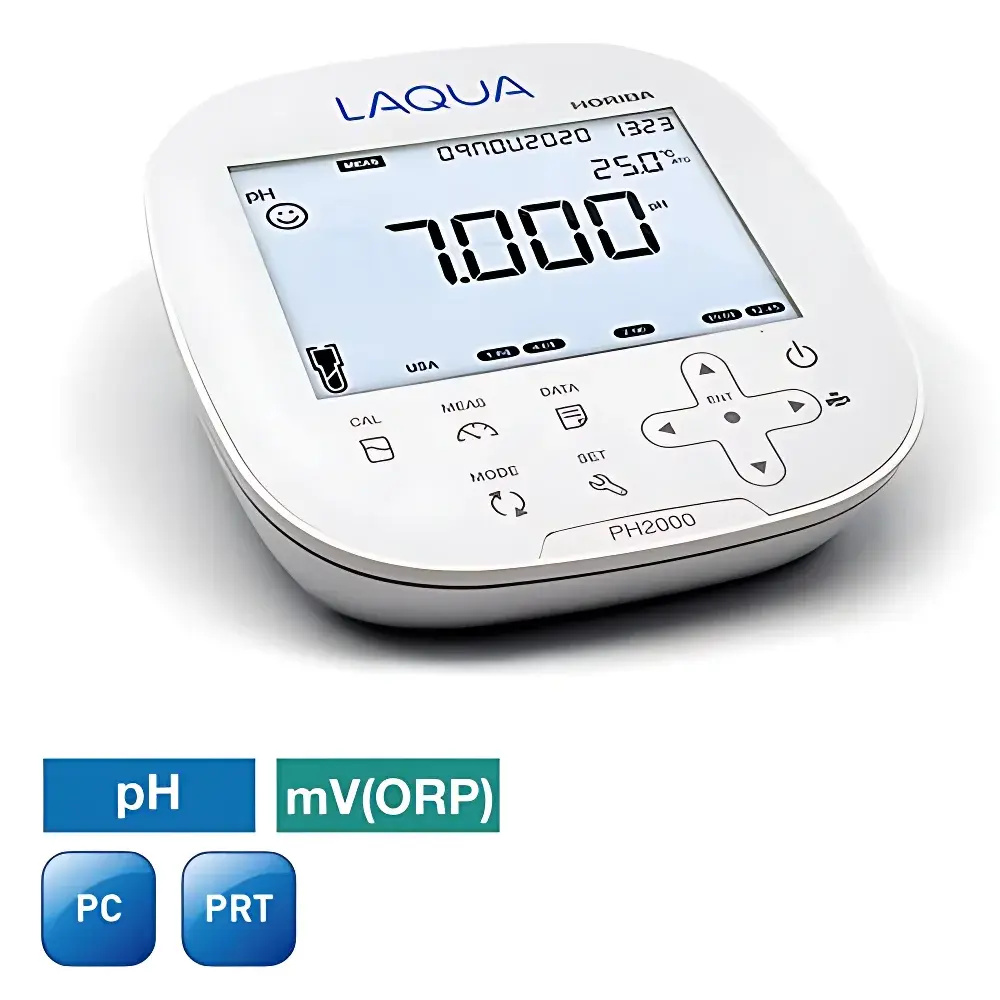
HORIBA LAQUA PH2000 Benchtop pH/ORP/Temperature Meter
| Brand | HORIBA |
|---|---|
| Origin | Japan |
| Model | PH2000 |
| Instrument Type | Laboratory Water Quality Analyzer |
| Measured Parameters | pH, ORP, Temperature (°C/°F) |
| pH Range | −2.000 to 20.000 |
| pH Resolution | 0.1 / 0.01 / 0.001 |
| pH Accuracy | ±0.003 |
| pH Calibration Buffers | USA, NIST, NIST2, DIN, Custom |
| Max Calibration Points | 5 (USA/NIST/NIST2), 6 (DIN/Custom) |
| ORP Range | ±2000.0 mV |
| ORP Resolution | 0.1 mV |
| ORP Accuracy | ±0.2 mV |
| Temperature Range | −30.0 to 130.0 °C |
| Temperature Resolution | 0.1 °C/°F |
| Temperature Accuracy | ±0.5 °C / ±0.9 °F |
| Memory Capacity | 2000 data points |
| Data Logging | Automatic with timestamp |
| Real-time Clock | Integrated |
| Measurement Modes | Auto-Stable, Auto-Hold, Real-Time |
| Electrode Status Indicator | On-screen |
| Diagnostic Functions | Built-in |
| Password Protection | Configurable |
| Communication Interfaces | BNC, Phono (ATC), DC sockets, USB/RS-232C via phono jack |
| Display | 5" custom LCD with backlight (320 segments) |
| Power Supply | AC adapter (100–240 V, 50–60 Hz) |
| Dimensions | 155 × 150 × 67 mm |
| Weight | 765 g |
Overview
The HORIBA LAQUA PH2000 is a high-precision benchtop meter engineered for rigorous laboratory-based water quality analysis. Designed around electrochemical potentiometric measurement principles, it delivers trace-level accuracy in pH, oxidation-reduction potential (ORP), and temperature determination—core parameters required for environmental monitoring, wastewater treatment validation, pharmaceutical process water qualification, and academic research. Its architecture adheres to fundamental metrological requirements defined in ISO 7888 (water quality — determination of pH), ASTM D1293 (standard test method for pH of water), and USP (pH measurement). The instrument operates on a stable, low-drift analog-to-digital conversion platform with active electrode impedance compensation, ensuring reliable readings across diverse sample matrices—including low-conductivity ultrapure water, high-ionic-strength industrial effluents, and buffered biological media.
Key Features
- Triple-parameter measurement capability: simultaneous, independent acquisition of pH, ORP (mV), and temperature with full cross-compensation logic.
- Multi-resolution pH display (0.1 / 0.01 / 0.001) selectable per application need—enabling both rapid field screening and GLP-compliant analytical reporting.
- Five- or six-point calibration support across internationally recognized buffer standards (NIST, DIN, USA, and user-defined), with slope and offset diagnostics embedded in every calibration cycle.
- Advanced electrode health monitoring: real-time impedance estimation, asymmetry potential tracking, and response time evaluation—all visualized directly on the LCD interface.
- Programmable auto-calibration alerts (up to 90 days) and configurable auto-power-off (1–30 minutes), supporting unattended operation in regulated environments.
- Integrated real-time clock with ISO 8601-compliant timestamping for all logged entries—critical for audit readiness under FDA 21 CFR Part 11 and ISO/IEC 17025 requirements.
- Rugged mechanical design: compact footprint (155 × 150 × 67 mm), shock-absorbing housing, and EMI-shielded signal paths compliant with IEC 61326-1 for electromagnetic compatibility in shared lab spaces.
Sample Compatibility & Compliance
The PH2000 accommodates standard glass-body combination electrodes (BNC connector) and optional ATC (Automatic Temperature Compensation) probes via dedicated phono input. It supports measurements in aqueous solutions with conductivity ranging from 1 µS/cm (e.g., deionized water post-purification) to >200 mS/cm (e.g., seawater or brine). Electrode compatibility includes double-junction, gel-filled, and refillable reference systems—facilitating compliance with EPA Method 150.1 (pH measurement in surface water) and ISO 10523 (water quality — determination of pH). All firmware and calibration routines are validated against NIST-traceable reference materials, and the device meets CE marking requirements under the EU’s Electromagnetic Compatibility Directive and Low Voltage Directive.
Software & Data Management
Data export and remote control are enabled via USB or RS-232C communication (using standardized SCPI command syntax), allowing seamless integration into LIMS or ELN platforms. The 2000-point internal memory stores values with full metadata: date/time stamp, measurement mode, electrode ID (user-assigned), calibration history ID, and environmental conditions. Exported CSV files include column headers compatible with Excel, MATLAB, and statistical process control (SPC) software. Audit trail functionality records operator login events, calibration modifications, and configuration changes—supporting GxP-aligned documentation practices. Firmware updates are performed via USB mass storage mode, with SHA-256 checksum verification to ensure integrity.
Applications
- Regulatory environmental testing: compliance monitoring of influent/effluent pH per NPDES permits and EU Water Framework Directive Annex V protocols.
- Pharmaceutical water systems: routine qualification of Purified Water (PW) and Water for Injection (WFI) per USP and EP 2.2.3.
- Academic hydrochemistry: kinetic studies of acid-base equilibria, redox titrations, and carbonate system modeling in freshwater and marine systems.
- Food & beverage QC labs: batch verification of rinse water pH in CIP validation and final product stability testing.
- Calibration laboratory services: as a reference standard transfer instrument for secondary pH standardization per ISO/IEC 17025 Clause 6.5.
FAQ
Does the PH2000 support GLP-compliant data handling?
Yes—it provides password-protected user accounts, electronic signatures (via operator ID entry), immutable timestamped logs, and full audit trail recording of all critical events.
Can it measure pH in non-aqueous or low-ionic-strength samples?
It is optimized for aqueous solutions; for solvents like ethanol or methanol, use a specialized non-aqueous electrode and apply manual temperature correction—consult HORIBA Technical Bulletin TB-LAQUA-04 for guidance.
Is the instrument compatible with FDA 21 CFR Part 11 requirements?
While the PH2000 itself does not provide digital signature or biometric authentication, its data integrity features (checksummed logs, time-stamped exports, and change history) form the foundational layer required for Part 11 compliance when deployed within a validated IT infrastructure.
What maintenance intervals are recommended for long-term accuracy?
We recommend quarterly verification using NIST-traceable buffer standards and annual factory recalibration—documented per ISO/IEC 17025 calibration certificate.
How is temperature compensation applied during pH measurement?
The PH2000 implements dual-slope Nernstian compensation: automatic correction based on measured temperature and configurable reference temperature (25°C default), with optional manual override for non-standard reference conditions.







