
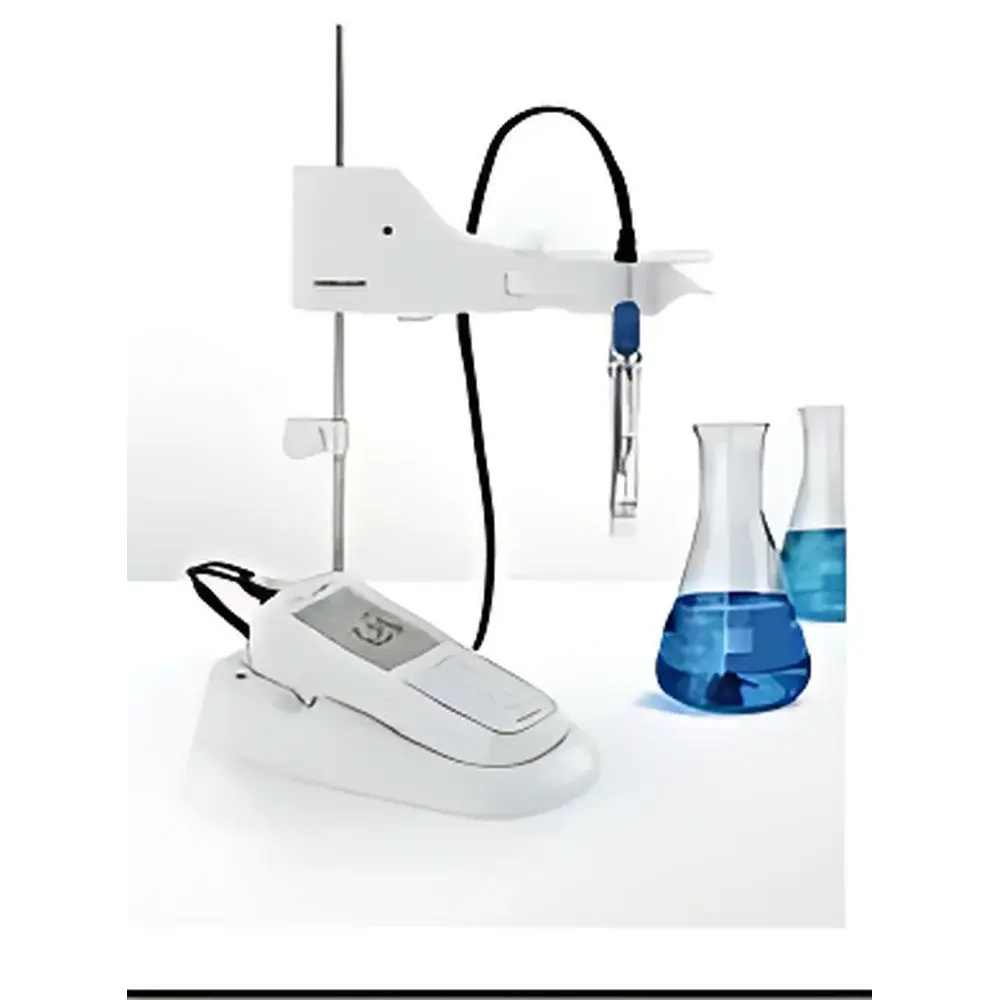
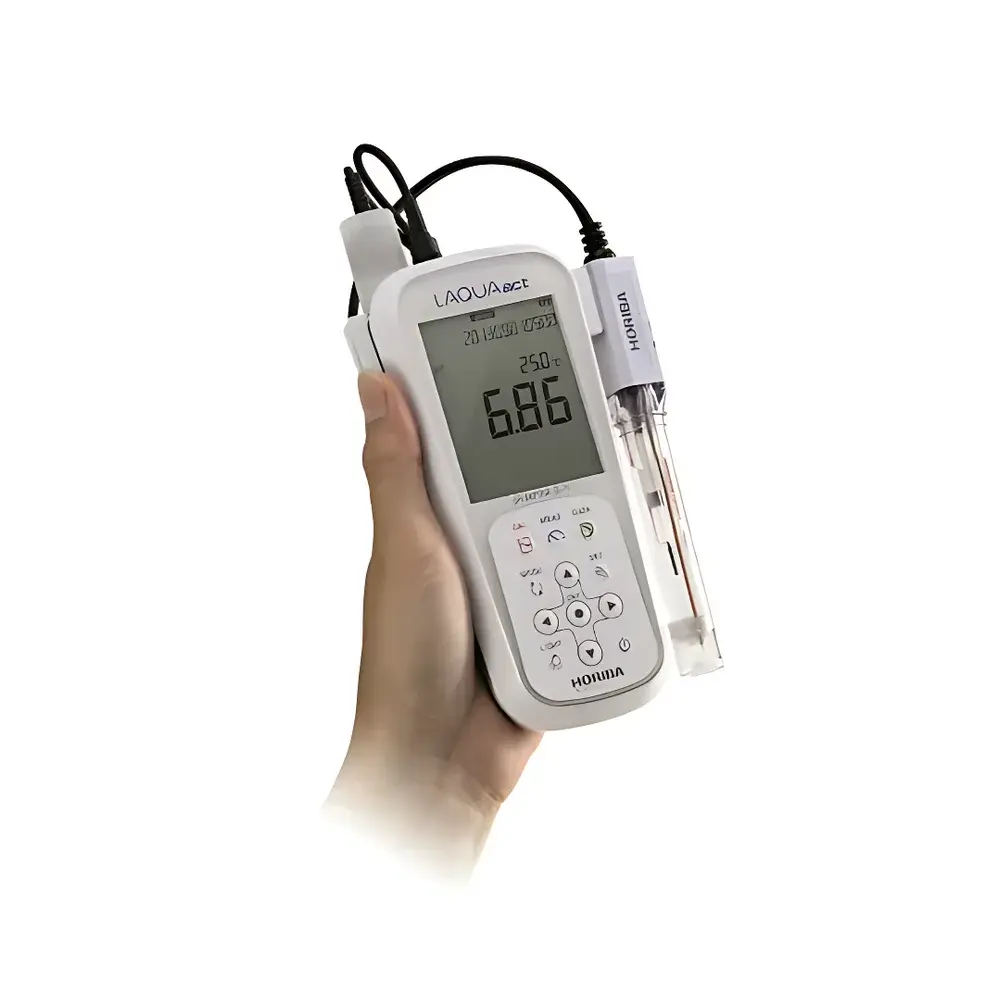
HORIBA LAQUAact D-70 Portable Multi-Parameter Water Quality Analyzer
| Brand | HORIBA |
|---|---|
| Origin | Japan |
| Model | LAQUAact D-70 |
| Instrument Type | Portable / Handheld Water Quality Analyzer |
| Measuring Parameters | pH, mV (ORP), Ion Concentration, Conductivity, Resistivity, Salinity, TDS, Dissolved Oxygen (DO), Saturation DO, % Oxygen |
| pH Range | 0.00–14.00 (Display: −2.00–16.00) |
| pH Accuracy | ±0.01 pH |
| pH Repeatability | ±0.01 pH ±1 digit |
| mV Range | −2000–+2000 mV |
| mV Accuracy | ±1 mV |
| Temperature Range | 0.0–100.0 °C (Display: −30.0–130.0 °C) |
| Temp. Accuracy | ±0.1 °C |
| Conductivity Range | 0.0 μS/m–200.0 S/m |
| Conductivity Accuracy | ±0.05% FS |
| DO Range | 0.00–20.00 mg/L |
| DO Accuracy | ±0.01 mg/L |
| DO Repeatability | ±0.1 mg/L ±1 digit |
| IP Rating | IP67 |
| Data Storage | 1000 measurements with timestamp, ID, and parameter metadata |
| Communication | USB interface compliant with GLP/GMP data integrity requirements |
| Power | 2× AAA alkaline or Ni-MH rechargeable batteries (≈1000 h operation) |
| Dimensions | 67 × 28 × 170 mm (W×D×H, max thickness 80 mm) |
| Weight | ≈270 g (without batteries) |
Overview
The HORIBA LAQUAact D-70 is a rugged, field-deployable multi-parameter water quality analyzer engineered for high-reliability environmental monitoring in both laboratory and uncontrolled outdoor settings. Built upon the proven architecture of the LAQUAact D-50 platform, the D-70 integrates dual-channel real-time display, enhanced mechanical robustness—including shock-absorbing polymer housing and IP67-rated ingress protection—and an optimized ergonomic form factor for single-hand operation. Its measurement engine employs standardized electrochemical principles: potentiometric glass electrode detection for pH and ORP; ion-selective electrode (ISE) methodology for monovalent and multivalent ion quantification; AC two-electrode conductivity measurement with automatic temperature compensation to 25 °C; galvanic membrane-based amperometric detection for dissolved oxygen (DO); and derived calculations for salinity, resistivity, and total dissolved solids (TDS). Designed for regulatory compliance workflows, the instrument supports traceable calibration logging, audit-ready timestamped data capture, and full alignment with ISO 5667 (water sampling), ASTM D1293 (pH), ASTM D3223 (DO), and ASTM D1125 (conductivity) test protocols.
Key Features
- Dual-parameter simultaneous display on high-contrast backlit LCD—enabling concurrent viewing of pH/mV, DO/conductivity, or any paired parameter combination without menu navigation.
- IP67-certified enclosure ensuring dust-tight operation and submersion resistance up to 1 m for 30 minutes—validated per IEC 60529 for deployment in rain, splashing, or temporary immersion scenarios.
- Five-point auto-identification pH calibration with programmable buffer recognition (NIST and USA standards), alarm-triggered periodic recalibration reminders, and non-volatile memory retention of calibration history.
- Integrated galvanic DO sensor with built-in temperature compensation (0–40 °C), salinity correction (0–40 ppt), and barometric pressure adjustment—eliminating manual correction factors during field surveys.
- Conductivity measurement with selectable SI units (S/m, mS/cm) or legacy units (μS/cm, mS/cm), automatic linearization, and configurable cell constant (K = 0.1, 1.0, 10.0 cm⁻¹).
- Onboard data management supporting 1000 measurement records, each stamped with date/time, operator ID, sample ID, and full parameter set—exportable via USB to CSV or proprietary .lqd format for LIMS integration.
- Self-diagnostic system continuously monitors electrode impedance, reference junction status, and sensor response time—flagging drift or contamination prior to measurement error accumulation.
Sample Compatibility & Compliance
The LAQUAact D-70 is validated for use with natural waters (freshwater, estuarine, wastewater effluent), process streams, aquaculture systems, and drinking water distribution networks. Its electrode suite accommodates turbid, low-ionic-strength, or high-suspended-solids matrices without flow-cell dependency. All measurement modes comply with GLP (Good Laboratory Practice) and GMP (Good Manufacturing Practice) documentation requirements: calibration events are immutably logged with user ID, timestamp, buffer lot numbers, and slope/asymmetry values; measurement records include environmental metadata (ambient temperature, battery voltage, sensor serials); and firmware enforces 21 CFR Part 11–compatible electronic signatures when paired with HORIBA’s optional LAQUA Software Suite. The device meets CE marking directives (2014/30/EU EMC, 2011/65/EU RoHS), and its battery-powered operation ensures intrinsic safety in Class I, Division 2 hazardous locations per UL 913.
Software & Data Management
Data export occurs via micro-USB 2.0 interface using vendor-agnostic CDC ACM class drivers—no proprietary dongles or runtime installations required. The included LAQUA PC Software enables batch calibration report generation (PDF/CSV), trend visualization across multiple parameters, statistical summary (mean, SD, CV%), and deviation flagging against user-defined action limits. Audit trails record all configuration changes, including unit switches, temperature compensation toggles, and calibration overrides—with immutable timestamps and operator authentication. For regulated environments, optional software modules provide 21 CFR Part 11 compliance: electronic signature enforcement, role-based access control (admin/operator/viewer), and encrypted database archiving with SHA-256 hash verification. Raw data files retain native resolution (e.g., pH to 0.001 resolution internally, displayed at 0.01), preserving metrological traceability from acquisition to reporting.
Applications
- Regulatory field monitoring under EPA Method 150.1 (pH), 365.1 (phosphate ISE), and 365.3 (nitrate ISE); Environment Agency (UK) EA-SOP-02-02 for surface water DO profiling.
- Wastewater treatment plant (WWTP) process control—real-time tracking of nitrification/denitrification zones via combined pH/DO trends and oxidation-reduction potential (ORP) thresholds.
- Aquaculture health management—simultaneous DO saturation % and conductivity-derived salinity mapping across pond arrays to optimize aeration and feeding schedules.
- Drinking water quality verification at point-of-use (POU) and distribution nodes—compliance checks against WHO Guidelines for Drinking-water Quality (GDWQ) and EU Directive 98/83/EC parametric limits.
- Academic and research field campaigns—long-duration autonomous logging (via optional interval mode) for diurnal DO/pH cycling studies in wetlands or riverine ecosystems.
FAQ
Does the D-70 support automatic temperature compensation for all measured parameters?
Yes—pH, ORP, conductivity, resistivity, salinity, TDS, and DO measurements apply automatic temperature compensation using the integrated NTC thermistor (±0.1 °C accuracy). User may override to manual temperature input where ambient probe conditions differ from sample temperature.
Can the instrument store calibration data separately for multiple electrodes?
Yes—each electrode type (pH, DO, conductivity, ISE) maintains independent calibration history, including date, buffer/solution IDs, slope, offset, and stability metrics—accessible via the Calibration Log menu.
Is the USB interface compatible with modern Windows/macOS/Linux systems without driver installation?
Yes—the D-70 enumerates as a standard CDC ACM serial device; no additional drivers are required beyond native OS support for virtual COM ports.
What is the expected service life of the galvanic DO sensor under typical field use?
With proper storage (wet cap with electrolyte solution) and quarterly zero/span verification, the factory-installed DO sensor maintains specification accuracy for ≥12 months in freshwater applications and ≥6 months in high-salinity or organic-rich matrices.
How does the instrument handle measurement in low-conductivity ultrapure water?
The D-70’s conductivity module applies a low-frequency AC excitation signal and adaptive gain control to minimize polarization errors; however, for resistivity >1 MΩ·m, users should select the K=0.1 cm⁻¹ cell option and enable “Ultra-Pure Water” mode to suppress stray capacitance artifacts.







