
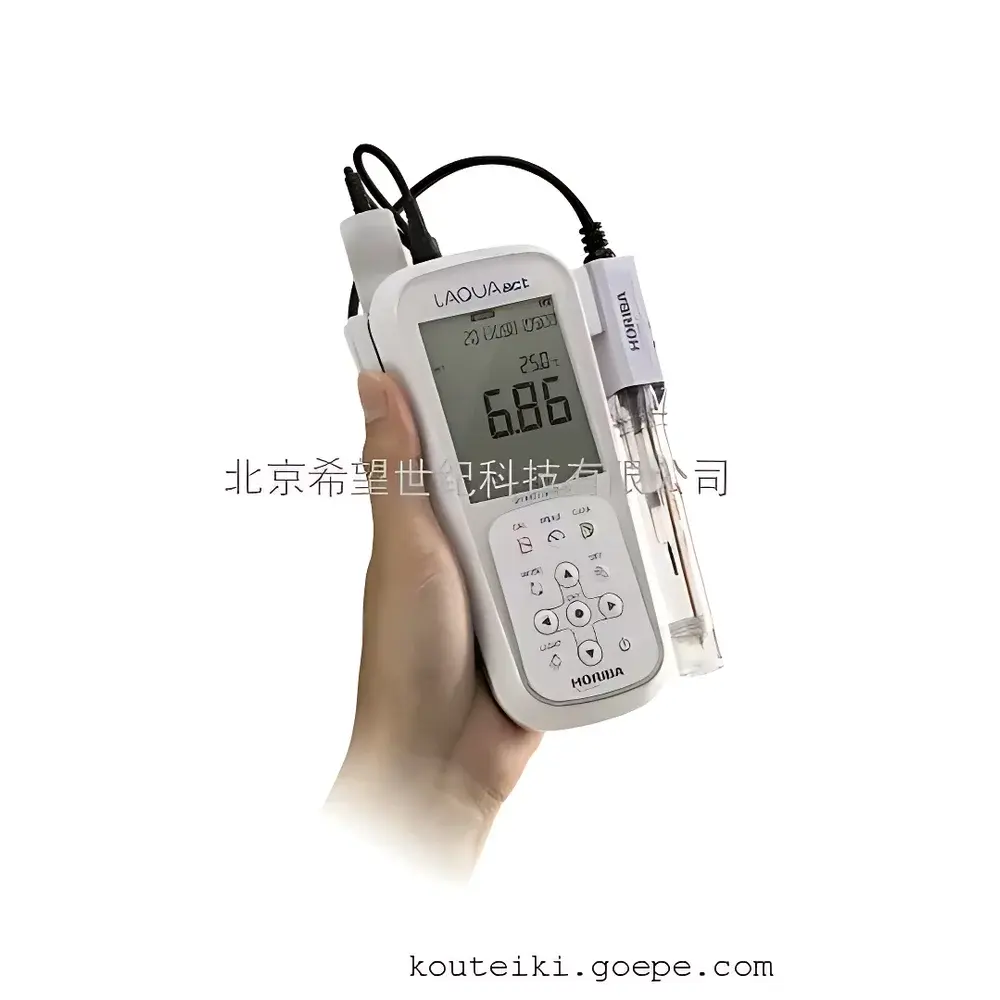
HORIBA LAQUAact D-70 Series Portable Multi-parameter Water Quality Analyzer
| Brand | HORIBA |
|---|---|
| Origin | Japan |
| Model | D-70 |
| Instrument Type | Portable / Handheld Water Quality Analyzer |
| Measurable Parameters | pH, mV (ORP), Ion Concentration, Conductivity, Resistivity, Salinity, Total Dissolved Solids (TDS), Dissolved Oxygen (DO) |
| Display | Backlit LCD with Capacitive Touchscreen |
| Protection Rating | IP67 (Instrument and Electrodes) |
| Data Storage | 1,000 measurement records |
| Power Supply | AAA alkaline batteries, Ni-MH rechargeable batteries, or AC adapter |
| Calibration Support | Auto-calibration prompts, 5-point pH calibration, NIST/USA standard compatibility, automatic temperature compensation (pH, conductivity, DO), pressure & salinity compensation (DO) |
| Compliance | JIS Z 8401 (pH), JIS K 0101 (conductivity), ISO 7888 (conductivity), ASTM D1125 (conductivity), USP <645> (water resistivity for pharmaceutical use) |
Overview
The HORIBA LAQUAact D-70 Series is a rugged, field-deployable multi-parameter water quality analyzer engineered for high-reliability measurements across diverse environmental, industrial, and regulatory applications. Based on electrochemical sensing principles—including potentiometric pH/ORP detection, four-electrode conductivity measurement, galvanic or optical dissolved oxygen sensing, and ion-selective electrode (ISE) methodology—the D-70 delivers traceable, repeatable data under variable ambient conditions. Its modular architecture supports interchangeable sensor modules (e.g., pH/DO combo probes, conductivity/TDS cells), enabling configuration-specific deployment without hardware replacement. Designed in accordance with Japanese Industrial Standards (JIS) and aligned with international metrological frameworks—including ASTM D1125 for conductivity and USP for purified water resistivity—the D-70 meets foundational requirements for routine monitoring, compliance verification, and GLP-aligned field studies.
Key Features
- Rugged IP67-rated housing and electrodes—tested for submersion up to 1 m for 30 minutes and resistant to alcohol, chlorine, and common laboratory solvents
- Capacitive touchscreen interface with anti-fingerprint, chemically strengthened glass display—optimized for gloved operation and outdoor visibility
- Dual-channel simultaneous measurement and real-time overlay display (e.g., pH + DO; conductivity + TDS)
- Intelligent electrode diagnostics—quantifies response slope, offset, and stability post-calibration, with pass/fail status indicators per parameter
- Automated calibration management: scheduled reminders, 5-point pH calibration support, auto-recognition of NIST and USA traceable buffers
- Integrated environmental compensation: automatic temperature correction (pH, conductivity, DO), barometric pressure adjustment (DO), and salinity compensation (DO)
- Onboard clock with timestamped logging, user-defined sample ID tagging, and configurable interval measurement (D-71 variant excluded)
Sample Compatibility & Compliance
The D-70 series accommodates aqueous samples ranging from ultrapure water (resistivity >18.2 MΩ·cm) to high-salinity seawater (up to 45 ppt), wastewater effluents, cooling tower fluids, and potable distribution systems. Sensor configurations comply with ISO 5667-3 for sampling preservation and ASTM D3370 for field measurement integrity. The pH module conforms to JIS Z 8401 Class 1 accuracy (±0.01 pH unit), while the conductivity cell satisfies ISO 7888 repeatability criteria (<0.5% RSD). For pharmaceutical water systems, the resistivity mode supports audit-ready reporting compliant with EU GMP Annex 1 and FDA CGMP 21 CFR Part 211. All firmware and data handling routines are structured to support ALCOA+ data integrity principles.
Software & Data Management
Data export is supported via USB-C connection to Windows/macOS platforms using HORIBA’s LAQUA Connect PC software—enabling CSV export, graphical trend analysis, and PDF report generation with embedded metadata (operator ID, location tag, calibration history). The onboard memory retains 1,000 timestamped records with full parameter sets, including raw mV, compensated values, and diagnostic flags. Audit trail functionality logs all critical events: calibration actions, probe swaps, configuration changes, and power cycles—meeting FDA 21 CFR Part 11 requirements when used with validated software and electronic signature protocols. No cloud dependency; all processing occurs locally to ensure data sovereignty and network-resilient operation.
Applications
- Environmental field surveys: stream health assessment, wetland monitoring, and stormwater runoff characterization
- Drinking water distribution: residual disinfectant tracking (via ORP), source-to-tap conductivity profiling, and leak-induced salinity intrusion detection
- Industrial process control: boiler feedwater resistivity verification, electroplating bath monitoring (pH + metal ion ISE), and cooling system corrosion potential (ORP)
- Academic and research settings: limnology studies requiring synchronized DO/pH kinetics, sediment porewater profiling with miniaturized probes
- Regulatory compliance: EPA Method 150.1 (conductivity), APHA 4500-H+ B (pH), and ISO 5814 (electrochemical DO) execution support
FAQ
Does the D-70 support Good Laboratory Practice (GLP) documentation requirements?
Yes—the instrument logs calibration dates, buffer IDs, electrode serial numbers, and operator inputs with immutable timestamps. When paired with LAQUA Connect and controlled access protocols, it satisfies core GLP data traceability mandates.
Can the D-70 perform simultaneous pH and dissolved oxygen measurements with temperature compensation?
Yes—dual-channel capability allows concurrent pH and DO acquisition, with automatic temperature compensation applied independently per sensor based on integrated thermistor readings.
Is the D-70 certified for use in hazardous locations?
No—the D-70 is not intrinsically safe or ATEX/IECEx certified. It is intended for general-purpose environmental and laboratory use outside classified hazardous zones.
What electrode maintenance routines are recommended for long-term field deployment?
HORIBA recommends weekly cleaning with mild detergent and deionized water, monthly storage in appropriate electrolyte solution (e.g., 3 M KCl for pH), and quarterly verification against certified reference materials per ISO/IEC 17025 internal quality control guidelines.
How does the D-70 handle data integrity during battery replacement?
All measurement data and configuration settings are retained in non-volatile memory; no data loss occurs during battery swap or AC adapter transition.
Related Products







