
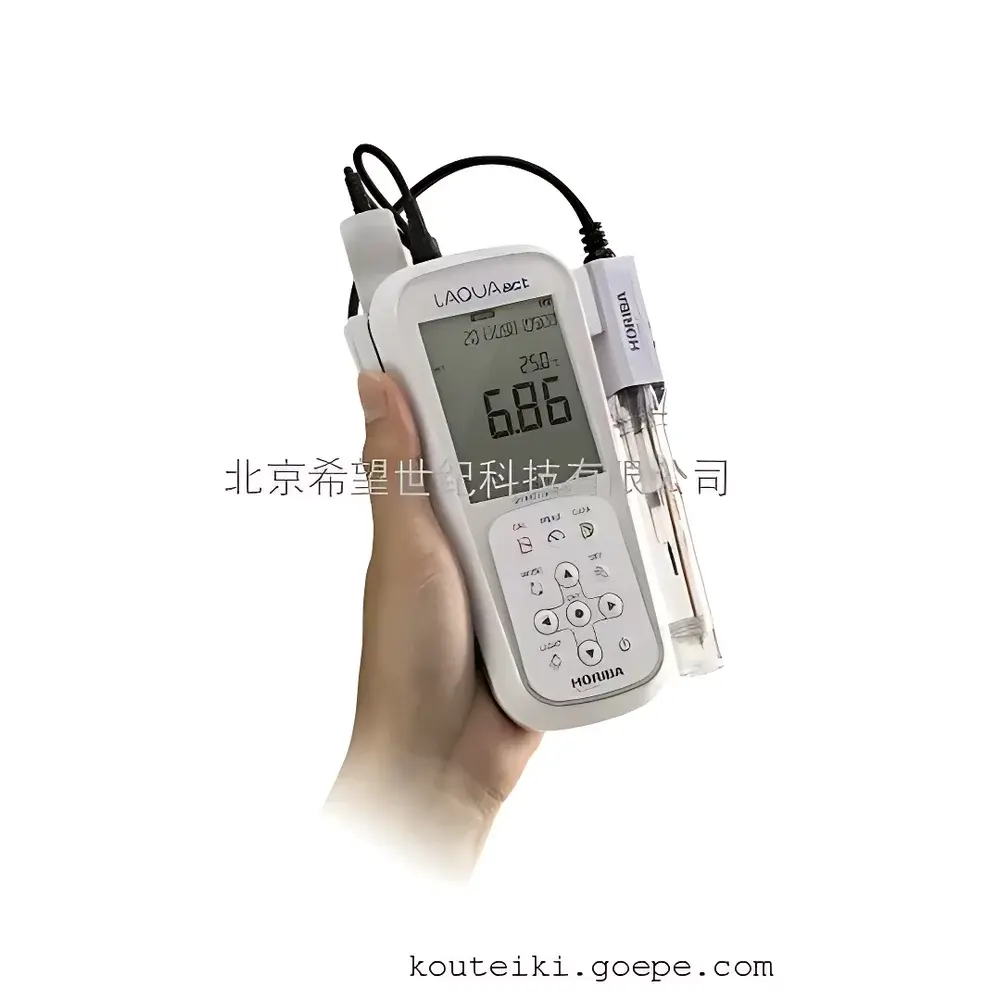
HORIBA LAQUAact D-71 Portable pH Meter
| Brand | HORIBA |
|---|---|
| Origin | Japan |
| Model | D-71 |
| Instrument Type | Portable pH Meter |
| Parameter Type | Single-parameter (pH) |
| Measurement Range | 0.00–14.00 pH |
| Resolution | 0.01 pH |
| Accuracy | ±0.01 pH ±1 digit |
| Repeatability | ±0.01 pH ±1 digit |
| Calibration Solutions | pH 4.01, 7.00, 9.18 (USA/NIST traceable) |
| Temperature Compensation | Automatic & Manual (0.0–100.0 °C, resolution 0.1 °C, accuracy ±0.1 °C ±1 digit) |
| Display | Backlit monochrome LCD |
| Data Storage | 1000 measurement records with timestamp, ID, and temperature |
| Environmental Rating | IP67 (dust-tight and submersible up to 1 m for 30 min) |
| Power Supply | 2 × AAA alkaline or Ni-MH batteries (battery life ≈ 1000 h) |
| Operating Conditions | 0–45 °C, ≤80% RH (non-condensing) |
| Dimensions | 67 × 28 × 170 mm (W × D × H, max thickness 80 mm) |
| Weight | 270 g (without batteries) |
| Compliance | GLP/GMP-ready data logging, audit trail support via PC software, conforms to ISO/IEC 17025 calibration traceability requirements for field-deployable electrochemical instrumentation |
Overview
The HORIBA LAQUAact D-71 is a rugged, field-grade portable pH meter engineered for high-reliability single-parameter pH measurement in environmental monitoring, wastewater treatment, aquaculture, education, and industrial process verification. It employs the conventional glass electrode potentiometric method—compliant with ASTM D1293 and ISO 10523—where pH is determined by measuring the potential difference between a pH-sensitive glass membrane electrode and a stable reference electrode (Ag/AgCl), converted to pH units via the Nernst equation. The D-71 integrates temperature-compensated slope calculation using an integrated thermistor (0.0–100.0 °C range), ensuring accurate readings across diverse sample matrices without manual correction. Its compact, IP67-rated housing—constructed from chemical-resistant, alcohol-tolerant polymer—enables operation in humid, dusty, or splash-prone environments, including riverbanks, effluent discharge points, and production floors. Unlike benchtop systems, the D-71 delivers laboratory-grade precision (±0.01 pH ±1 digit) in a handheld format optimized for rapid deployment and repeatable field use.
Key Features
- Rugged IP67 enclosure certified for dust ingress protection and temporary water immersion (1 m / 30 min), validated per IEC 60529
- High-contrast backlit monochrome LCD with large numeric display and intuitive icon-driven interface
- Automatic temperature compensation (ATC) with built-in thermistor; manual override available for non-aqueous or high-viscosity samples
- Smart calibration assistant: real-time electrode response evaluation, slope % and offset diagnostics, and buffer recognition for pH 4.01, 7.00, and 9.18 standards (USA/NIST-traceable)
- GLP-compliant data management: 1000-stored measurements with date/time stamp, user ID, temperature, and calibration history
- Auto-hold function with stability detection (±0.01 pH for 3 sec) to capture stable endpoints without operator intervention
- Low-power architecture: 1000-hour battery life on two AAA alkaline cells; compatible with rechargeable Ni-MH cells and optional AC adapter (100–240 V, 50/60 Hz)
- Auto-power-off with battery-level indicator and customizable timeout settings (1–60 min)
Sample Compatibility & Compliance
The D-71 is validated for aqueous solutions within pH 0.00–14.00 and conductivity 5%), it meets ISO 5725-2 repeatability criteria for field instruments and supports traceable calibration per ISO/IEC 17025 when used with accredited buffer standards. Its data logging structure—including unique ID assignment, time/date stamping, and calibration event logging—aligns with GLP (21 CFR Part 58) and GMP (21 CFR Part 211) documentation expectations for quality-controlled environmental testing.
Software & Data Management
Measurements are exportable via USB connection to Windows-based LAQUA Software (v3.x or later), enabling CSV/Excel report generation, trend visualization, and audit trail review. The software enforces electronic signature capability, session locking, and change history tracking—fully compliant with FDA 21 CFR Part 11 requirements for electronic records and signatures. All stored entries include metadata: measurement ID, operator code, calibration status (slope %, offset mV), ambient temperature, and timestamp. No cloud upload or remote connectivity is embedded; data integrity is preserved through local, encrypted file transfer only—critical for regulated laboratories handling sensitive environmental or compliance data.
Applications
- Field-based water quality assessment: surface water, groundwater, wastewater influent/effluent, stormwater runoff
- Aquaculture and hydroponic system monitoring: pH stability tracking across diurnal cycles
- Educational labs: student experiments requiring robust, low-maintenance instrumentation
- Food & beverage pre-process verification: rinse water, cleaning solution titration support
- Environmental consulting: EPA Method 150.1-compliant pH screening during site investigations
- Pharmaceutical facility utility monitoring: purified water (PW) and water-for-injection (WFI) system spot checks per USP
FAQ
Does the D-71 support multi-point calibration?
Yes—it accepts up to three-point calibration (pH 4.01, 7.00, 9.18) with automatic buffer identification and slope/offset validation.
Is temperature measurement mandatory for pH readings?
No—manual temperature entry is supported, but ATC is strongly recommended to minimize systematic error in variable-temperature field conditions.
Can the D-71 store calibration data separately from measurement records?
Yes—each calibration event is timestamped and retained independently in device memory, accessible via LAQUA Software or on-device menu navigation.
What electrode types are compatible with the D-71?
It uses standard BNC connectors and is validated with HORIBA’s 9615S-10D combination pH electrode; other industry-standard gel-filled or refillable electrodes may be used but require performance verification.
Is the D-71 certified for hazardous locations?
No—it is not intrinsically safe or ATEX/IECEx rated; use is restricted to non-classified environments per IEC 60079-0.




