
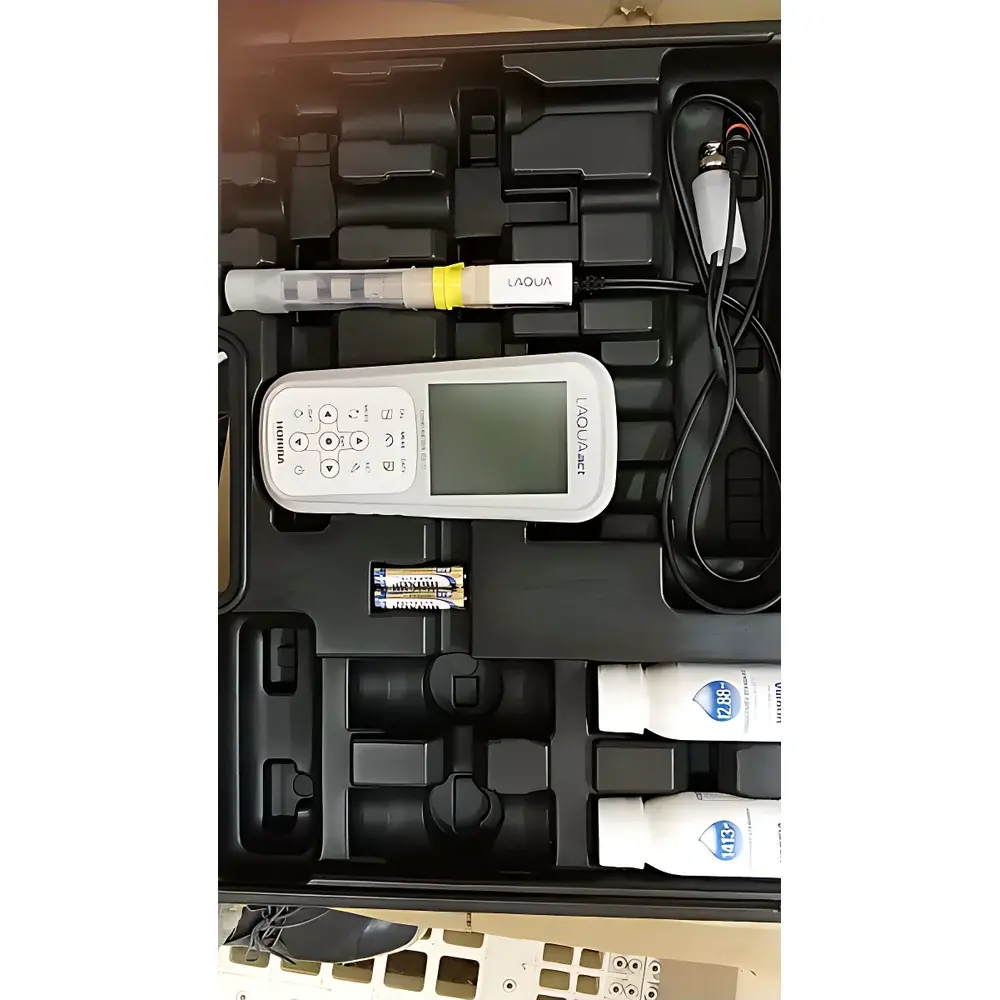
HORIBA LAQUAact ES-71 Portable Multiparameter Conductivity Meter
| Brand | HORIBA |
|---|---|
| Origin | Japan |
| Model | ES-71 |
| Portability | Portable |
| Conductivity Measurement Range | 0.0 μS/m – 200.0 S/m |
| TDS Range | 0.01 mg/L – 100 g/L |
| Resistivity Range | 0.000 Ω·m – 2.000 mΩ·m |
| Salinity Range | 0.00–4.00% (0.0–40.0 ppt) |
| Temperature Range | 0.0–100.0 °C (display), −30–130 °C (operational) |
| Accuracy | ±0.05% F.S. (conductivity, resistivity, salinity, TDS) |
| Temperature Accuracy | ±0.1 °C |
| Resolution | 0.01% F.S. |
| Repeatability | ±0.5% F.S. ±1 digit |
| Temperature Compensation | Automatic (25 °C reference) & Manual |
| IP Rating | IP67 |
| Data Storage | 1000 measurements with timestamp, ID, and temperature |
| Interface | USB for PC connectivity (GLP/GMP-compliant data export) |
| Power | 2× AAA alkaline or Ni-MH batteries (≈1000 h battery life) |
Overview
The HORIBA LAQUAact ES-71 is a rugged, handheld multiparameter meter engineered for field-deployable and laboratory-grade measurement of electrical conductivity (EC), total dissolved solids (TDS), resistivity, salinity, and temperature in aqueous samples. Built upon HORIBA’s proven AC two-electrode conductivity measurement principle—minimizing polarization error and electrode fouling—the ES-71 delivers high reproducibility across dynamic environmental and industrial water matrices. Its compact, IP67-rated enclosure ensures reliable operation in humid, dusty, or splash-prone conditions, including wastewater treatment plants, aquaculture sites, river monitoring stations, and food processing facilities. Unlike benchtop alternatives, the ES-71 integrates real-time temperature compensation (based on ASTM D1125 and ISO 7888 conventions), automatic range switching, and SI/legacy unit toggling—enabling consistent compliance with regional reporting requirements without manual recalibration.
Key Features
- IP67-rated housing with chemical-resistant, impact-tolerant polymer body and tempered glass touchscreen interface
- Simultaneous dual-parameter display (e.g., conductivity + temperature; salinity + TDS) with auto-hold stabilization and numeric trend indicators
- Smart electrode diagnostics: real-time response time quantification, calibration status flagging, and drift alerting per IUPAC-recommended electrode validation protocols
- GLP/GMP-ready data management: 1000-entry internal memory with user-definable sample ID, operator code, timestamp, and temperature metadata
- Auto-compensated conductivity-to-salinity/TDS/resistivity conversion using built-in algorithms aligned with USGS and APHA Standard Methods (23rd ed.)
- Battery-efficient architecture: <1 mA standby current; up to 1000 hours of continuous operation on two AAA alkaline cells or rechargeable Ni-MH equivalents
- USB interface supporting CSV export compatible with LIMS integration and FDA 21 CFR Part 11–compliant audit trail generation (when paired with HORIBA’s LAQUA Studio software)
Sample Compatibility & Compliance
The ES-71 is validated for use with natural waters (freshwater, estuarine, seawater), process streams, cooling tower fluids, boiler feedwater, and beverage production rinse solutions. Its AC two-electrode sensor design eliminates electrolysis-induced errors common in DC-based meters, ensuring stable readings in low-conductivity (100 mS/cm) samples. All measurement algorithms adhere to ISO 7888 (conductivity), ISO 5667-3 (sampling preservation), and ASTM D5391 (electrical conductivity of water). The device supports traceable calibration via NIST-traceable KCl standards (e.g., 0.01 mol/kg, 0.1 mol/kg) and includes configurable calibration reminders aligned with ISO/IEC 17025 internal quality control intervals.
Software & Data Management
Data acquisition and reporting are managed through HORIBA’s LAQUA Studio desktop application (Windows only), which enables batch export to CSV or Excel, customizable report templates (including header fields for QA/QC sign-off), and automated generation of calibration certificates. Raw measurement logs include full metrological context: date/time, ambient temperature, electrode serial number, calibration date, and deviation from reference values. Audit trails meet FDA 21 CFR Part 11 requirements when digital signatures and role-based access controls are enabled. For offline environments, the ES-71 supports direct thermal printer output (via optional interface cable) with GLP-compliant headers—including instrument ID, analyst initials, and environmental conditions.
Applications
- Environmental monitoring: rapid assessment of conductivity anomalies indicating contamination events or saltwater intrusion in groundwater wells
- Pharmaceutical water systems: routine verification of purified water (PW) and water for injection (WFI) resistivity per USP and EP 2.2.38
- Aquaculture management: concurrent tracking of salinity and temperature to optimize larval development and feeding cycles
- F&B quality control: TDS verification in brewing liquor, dairy rinse water, and bottled spring water against Codex Alimentarius limits
- Academic fieldwork: student-led watershed studies requiring portable, education-grade instrumentation with intuitive navigation and contextual help prompts
- Industrial pretreatment: screening of influent conductivity prior to reverse osmosis or ion exchange units to prevent membrane scaling
FAQ
Does the ES-71 support multi-point conductivity calibration?
Yes—it accepts up to three-point calibration using certified KCl standard solutions (e.g., 84 μS/cm, 1413 μS/cm, 12.88 mS/cm) with automatic slope and offset calculation.
Can the device store calibration history with timestamps?
Yes—each calibration event is logged internally with date, time, standard used, measured value, and deviation from certified concentration.
Is temperature compensation fixed to 25 °C, or adjustable?
The ES-71 defaults to 25 °C linear compensation but allows manual input of alternative reference temperatures (e.g., 20 °C for UK drinking water compliance).
What electrode types are compatible with the ES-71?
It interfaces with HORIBA’s interchangeable K=0.1, K=1.0, and K=10.0 cell constant electrodes (e.g., 9521-10D, 3551-10D), each auto-recognized via embedded EEPROM chip.
Does the meter comply with ISO/IEC 17025 documentation requirements?
When used with LAQUA Studio and configured calibration logs, it satisfies clause 7.7 (measurement traceability) and clause 7.8.2 (record retention) for accredited testing laboratories.






