
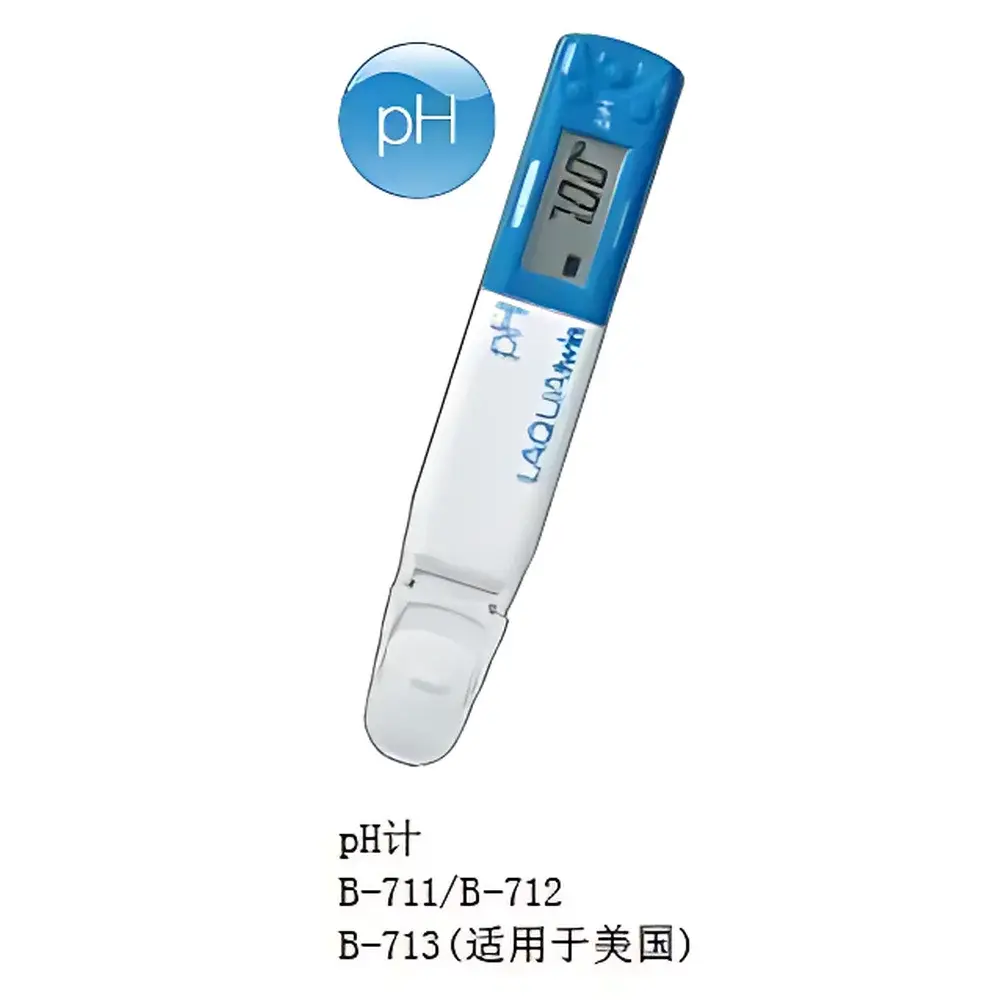
HORIBA LAQUAtwin B-711/B-712 Portable pH Meter
| Brand | HORIBA |
|---|---|
| Origin | Japan |
| Model | B-711 / B-712 |
| Instrument Type | Pen-style pH Meter |
| Parameter Type | Single-parameter (pH) |
| Measurement Range | 2.0–12.0 pH |
| Resolution | 0.1 pH |
| Accuracy | ±0.1 pH (after calibration with standard buffers) |
| Calibration Solutions | pH 4.01, 7.00, and 9.18 buffer solutions |
| Calibration Modes | B-711 — single-point calibration |
| Temperature Compensation | Automatic (ATC), 5–40 °C |
| IP Rating | IP67 (dust-tight and submersible to 1 m for 30 min) |
| Sample Volume | ≥0.05 mL (with optional sampling film B) or ≥0.1 mL (standard) |
| Power Supply | Two CR2032 lithium batteries |
| Dimensions (L×W×H) | 164 × 29 × 20 mm (excluding protrusions) |
| Weight | Approx. 50 g (instrument only, excluding batteries) |
Overview
The HORIBA LAQUAtwin B-711 and B-712 are compact, field-deployable pen-style pH meters engineered for rapid, reliable, and sample-efficient measurements in demanding environments—from aquaculture and hydroponics to food safety screening and educational labs. Unlike conventional glass electrode-based benchtop meters, these instruments utilize a robust planar pH electrode architecture developed from HORIBA’s decades of electrochemical sensor expertise. The measurement principle relies on potentiometric response of a solid-state, miniaturized pH-sensitive membrane against a stable internal reference system—eliminating fragile glass bulbs and enabling consistent performance with minimal sample volume. Designed as direct successors to the B-211/B-212 series, the B-711/B-712 integrate enhanced electronics, improved moisture sealing, and intuitive user feedback (including visual confirmation via smiley icon upon stabilization) to reduce operator dependency and measurement variability. Their lightweight, ergonomic form factor and IP67-rated enclosure support operation in humid, dusty, or splash-prone conditions without compromising metrological integrity.
Key Features
- Planar electrode technology enabling accurate pH measurement from as little as 0.05 mL sample volume—ideal for viscous, particulate-laden, or volume-constrained samples (e.g., fruit pulp, soil extracts, micro-batches)
- One-touch operation: single-button initiation of calibration and measurement; automatic endpoint detection with visual stabilization indicator (smiley icon)
- IP67-certified housing: fully dust-tight and submersible to 1 meter for 30 minutes—validated per IEC 60529—ensuring operational continuity in outdoor, industrial, or mobile laboratory settings
- Integrated automatic temperature compensation (ATC) across 5–40 °C, using a built-in NTC thermistor for real-time correction per NIST-traceable pH/temperature relationships
- Auto-hold function freezes stable readings on-screen, reducing parallax error and supporting documentation under GLP-compliant workflows
- Dual calibration flexibility: B-711 supports single-point calibration at pH 7.00; B-712 allows selection between single-point (pH 7.00) or two-point calibration (e.g., pH 4.01 and 7.00 or 7.00 and 9.18) to optimize accuracy across extended ranges
Sample Compatibility & Compliance
The LAQUAtwin B-711/B-712 accommodates heterogeneous aqueous matrices including wastewater effluents, nutrient solutions, beverage concentrates, and agricultural runoff. For samples containing suspended solids, optional filtration membranes (sold separately) enable particle separation prior to measurement—ensuring electrode surface integrity and minimizing drift. The instrument complies with general requirements for portable electrochemical analyzers outlined in ISO 7888 (water quality — determination of pH) and ASTM D1293 (Standard Test Methods for pH of Water). While not certified for regulated pharmaceutical manufacturing, its design supports routine QC testing aligned with USP guidance for pH measurement validation. Data output is non-GMP but suitable for internal process monitoring where audit trails are maintained manually or via external logging systems.
Software & Data Management
These standalone meters do not interface directly with computers or cloud platforms. All data remain on-device: no memory storage, no Bluetooth/Wi-Fi connectivity, and no proprietary software dependencies. This architecture prioritizes simplicity, battery longevity (>1000 measurements per battery set), and immunity to cybersecurity vulnerabilities—making them appropriate for decentralized deployment across multi-site operations. Users record results manually or photograph the LCD display for traceability. For laboratories requiring electronic records, integration with LIMS or ELN systems is achieved externally via documented SOPs governing manual transcription and reviewer sign-off—fully compatible with FDA 21 CFR Part 11 principles when implemented within controlled documentation practices.
Applications
- Aquaculture and pond management: real-time pH monitoring during feeding cycles or aeration events
- Hydroponic nutrient solution control: rapid verification of pH stability before reservoir replenishment
- Food and beverage QA: spot-checking pH of sauces, dairy products, or fermented items at production line checkpoints
- Environmental field surveys: stream, lake, or wetland pH profiling under variable ambient conditions
- Educational laboratories: introducing core concepts of acid-base chemistry and sensor fundamentals with low-risk, high-reproducibility instrumentation
- Small-scale horticulture: verifying substrate pH in greenhouse propagation trays or compost piles
FAQ
What is the minimum sample volume required for reliable measurement?
A minimum of 0.05 mL is achievable when using the optional sampling film B; otherwise, ≥0.1 mL is recommended for standard operation.
Can the B-711 perform two-point calibration?
No—the B-711 is hardware-limited to single-point calibration at pH 7.00. The B-712 supports both single- and two-point calibration modes via menu selection.
Is the instrument suitable for measuring pH in strongly buffered or high-ionic-strength solutions?
Yes, provided the sample falls within the 2.0–12.0 pH range and temperature remains between 5–40 °C. Electrode response time may increase slightly in viscous media, but accuracy remains within ±0.1 pH post-calibration.
Does the IP67 rating permit underwater use?
No—IP67 certifies resistance to temporary immersion (1 m depth, 30 min), not continuous submersion or active measurement underwater. Operation must occur above liquid level.
How often should calibration be performed?
Calibration is recommended before each measurement session or after exposure to extreme pH values, temperature shifts >5 °C, or physical shock. Daily calibration is advised for regulated applications.






