
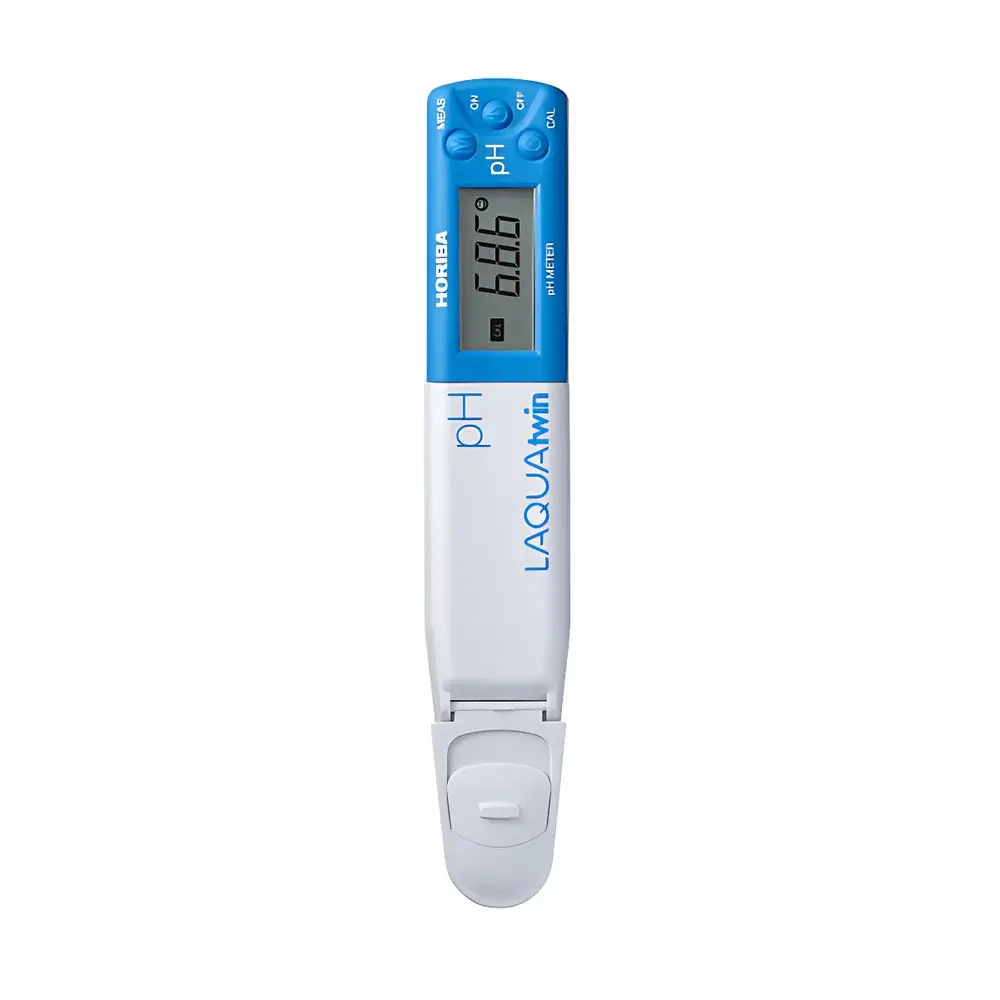
HORIBA LAQUAtwin B-711/B-712 Portable Pocket pH Meter
| Brand | HORIBA |
|---|---|
| Origin | Japan |
| Model | B-711 / B-712 |
| Instrument Type | Pen-style pH Meter |
| Parameter Type | Single-parameter (pH) |
| Measurement Range | 2.0–12.0 pH |
| Resolution | 0.1 pH |
| Accuracy | ±0.1 pH (after calibration with standard buffers) |
| Calibration Solutions | pH 4.01, 7.00, and 9.01 buffer solutions |
| Calibration Modes | B-711 — single-point calibration |
| Minimum Sample Volume | 0.05 mL (with optional sampling film B) or ≥0.1 mL |
| Temperature Compensation | Automatic (NTC thermistor) |
| IP Rating | IP67 (dust-tight |
| Operating Environment | 5–40 °C, ≤85% RH (non-condensing) |
| Power Supply | Two CR2032 lithium coin cells |
| Dimensions (L×W×H) | 164 × 29 × 20 mm (excl. protrusions) |
| Weight | Approx. 50 g (instrument only, excluding batteries) |
Overview
The HORIBA LAQUAtwin B-711 and B-712 are compact, pen-style pH meters engineered for rapid, reliable field and routine laboratory measurements of aqueous solutions. Based on proven glass electrode potentiometry, these instruments utilize HORIBA’s proprietary flat-surface pH electrode architecture—designed to minimize sample volume requirements while maintaining high electrochemical stability and response reproducibility. Unlike conventional combination electrodes requiring immersion in bulk solution, the B-711/B-712 platform achieves accurate pH determination from as little as 0.05 mL of sample when used with the optional sampling film accessory—making it especially suitable for micro-volume applications such as food surface testing, plant sap analysis, small-batch fermentation monitoring, and quality control in pharmaceutical manufacturing environments where material conservation is critical. The devices feature a robust, ergonomic housing rated to IP67, ensuring operational integrity in humid, dusty, or splash-prone settings typical of industrial process lines, agricultural fieldwork, or educational laboratories.
Key Features
- Ultra-low sample requirement: Measures accurately from just one drop (≥0.05 mL with sampling film B; ≥0.1 mL without)
- Intuitive one-button operation: Simplified calibration and measurement sequence with visual feedback (smiley-face icon confirms stable reading)
- Automatic temperature compensation (ATC): Integrated NTC sensor enables real-time correction across 5–40 °C operating range
- Auto-hold function: Freezes display upon signal stabilization, eliminating subjective endpoint judgment
- Dual calibration flexibility: B-711 supports single-point calibration; B-712 supports either single- or two-point calibration using pH 4.01/7.00 or 7.00/9.01 buffers
- IP67-rated enclosure: Fully dust-tight and submersible to 1 m for 30 minutes—meets IEC 60529 requirements for harsh environments
- Long battery life: Powered by two standard CR2032 lithium coin cells (typical service life >1000 measurements)
- Ergonomic, pocket-sized design: 164 mm × 29 mm × 20 mm; weight ≈50 g (instrument only), enabling true handheld portability
Sample Compatibility & Compliance
The LAQUAtwin B-711/B-712 is validated for use with clear, low-turbidity aqueous samples—including drinking water, beverage formulations, nutrient solutions, cosmetic emulsions, and biological extracts. For particulate-laden or viscous samples, HORIBA recommends filtration through a 0.45 µm membrane prior to measurement to prevent electrode fouling and ensure consistent junction potential. The instrument complies with general principles outlined in ISO 10523 (water quality — determination of pH) and ASTM D1293 (standard test method for pH of water). While not certified for GLP or GMP-regulated workflows out-of-the-box, its calibration traceability to NIST-traceable pH standards (e.g., pH 4.01, 7.00, 9.01 at 25 °C), combined with built-in auto-hold and ATC functions, supports data integrity requirements under FDA 21 CFR Part 11 when paired with documented SOPs and audit-trail-enabled recordkeeping practices.
Software & Data Management
The B-711 and B-712 operate as standalone instruments with no onboard data logging or Bluetooth/Wi-Fi connectivity. All measurements are displayed in real time on a high-contrast LCD screen and must be manually recorded. This design prioritizes simplicity, reliability, and regulatory transparency—eliminating firmware dependencies, software validation overhead, or cybersecurity concerns associated with connected instrumentation. For laboratories requiring electronic records, HORIBA recommends integrating these meters into validated paper-based or LIMS-linked manual entry protocols. Calibration history, date/time stamps, and operator IDs should be maintained externally per ISO/IEC 17025 Clause 7.7 (control of records).
Applications
- On-site water quality screening (e.g., aquaculture ponds, irrigation channels, wastewater effluent)
- Food & beverage QA/QC: surface pH of cheeses, fruits, meats; pH of sauces, dressings, and dairy products
- Hydroponics and greenhouse nutrient solution management
- Education: undergraduate chemistry labs, environmental science field courses
- Pharmaceutical excipient verification and cleaning validation rinse water checks
- Small-scale bioprocessing: cell culture media pH spot-checks during inoculation or harvest
FAQ
What is the minimum sample volume required for accurate measurement?
With the optional sampling film B accessory, the B-711/B-712 can measure reliably from 0.05 mL; without it, ≥0.1 mL is recommended.
Can the instrument measure outside the 2.0–12.0 pH range?
No—measurements beyond this range are not supported and may yield non-linear or unstable readings.
Is the electrode replaceable?
Yes—the flat-surface pH sensor is integrated but service-replaceable by authorized HORIBA service centers; end users should not attempt disassembly.
Does the device support GLP-compliant calibration documentation?
It does not generate electronic calibration logs; however, its repeatable ±0.1 pH accuracy and standardized buffer compatibility enable full compliance when manual calibration records follow internal SOPs.
How often should calibration be performed?
Calibration is recommended before each measurement session and whenever ambient temperature changes exceed ±5 °C or after measuring samples with extreme pH values.




