
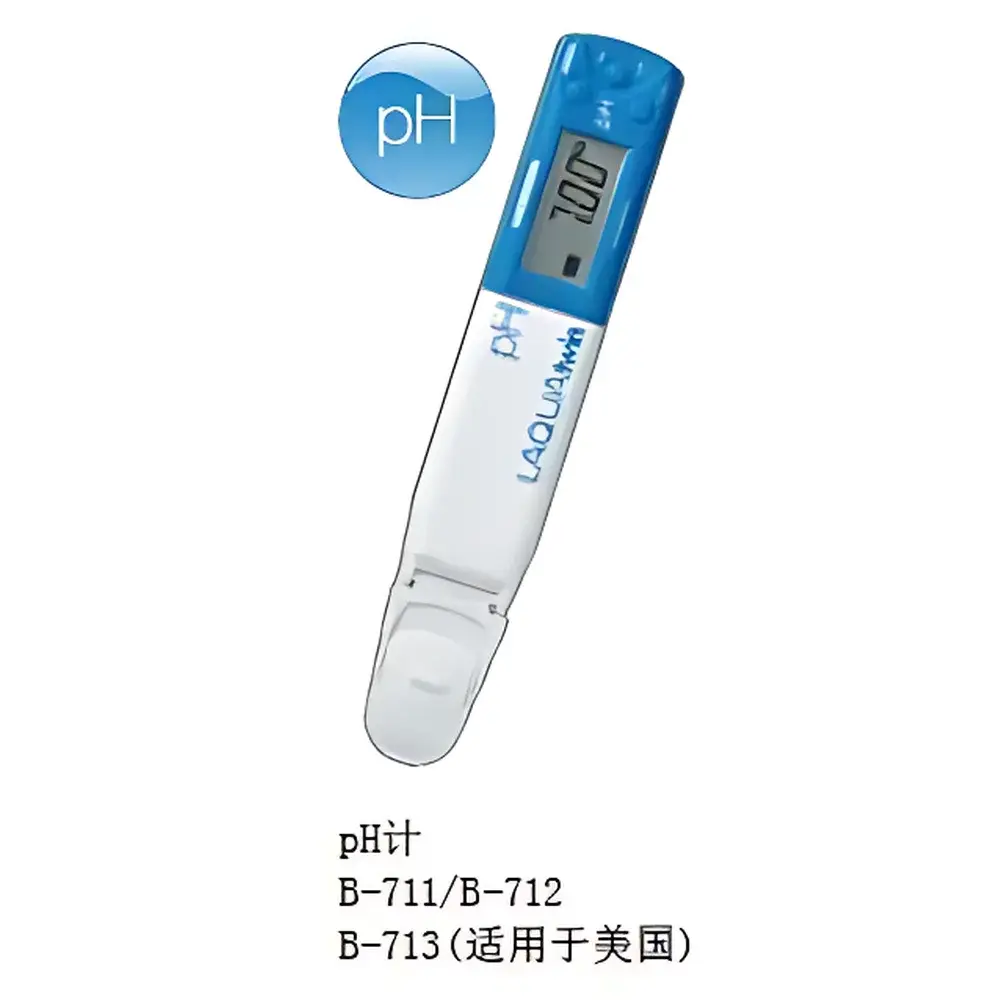
HORIBA LAQUAtwin B-711/B-712 Portable Pocket pH Meter
| Brand | HORIBA |
|---|---|
| Origin | Japan |
| Model | B-711 / B-712 |
| Instrument Type | Pen-style pH Meter |
| Parameter Type | Single-parameter (pH) |
| Measurement Range | 2.0–12.0 pH |
| Resolution | 0.1 pH |
| Accuracy | ±0.1 pH (after calibration with standard buffers) |
| Calibration Solutions | pH 4.01, 7.00, and 9.18 buffers |
| Calibration Modes | B-711 — single-point |
| Temperature Compensation | Automatic (NTC sensor) |
| IP Rating | IP67 (submersible up to 1 m for 30 min |
| Sample Volume | ≥0.05 mL (with optional sampling film B) or ≥0.1 mL (standard) |
| Operating Environment | 5–40 °C, ≤85% RH (non-condensing) |
| Power | Two CR2032 lithium batteries |
| Dimensions (L×W×H) | 164 × 29 × 20 mm (excl. protrusions) |
| Weight | Approx. 50 g (instrument only, batteries excluded) |
Overview
The HORIBA LAQUAtwin B-711 and B-712 are compact, pen-style pH meters engineered for rapid, reliable field and spot-check measurements in environmental monitoring, aquaculture, food processing, education, and routine laboratory quality control. Based on proven glass electrode potentiometry, these instruments measure hydrogen ion activity in aqueous solutions via a stable, planar pH-sensitive glass membrane—HORIBA’s proprietary design optimized for minimal sample consumption and high reproducibility. Unlike conventional benchtop or handheld meters requiring voluminous sample immersion, the B-711/B-712 operate with as little as 0.05 mL of liquid, enabled by an integrated flat-surface electrode architecture that ensures consistent junction potential and fast response (<5 seconds typical stabilization). The devices feature automatic temperature compensation (ATC) using an embedded NTC thermistor, eliminating manual correction errors across the operational range (5–40 °C). Designed as direct successors to the B-211/B-212 series, they incorporate enhanced electronics, improved moisture sealing, and intuitive one-button operation—significantly reducing operator dependency and measurement variability.
Key Features
- Ultra-low sample requirement: Measures accurately with ≥0.05 mL (when used with optional sampling film B) or ≥0.1 mL of solution—ideal for droplet analysis, micro-volumes, or viscous media.
- One-touch operation: Single-button interface initiates calibration or measurement; visual confirmation via smiley-face icon on LCD ensures correct execution before reading.
- IP67-rated enclosure: Fully dust-tight and submersible to 1 m for 30 minutes—meets IEC 60529 standards for ruggedized portable instrumentation used in humid, outdoor, or wash-down environments.
- Automatic endpoint hold: Freezes stable readings on-screen, preventing misinterpretation during transient conditions or hand-held use.
- Integrated ATC: Real-time temperature correction applied per NIST-traceable pH/temperature relationship (2 °C⁻¹ coefficient), ensuring traceable accuracy across ambient fluctuations.
- Long battery life: Powered by two industry-standard CR2032 coin cells (typical service life >1000 measurements), with low-battery indicator and auto-power-off after 10 minutes of inactivity.
Sample Compatibility & Compliance
The B-711/B-712 are validated for use with clear, low-turbidity aqueous solutions—including freshwater, seawater (diluted), nutrient solutions, beverage extracts, and buffered reagents. For samples containing suspended solids or particulates, HORIBA recommends pre-filtration using certified 0.45 µm syringe filters to prevent clogging of the reference junction and ensure electrochemical stability. These meters comply with ISO 7888 (water quality — determination of pH) for field-deployable pH assessment and support GLP-aligned workflows through documented calibration records (user-maintained logbooks). While not FDA 21 CFR Part 11 compliant out-of-the-box due to lack of electronic audit trail, their calibration traceability to NIST-certified buffer standards (pH 4.01, 7.00, 9.18) satisfies ISO/IEC 17025 requirements for accredited testing laboratories performing pH verification.
Software & Data Management
As standalone, battery-operated instruments, the B-711/B-712 do not feature Bluetooth, USB, or data logging capabilities. All measurement data remain on-device only—displayed numerically on the monochrome LCD—and must be manually recorded. This architecture prioritizes robustness, electromagnetic immunity, and regulatory simplicity over connectivity, making them suitable for controlled environments where data integrity is maintained via procedural controls (e.g., SOP-driven calibration logs, dual-operator verification, and periodic metrological validation against reference electrodes). Users are advised to perform daily two-point calibration (B-712) or single-point verification (B-711) using certified buffers prior to critical measurements, with calibration intervals aligned to ISO 17025 clause 5.9.1 for measurement assurance.
Applications
- Aquaculture & hydroponics: Real-time pH monitoring of recirculating tanks, nutrient reservoirs, and hatchery water supplies.
- Food & beverage QA: Spot-checking acidity of juices, dairy products, sauces, and fermentation broths at production lines or receiving docks.
- Environmental field surveys: Rapid pH screening of surface water, groundwater wells, stormwater runoff, and wetland sediments.
- Education & training labs: Student-level experiments requiring safe, intuitive, and contamination-resistant pH tools.
- Facility maintenance: Verification of cleaning solution pH during CIP (clean-in-place) validation or disinfectant efficacy checks.
FAQ
What is the minimum sample volume required for accurate measurement?
0.05 mL when used with HORIBA’s optional Sampling Film B; otherwise, ≥0.1 mL is recommended. Always close the light-shielding cap during measurement to stabilize readings.
Can the B-711/B-712 measure outside the 2.0–12.0 pH range?
No. Operation beyond this range may cause irreversible electrode drift or junction clogging. Samples outside this span must be diluted and re-measured within the valid range.
Is IP67 rating sufficient for use in rain or splashing environments?
Yes—IP67 guarantees full protection against dust ingress and temporary immersion. However, continuous exposure to heavy rain or pressurized spray is not recommended; wipe dry after wet use.
How often should calibration be performed?
Prior to each measurement session, or every 2 hours during continuous use. Two-point calibration (using pH 7.00 and either pH 4.01 or 9.18) is strongly recommended for B-712; B-711 requires at least daily single-point verification.
Are replacement electrodes available separately?
No—the B-711/B-712 employ sealed, non-serviceable planar electrode modules. Units are replaced as complete assemblies upon end-of-life or performance degradation (typically after 12–18 months of regular use).




