
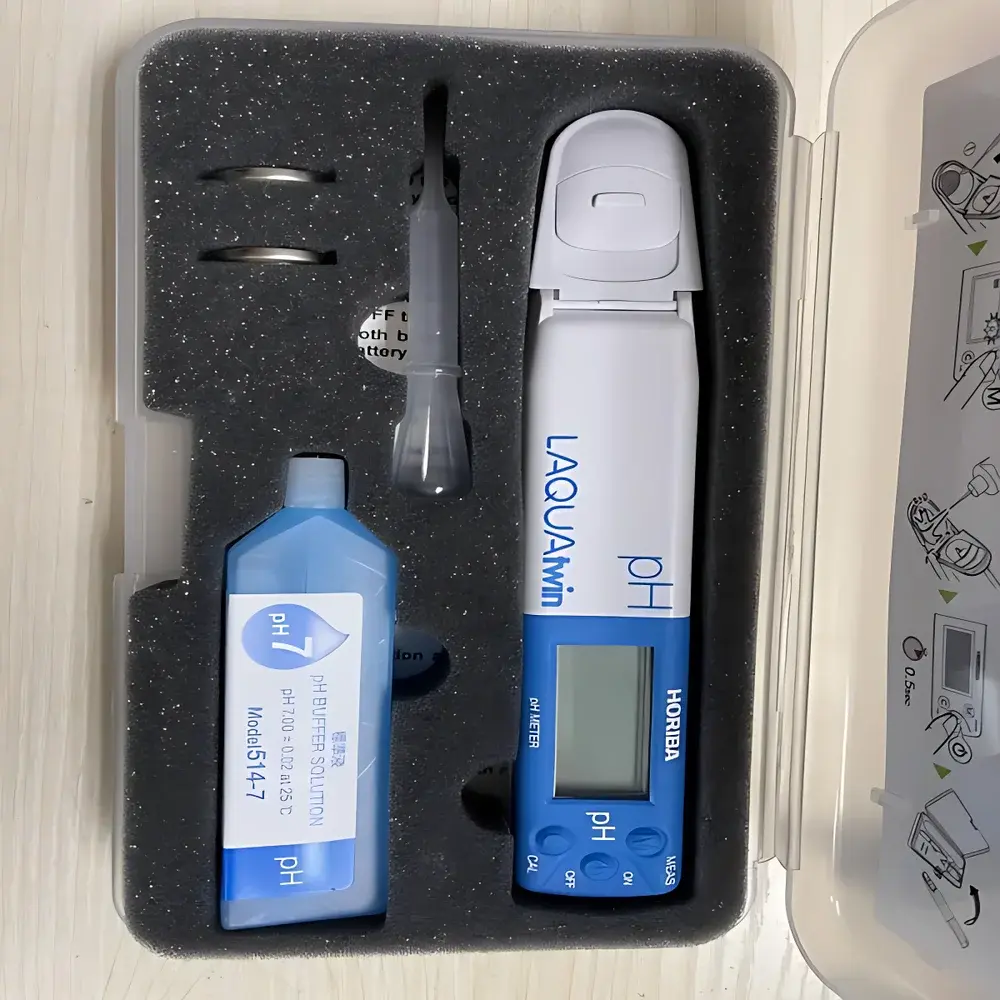
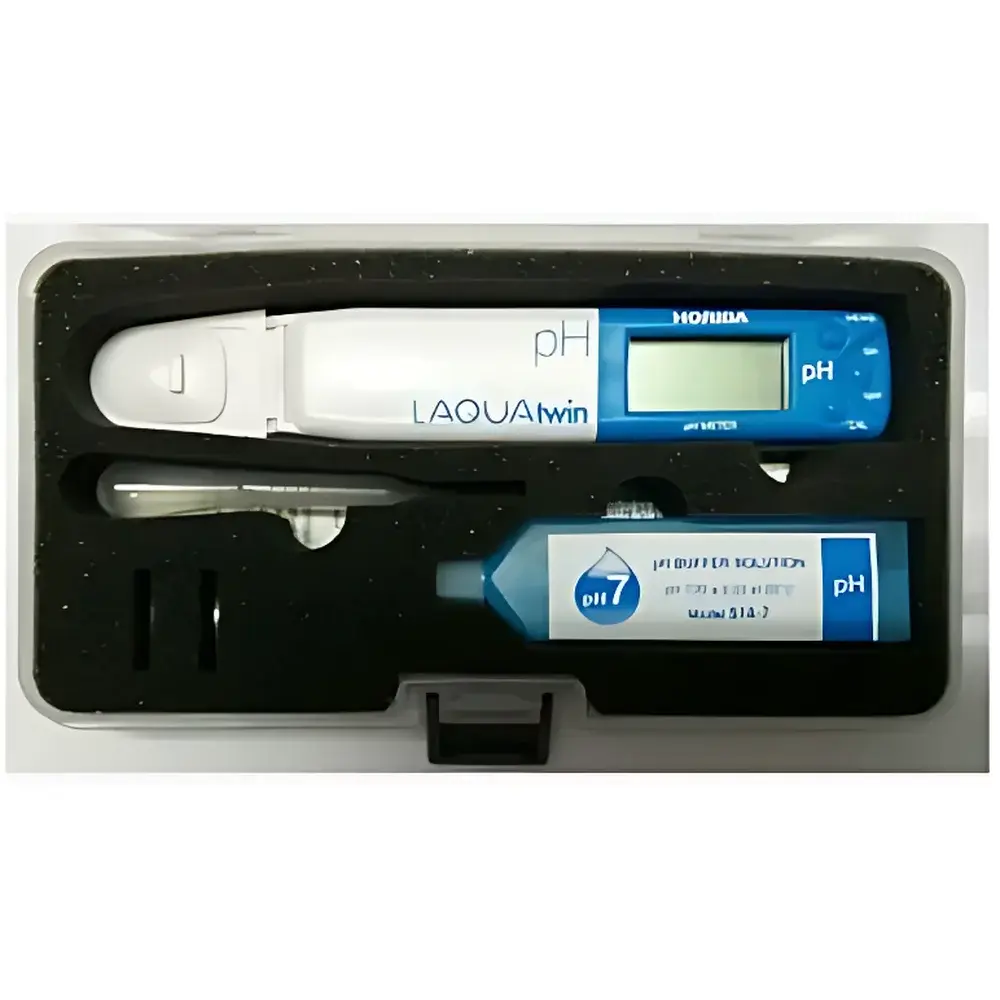
HORIBA LAQUAtwin pH-33 Portable Pocket pH Meter
| Brand | HORIBA |
|---|---|
| Origin | Japan |
| Model | pH-33 |
| Instrument Type | Pen-style |
| Parameter Type | Single-parameter (pH) |
| Measurement Range | 0.00–14.00 pH |
| Resolution | ±0.01 pH |
| Accuracy | ±0.01 pH |
| Calibration Solutions | pH 4.01 and pH 7.00 standard buffers |
| IP Rating | IP67 |
| Electrode Type | Integrated flat-surface pH electrode |
Overview
The HORIBA LAQUAtwin pH-33 is a compact, pen-style portable pH meter engineered for rapid, high-reproducibility field and on-site measurements in demanding environments. Unlike conventional glass-electrode pH meters requiring substantial sample volume and careful handling, the pH-33 employs HORIBA’s proprietary integrated flat-surface pH sensor—designed to deliver laboratory-grade accuracy from as little as a single drop (≈15–20 µL) of aqueous solution. Its measurement principle relies on potentiometric detection of hydrogen ion activity across a stable, low-drift solid-state sensing membrane, coupled with an integrated reference system optimized for minimal liquid junction potential variation. This architecture enables reliable operation under transient conditions—such as spot-checking process streams, environmental water sampling, food surface testing, or educational demonstrations—without the need for temperature compensation hardware (automatic temperature compensation, ATC, is built-in via a precision NTC thermistor). The device complies with fundamental metrological requirements outlined in ISO 7888 (water quality — determination of pH) and supports traceable calibration protocols aligned with national standards.
Key Features
- Single-drop sampling capability enabled by HORIBA’s patented flat-surface pH electrode—eliminates air bubble entrapment and reduces contamination risk between samples
- Intuitive one-button operation: simultaneous calibration and measurement initiation; visual confirmation via smiley-face icon on LCD display indicates readiness and successful stabilization
- Rugged, fully sealed housing rated IP67—dust-tight and submersible up to 1 m for 30 minutes—suitable for outdoor, industrial, and humid laboratory use
- Auto-ranging digital display with 0.01 pH resolution and ±0.01 pH accuracy at 25 °C, referenced to NIST-traceable pH 4.01 and 7.00 buffer standards
- Built-in automatic temperature compensation (ATC) using integrated NTC sensor (range: 0–50 °C), ensuring consistent pH reporting across variable ambient conditions
- Low-power design with replaceable CR2032 coin-cell battery (typical life: >2,000 measurements); auto power-off after 10 minutes of inactivity
Sample Compatibility & Compliance
The pH-33 is validated for use with aqueous solutions including drinking water, wastewater, nutrient solutions, beverage extracts, cosmetic formulations, and buffered biological media. It is not intended for non-aqueous solvents, highly viscous suspensions (>500 cP), or strongly oxidizing/reducing matrices (e.g., concentrated bleach or H₂O₂ >3%). Its flat electrode geometry minimizes clogging and facilitates cleaning with deionized water or mild detergent—critical for repeated use in QC/QA workflows. Device firmware and calibration routines adhere to principles defined in ASTM D1293 (Standard Test Methods for pH of Water) and support documentation required under GLP-compliant environments when paired with controlled calibration logs. While the instrument itself does not include electronic audit trail functionality, its calibration status, date stamp, and measurement history can be manually recorded per FDA 21 CFR Part 11 guidance for non-automated systems.
Software & Data Management
The LAQUAtwin pH-33 operates as a standalone, embedded-system device with no Bluetooth, USB, or cloud connectivity. All data are displayed in real time on a high-contrast LCD screen and retained only during active measurement sessions. No internal memory or export interface is provided—consistent with its design intent as a rapid verification tool rather than a data-logging platform. Users are expected to transcribe readings manually into lab notebooks, LIMS, or spreadsheets. For traceability, each unit ships with a certificate of conformance indicating factory calibration against certified reference materials. Optional accessories—including calibrated buffer sachets (pH 4.01/7.00), protective carrying case with desiccant chamber, and electrode cleaning kit—are available separately to maintain long-term measurement integrity.
Applications
- Field-based environmental monitoring: river, lake, and groundwater pH screening per EPA Method 150.1
- In-process quality control in food & beverage production: fruit juice acidity checks, dairy fermentation tracking, and rinse-water validation
- Education and training: undergraduate chemistry labs requiring robust, low-maintenance pH tools for student-led experiments
- Aquaculture and hydroponics: daily nutrient solution pH verification without sample dilution or transfer errors
- Pharmaceutical excipient testing: rapid batch release checks for purified water (USP ) and buffer preparations
- Maintenance of electroplating baths and cooling tower water where frequent spot measurements reduce downtime
FAQ
What calibration buffers are required for routine operation?
The pH-33 requires two-point calibration using certified pH 4.01 and pH 7.00 standard buffer solutions at 25 °C. Single-point calibration (e.g., pH 7.00 only) is permitted for relative trend analysis but not for compliance-critical reporting.
Can the electrode be replaced independently?
No—the flat-surface pH sensor is permanently integrated into the probe body and not user-replaceable. Full unit replacement is recommended after 12–18 months of regular use or if calibration drift exceeds ±0.03 pH.
Is temperature measurement independent of pH sensing?
Yes—the integrated NTC thermistor operates independently and provides continuous temperature readout (°C) alongside pH values, enabling manual correction if needed per IUPAC pH scale conventions.
Does the IP67 rating apply during active measurement?
Yes—submersion up to 1 m depth for 30 minutes is permissible even with the device powered on, though prolonged immersion is discouraged to preserve battery seal integrity.
How often should the electrode be cleaned?
Rinse with deionized water after each measurement; perform deep cleaning with 0.1 M HCl or enzymatic solution weekly if used with protein-rich or oily samples.
Related Products




