
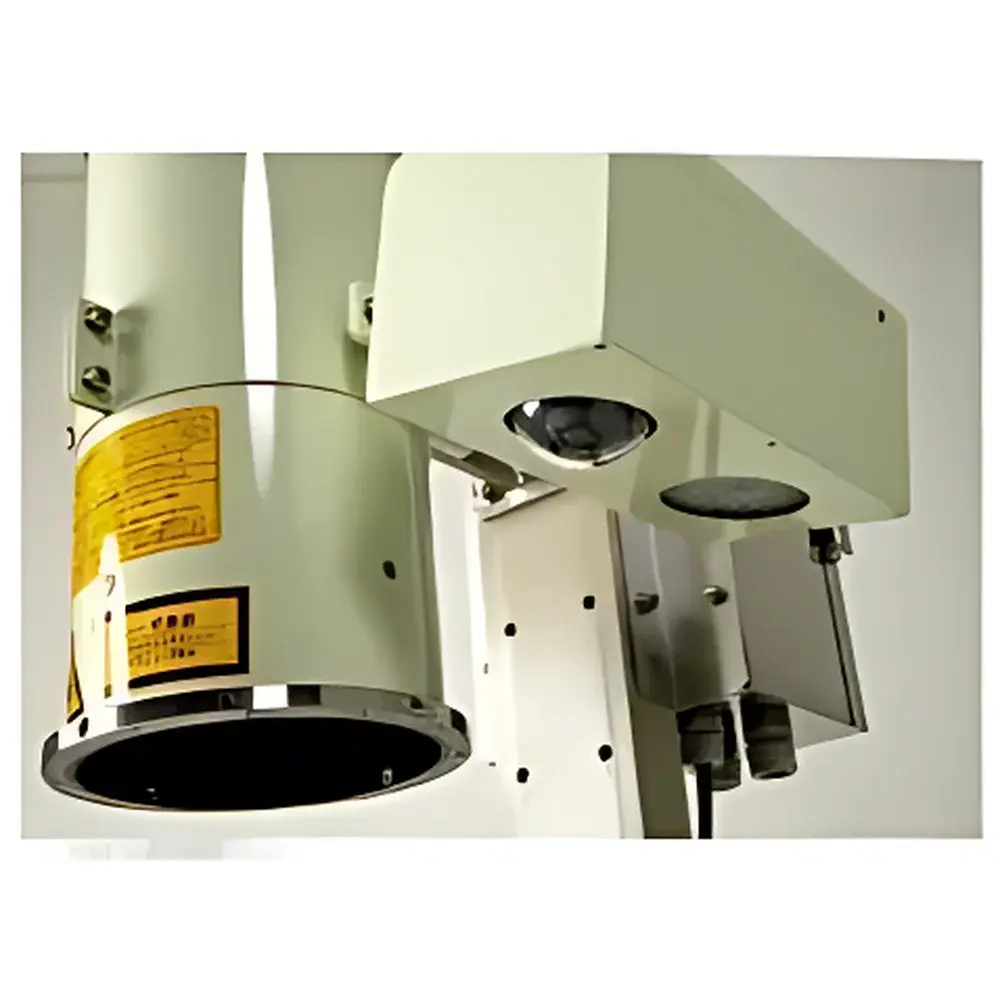
HORIBA LO-300 Online Oil Film Monitor
| Brand | HORIBA |
|---|---|
| Origin | Japan |
| Model | LO-300 |
| Instrument Type | Online |
| Detection Principle | Laser Circular Area Scanning Reflectometry |
| Detection Range | 0.3–4.0 m (up to 6.0 m on still water) |
| Oil Detection Target | Floating/Adherent hydrocarbon films (gasoline, kerosene, diesel, heavy fuel oil, insulating oil, lubricating oil) |
| Output | 4–20 mA analog signal (reflected light intensity), 2 dry contact outputs (oil film alarm, system fault) |
| Display | Color touchscreen showing oil coverage (%), threshold level, real-time received light intensity, status indicators |
| Power Supply | AC 100 V ±10%, 50/60 Hz, ≤100 VA |
| Enclosure Rating | IP66 |
| Operating Temperature | –10 to +50 °C |
| Dimensions | Ø185 × 547 mm (H) |
| Weight | ~11 kg |
| Optional | Surveillance camera module (MP4 video recording at 1 or 3 fps |
| Compliance | Class 2 laser (≤1 mW semiconductor laser) |
Overview
The HORIBA LO-300 Online Oil Film Monitor is an industrial-grade, non-contact optical sensor engineered for continuous, real-time detection of hydrocarbon oil films on water surfaces and flat industrial substrates. It operates on the principle of laser circular area scanning reflectometry: a Class 2 semiconductor laser (≤1 mW) emits a rotating conical beam that illuminates a wide annular zone on the target surface; reflected light intensity is analyzed pixel-by-pixel across the scan profile to distinguish hydrophobic oil layers from clean water or bare concrete based on characteristic specular reflection patterns and spatial continuity. Unlike traditional extractive or fluorescence-based analyzers, the LO-300 requires no sample intake, reagents, or consumables—eliminating cross-contamination risk and minimizing maintenance intervals. Its robust IP66-rated aluminum housing enables direct outdoor installation in wastewater treatment plants, refinery outfall channels, stormwater retention basins, and industrial effluent discharge points where regulatory compliance with oil-in-water limits (e.g., EPA Method 1664, ISO 9377-2) is mandated.
Key Features
- Non-contact, maintenance-free operation with no wetted parts or calibration drift over time
- Laser-based circular scanning (0.3–4.0 m standard range; up to 6.0 m on still water) ensures stable detection despite minor wave motion or surface turbulence
- Automatic vertical alignment between transmitter and receiver optics simplifies field commissioning and reduces installation error
- Configurable multi-parameter alarm logic: user-defined oil coverage threshold (%), minimum persistence duration, and dynamic baseline compensation for ambient light variation
- Integrated full-color touchscreen interface with intuitive menu navigation, real-time graphical display of oil coverage (%) and received signal intensity (4–20 mA equivalent), and system status diagnostics
- Optional surveillance camera module provides forensic-grade MP4 video recording (1 or 3 fps) capturing 30 seconds before and after each alarm event—including timestamp overlay, automatic night-mode LED illumination, and LAN-based remote access for live viewing or playback
Sample Compatibility & Compliance
The LO-300 detects floating and adherent hydrocarbon films—including gasoline, jet fuel (Jet A-1), diesel (EN 590), marine fuel oil (IFO 180/380), transformer insulating oil (IEC 60296), and industrial lubricants—on aqueous or solid surfaces. It does not respond to water-miscible oils (e.g., synthetic ester-based coolants) or emulsified oil-in-water dispersions below ~10 µm droplet size. The instrument complies with IEC 60825-1 (laser safety), IP66 ingress protection (IEC 60529), and electromagnetic compatibility standards (IEC 61326-1). Its analog 4–20 mA output and relay contacts integrate seamlessly into existing SCADA, DCS, or PLC systems used in municipal and industrial water management infrastructure. While not certified for direct regulatory reporting under USP or EPA 1664, its detection capability supports GLP-aligned leak detection protocols and fulfills preliminary screening requirements per ISO 9377-2 Annex B for gross oil presence.
Software & Data Management
The LO-300 operates autonomously without external software dependencies. All configuration—including alarm thresholds, persistence timers, display units, and camera settings—is performed locally via the built-in touchscreen interface. When equipped with the optional camera module, recorded MP4 files (6 MB per 3-fps clip) are stored onboard in non-volatile memory and accessible via Ethernet (LAN) using standard HTTP or FTP protocols. Remote operators can initiate live streaming, download historical clips, or export timestamped CSV logs of alarm events and analog output trends. No proprietary drivers or cloud platforms are required; data exports comply with common IT security policies and support integration into enterprise-level asset monitoring systems. Audit trails—including parameter changes, alarm timestamps, and firmware version history—are retained internally for traceability during internal quality audits.
Applications
- Continuous monitoring of final effluent discharge points in municipal wastewater treatment plants to prevent exceedance of local oil-in-water limits (typically <10 mg/L)
- Early leak detection at petroleum storage tank bunds, loading docks, and pipeline right-of-ways
- Stormwater runoff surveillance in industrial parks and airport aprons to identify illicit hydrocarbon discharges
- Process water recirculation loops in metalworking facilities, where tramp oil accumulation compromises coolant performance
- Environmental compliance verification at power plant cooling water intakes and transformer oil containment areas
FAQ
Can the LO-300 detect emulsified or dissolved oil?
No. The LO-300 is designed exclusively for free-phase, surface-adherent hydrocarbon films. It cannot quantify dissolved hydrocarbons or sub-micron emulsions.
Is calibration required during routine operation?
No. The system uses factory-calibrated optical geometry and signal processing algorithms. Zero-point verification may be performed manually using a clean reference surface, but periodic recalibration is not necessary.
What environmental conditions affect measurement reliability?
Direct solar exposure, heavy rain, snow accumulation, or frozen water surfaces degrade performance. Installation must avoid unshielded sunlight and ensure the detection path remains unfrozen and free of persistent fog or steam.
Does the camera option meet evidentiary standards for regulatory reporting?
Video recordings include embedded UTC timestamps and are stored in immutable MP4 format. While not inherently admissible as standalone legal evidence, they provide corroboration when combined with analog output logs and system event histories in incident investigations.
How is the device powered and integrated into existing control systems?
It accepts AC 100 V ±10% input and provides isolated 4–20 mA output proportional to detected oil coverage, plus two programmable dry contact relays. Signal wiring follows standard industrial practices (shielded twisted pair for analog, relay-rated cabling for contacts).







