
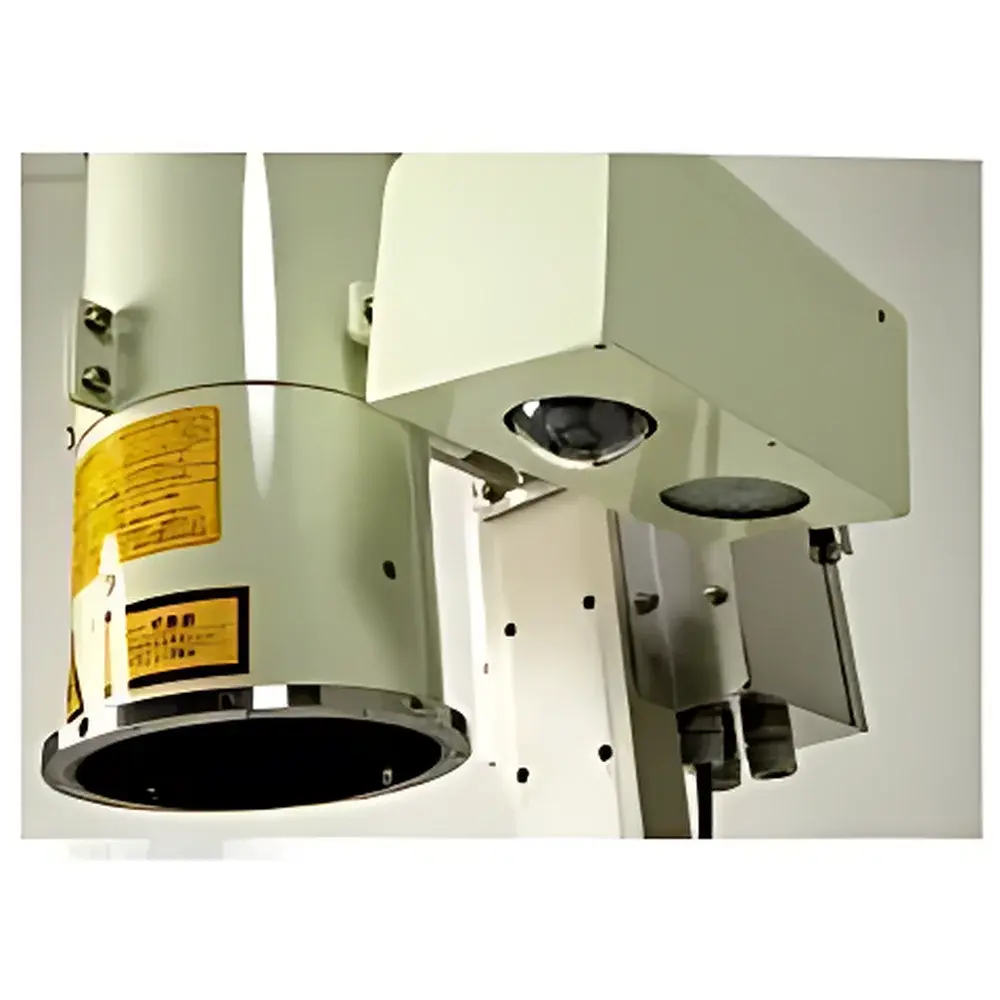
HORIBA LO-300 Online Oil Film Monitor
| Brand | HORIBA |
|---|---|
| Origin | Japan |
| Model | LO-300 |
| Detection Principle | Laser Circular Area Scanning Reflectometry |
| Detection Range | 0.3–4.0 m (up to 6.0 m on still water) |
| Oil Detection Target | Floating/Adherent hydrocarbon films (gasoline, kerosene, diesel, heavy fuel oil, insulating oil, lubricating oil) |
| Output | 4–20 mA analog signal (reflected light intensity), 2 dry contact alarms (oil film presence, system fault) |
| Display | Color touchscreen showing oil coverage (%), threshold level, real-time received light level, status indicators |
| Power Supply | AC 100 V ±10%, 50/60 Hz, ≤100 VA |
| Enclosure Rating | IP66 |
| Operating Temperature | −10 to +50 °C |
| Dimensions | Ø185 × 547 mm (H) |
| Weight | ~11 kg |
| Optional | Surveillance camera module (MP4 video recording at 1 or 3 fps |
| Compliance | CE-marked |
Overview
The HORIBA LO-300 Online Oil Film Monitor is an industrial-grade, non-contact optical surveillance instrument engineered for continuous, real-time detection of floating hydrocarbon films on water surfaces—primarily deployed in wastewater treatment plants, industrial effluent discharge points, harbor monitoring stations, and cooling water circuits. It operates on the principle of laser circular area scanning reflectometry: a Class 2 semiconductor laser (≤1 mW output) projects a rotating conical beam across the monitored surface, and the system analyzes spatial and temporal variations in reflected light intensity to distinguish thin oil films from water, foam, debris, or wave-induced glare. Unlike absorbance- or fluorescence-based analyzers, the LO-300 does not require reagents, sampling lines, or immersion probes—eliminating fouling risk, calibration drift, and consumable dependency. Its fixed-mount, above-surface configuration ensures long-term stability and minimal maintenance, with a certified IP66 enclosure enabling direct outdoor installation in harsh environments.
Key Features
- Laser-based circular scanning optics provide uniform coverage over adjustable detection distances (0.3–4.0 m standard; up to 6.0 m on calm water), mitigating false positives caused by surface ripples or wind-induced turbulence.
- Self-aligning transmitter/receiver optics simplify field commissioning—no manual leveling tools required; angular tolerance maintained within ±3°.
- Configurable multi-parameter alarm logic: users define oil film coverage threshold (% area), minimum persistence duration (e.g., ≥5 seconds), and hierarchical alarm states (warning vs. critical).
- Integrated color touchscreen interface supports intuitive setup, live visualization of oil coverage percentage, real-time analog output tracking (4–20 mA), and system health diagnostics.
- Optional surveillance camera module enables forensic-grade incident documentation: MP4 video clips (1 or 3 fps) are automatically saved—including 10 seconds pre-trigger and 20 seconds post-trigger—with embedded timestamp, LED-assisted night operation, and LAN-based remote access.
- No consumables, no wetted parts, no routine optical cleaning—maintenance intervals extend beyond 12 months under typical industrial conditions.
Sample Compatibility & Compliance
The LO-300 detects adherent and free-floating hydrophobic oil layers—including gasoline, jet fuel (Jet-A), diesel (EN 590), marine fuel oil (IFO 180/380), transformer insulating oil (IEC 60296), and industrial lubricants—provided they form a visible interfacial film with measurable reflectance contrast versus water. It is not sensitive to water-miscible cutting fluids, glycol-based coolants, or emulsified hydrocarbons below detectable thickness thresholds (~100 nm). The system complies with IEC 60529 (IP66 ingress protection), IEC 61000-6-2 (immunity) and -6-4 (emissions), and meets CE requirements for electromagnetic compatibility and low-voltage safety. While not intrinsically rated for Zone 1 hazardous areas, it may be installed in classified zones with appropriate barrier certification. Data integrity aligns with GLP and GMP expectations when paired with audit-trail-capable SCADA or DCS platforms supporting 21 CFR Part 11-compliant electronic records.
Software & Data Management
The LO-300 operates autonomously via embedded firmware—no external PC is required for basic functionality. Analog output (4–20 mA) integrates seamlessly into PLCs, DCS, or centralized SCADA systems for trend logging and alarm forwarding. With the optional camera module, video events are stored locally on internal flash memory (6 MB per clip, MP4 H.264 encoding) and accessible via standard Ethernet (10/100BASE-TX). Remote configuration, live view, and clip retrieval are supported through a web-based HTTP interface compliant with RFC 7230–7235. Video metadata includes UTC timestamp, device ID, alarm type, and environmental status flags—enabling traceability for regulatory reporting or root-cause analysis. Firmware updates are performed via secure HTTPS upload with SHA-256 signature verification.
Applications
- Effluent compliance monitoring at municipal and industrial wastewater outfalls—verifying absence of hydrocarbon discharge prior to environmental release.
- Oil-water separator performance validation in petrochemical refineries and engine test facilities.
- Harbor and marina surveillance for illegal bilge dumping or accidental spills.
- Cooling tower and closed-loop industrial water systems—early detection of heat exchanger leakage or lubricant ingress.
- Stormwater retention pond monitoring to trigger diversion or treatment protocols upon oil presence.
- Regulatory inspection support: time-stamped video evidence satisfies evidentiary requirements under EPA 40 CFR Part 112, ISO 14001 clause 8.2, and EU Water Framework Directive Annex V reporting frameworks.
FAQ
Does the LO-300 require periodic calibration?
No—its measurement relies on stable optical geometry and semiconductor laser output, both factory-characterized and drift-compensated in firmware. Zero-point verification can be performed visually using clean water reference, but formal recalibration is not specified in the maintenance schedule.
Can it detect oil films on moving or turbulent water?
Yes—the circular scanning method and adaptive signal averaging reduce sensitivity to short-term surface fluctuations. Performance is validated for flow velocities up to 0.5 m/s in open channels and wave heights <5 cm (significant wave height). For highly aerated or foaming surfaces, optional anti-foam algorithms may be enabled.
Is the camera module mandatory for regulatory compliance?
Not universally—but many jurisdictions (e.g., U.S. Coast Guard, German LAWA guidelines) require corroborative visual evidence for enforcement actions. The LO-300’s timestamped, tamper-evident MP4 clips meet evidentiary standards for chain-of-custody documentation.
What network security protocols does the Ethernet interface support?
The embedded web server supports TLS 1.2 encryption for configuration sessions and implements role-based access control (admin/operator/guest), session timeouts, and failed-login lockout—aligned with ISA/IEC 62443-3-3 SL1 baseline requirements.
How is environmental temperature compensated?
Internal thermistor readings feed into real-time gain adjustment of the photodetector amplifier stage, maintaining consistent signal-to-noise ratio across the full −10 to +50 °C operating range without user intervention.







