
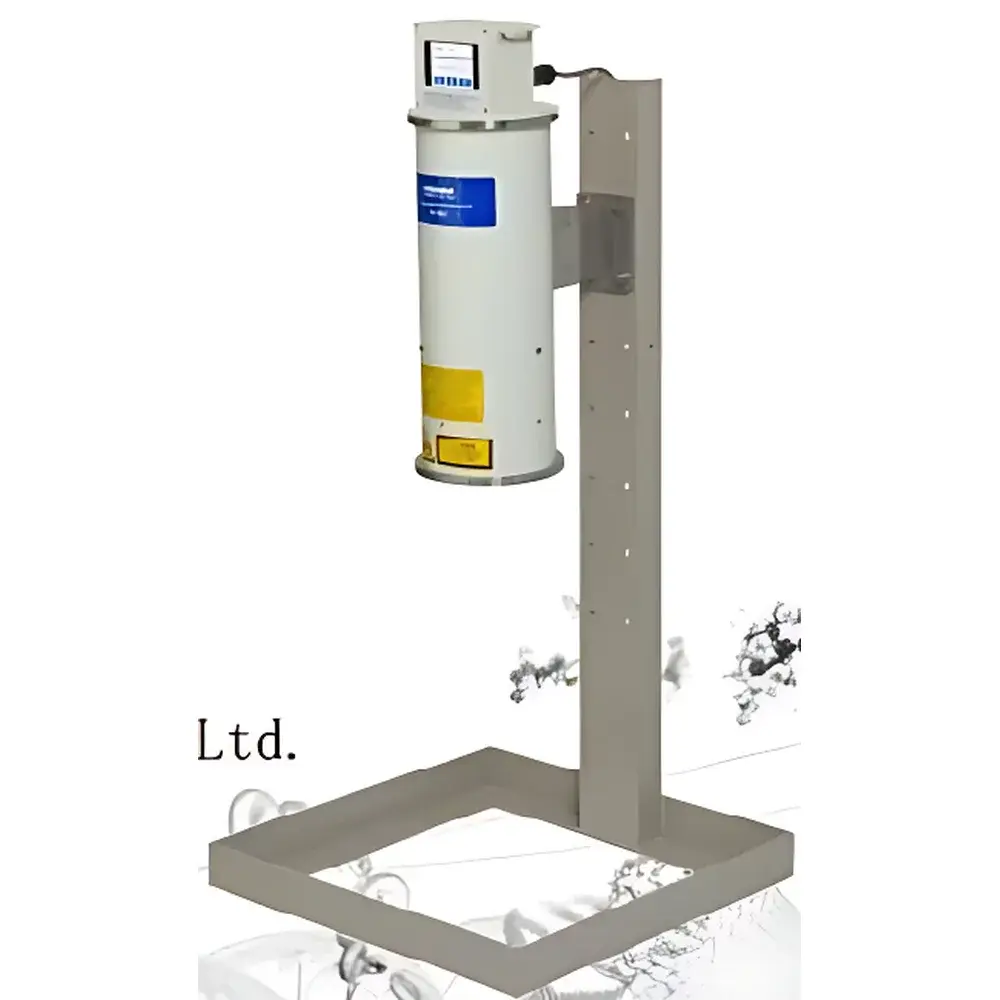
HORIBA LO-300 Online Oil Film Monitor
| Brand | HORIBA |
|---|---|
| Origin | Japan |
| Model | LO-300 |
| Instrument Type | Online |
| Measurement Principle | Laser Circular Area Scanning Reflectometry |
| Measurement Range | 0–200 mg/L |
| Detection Limit | < 200 mg/L |
| Accuracy | ±1 mg/L |
| Resolution | 0.01 mg/L |
| Measurement Frequency | 0.5/min |
| IP Rating | IP66 |
| Operating Temperature | −10 to +50 °C |
| Detection Distance | 0.3–4.0 m (up to 6.0 m on still water) |
| Power Supply | AC 100 V ±10%, 50/60 Hz, ≤100 VA |
| Dimensions | Ø185 × 547 mm (H) |
| Weight | ~11 kg |
Overview
The HORIBA LO-300 Online Oil Film Monitor is an industrial-grade, non-contact optical sensing system engineered for continuous, real-time detection and quantification of floating hydrocarbon films on water surfaces. It operates on the principle of laser circular area scanning reflectometry—emitting a Class 2 semiconductor laser (≤1 mW) in a rotating conical pattern across the monitored surface. Variations in reflected light intensity, caused by refractive index discontinuities at oil–water or oil–air interfaces, are captured and analyzed to determine oil presence, spatial coverage, and relative thickness. Unlike extractive or fluorescence-based methods, the LO-300 requires no reagents, sample conditioning, or physical contact with the medium—making it ideal for harsh, remote, or explosion-hazardous environments where maintenance access is limited. Its design conforms to long-term unattended operation requirements in wastewater treatment plants, industrial effluent channels, port surveillance zones, and cooling water circuits.
Key Features
- Non-intrusive, maintenance-free operation: No consumables, no wetted parts, and no calibration drift due to optical stability and solid-state laser source.
- Adaptive laser scanning optics: Automatic vertical alignment between transmitter and receiver units simplifies field installation and ensures consistent beam geometry across variable mounting conditions (tilt tolerance ±3°).
- Extended detection range: Effective monitoring distance of 0.3–4.0 m; up to 6.0 m over still water surfaces—enabling coverage of wide canals, open reservoirs, or large containment basins from a single vantage point.
- Intelligent alarm logic: Configurable thresholds based on oil-covered area percentage (%), minimum persistence duration, and dynamic baseline compensation—reducing false positives from transient reflections, foam, or debris.
- Rugged outdoor-rated enclosure: IP66-certified housing with corrosion-resistant aluminum alloy construction, rated for continuous operation between −10 °C and +50 °C.
- Integrated color touchscreen interface: Full-featured local HMI with real-time visualization of reflected signal strength (4–20 mA), oil coverage ratio (0–100%), alarm status, and system diagnostics.
Sample Compatibility & Compliance
The LO-300 detects non-water-soluble hydrocarbons—including gasoline, kerosene, diesel, heavy fuel oil, insulating oil, and lubricating oils—by their distinct optical reflectance signature at the air–oil–water interface. It does not respond to water-miscible oils (e.g., certain synthetic coolants or emulsified cutting fluids). The instrument meets electromagnetic compatibility standards per IEC 61326-1 and is suitable for installation in Zone 2 hazardous areas when used with appropriate barrier systems. While not certified to ATEX or IECEx out-of-the-box, its intrinsic safety profile supports integration into SIL2-capable monitoring architectures under end-user risk assessment. Data logging and alarm events comply with basic GLP traceability requirements; optional LAN connectivity enables time-stamped event export for audit-ready records.
Software & Data Management
Standard analog outputs include one isolated 4–20 mA channel (proportional to average reflection intensity) and two relay contacts (oil film alarm and unit fault). Optional Ethernet (LAN) interface enables remote configuration, live video streaming, and alarm-triggered MP4 video capture (1 or 3 fps, 6 MB/event) with embedded UTC timestamps. Video recordings—stored internally on removable SD card—are accessible via standard HTTP or FTP protocols. No proprietary software is required for basic operation; however, HORIBA’s optional WebConfigurator tool provides centralized fleet management, firmware updates, and trend analysis across multiple LO-300 units. All configuration changes and alarm events are logged with date/time stamps, supporting 21 CFR Part 11–aligned audit trails when deployed with validated IT infrastructure.
Applications
- Effluent discharge monitoring at municipal and industrial wastewater treatment facilities.
- Early leak detection in oil storage tank bunds, pipeline right-of-ways, and refinery drainage networks.
- Port and harbor environmental compliance surveillance—particularly in berthing zones and shipyard dry docks.
- Cooling tower and condenser water circuit integrity verification in power generation and HVAC systems.
- Automated spill response triggering in secondary containment systems equipped with sump pumps or isolation valves.
- Regulatory reporting support for ISO 14001 environmental management systems and local water authority discharge permits.
FAQ
Does the LO-300 require periodic recalibration?
No. The system relies on stable optical geometry and factory-trimmed photodetector gain; no routine recalibration is needed. Annual verification against a reference oil patch (e.g., standardized diesel film) is recommended for QA/QC programs.
Can it distinguish between oil types?
No. It detects optical contrast indicative of hydrocarbon presence—not chemical composition. Identification of specific oil classes requires complementary lab analysis (e.g., GC-MS or FTIR).
Is sunlight interference mitigated?
Yes. The system incorporates narrow-band optical filtering synchronized with pulsed laser emission and adaptive ambient light subtraction algorithms. However, direct solar incidence on the lens must be avoided via shading or installation orientation.
What is the maximum allowable wave height for reliable detection?
The LO-300 maintains performance on water surfaces with RMS wave heights ≤2 cm. For highly turbulent flows, mounting height adjustment or use of stilling wells is advised.
Can video recordings be integrated into a SCADA system?
Yes—via HTTP API or FTP polling. Timestamped MP4 files and JSON-formatted metadata (alarm type, duration, coverage %) are generated per event and support automated ingestion into third-party supervisory platforms.







