
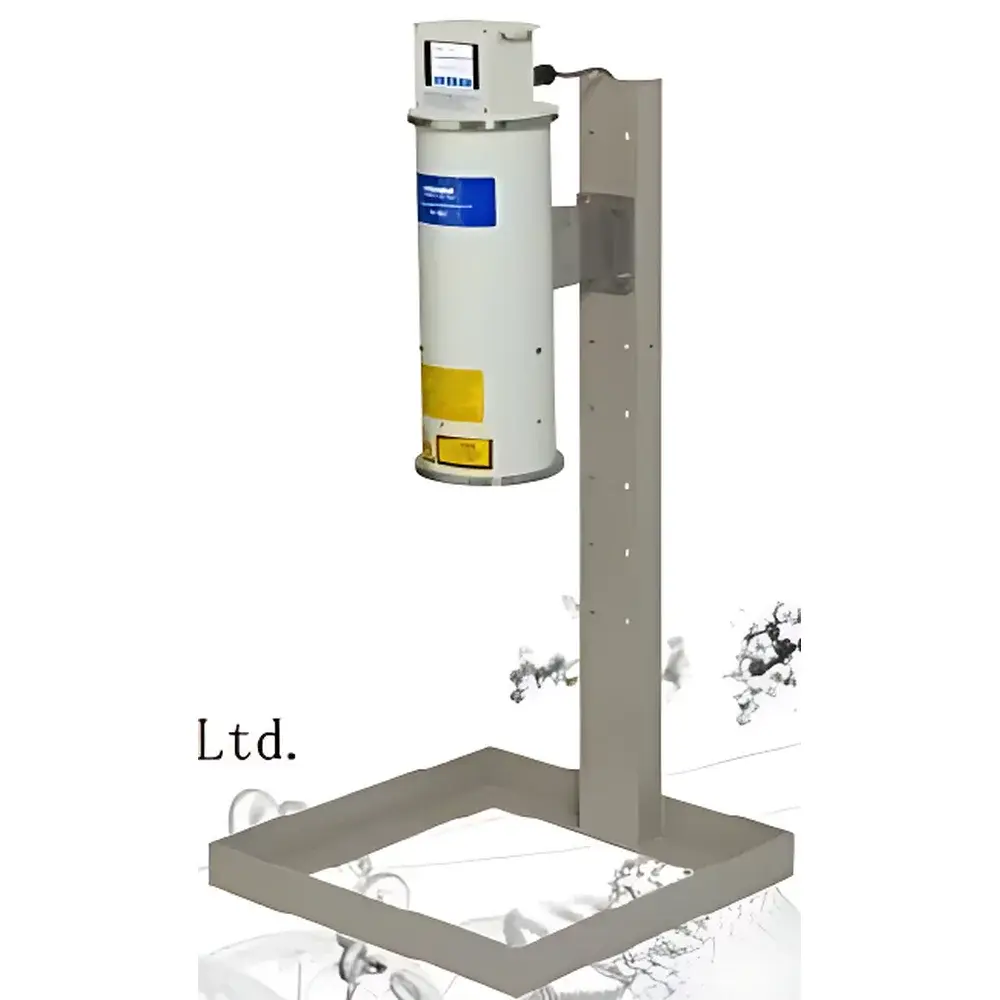
HORIBA LO-300 Online Oil Film Monitor
| Brand | HORIBA |
|---|---|
| Origin | Japan |
| Model | LO-300 |
| Detection Principle | Laser-based Reflective Scanning |
| Detection Range | 0.3–4.0 m (up to 6.0 m on still water) |
| Oil Detection Method | Non-contact surface oil film reflectance measurement |
| IP Rating | IP66 |
| Power Supply | AC 100 V ±10%, 50/60 Hz, ≤100 VA |
| Operating Temperature | −10 to +50 °C |
| Enclosure Dimensions | Ø185 × 547 mm (H) |
| Weight | ~11 kg |
| Output Signals | 4–20 mA analog output (reflected light intensity), 2 dry contact outputs (oil alarm & unit tilt fault) |
| Display | Color touchscreen showing oil coverage (%), received signal level (4–20 mA), threshold setting, and status indicators |
| Optional Video Recording | MP4 format, up to 3 fps, 6 MB per clip, pre-/post-alarm capture, LED-assisted night imaging, LAN-enabled remote monitoring |
Overview
The HORIBA LO-300 Online Oil Film Monitor is an industrial-grade, non-invasive optical instrument engineered for continuous, real-time detection of floating hydrocarbon films on water surfaces in environmental monitoring, wastewater treatment, industrial effluent discharge points, and stormwater management systems. It operates on a laser-based reflective scanning principle: a Class 2 semiconductor laser (≤1 mW) emits a circular scanning beam across the monitored surface; variations in reflected light intensity—caused by changes in surface reflectivity due to oil presence—are captured and quantified. Unlike extraction-based or fluorescence methods, the LO-300 requires no reagents, sample contact, or consumables, ensuring long-term operational stability with minimal maintenance. Its robust, weatherproof IP66 enclosure enables direct outdoor installation above open channels, retention ponds, or drainage ditches without protective housing. The system is designed for regulatory-compliant surveillance under frameworks such as ISO 15709 (water quality — determination of hydrocarbons), EPA Method 1664 (n-hexane extractable material), and EU Directive 2000/60/EC (Water Framework Directive), supporting early leak detection and automated incident logging.
Key Features
- Non-contact, maintenance-free operation: No immersion probes, no fouling risk, no calibration drift from physical contact with water or oil.
- Adaptive laser scanning: Circular beam geometry compensates for minor wave motion and surface turbulence, enabling stable detection even on dynamically fluctuating water surfaces.
- Intelligent area-based alarm logic: Users define alarm thresholds based on percentage of scanned area covered by oil film—not just intensity—reducing false positives from glare, debris, or foam.
- Self-aligning optical assembly: Transmitter and receiver units automatically achieve vertical alignment during installation, minimizing setup time and eliminating manual leveling errors.
- Integrated color touchscreen HMI: Full-featured local interface with real-time visualization of oil coverage (%), reflected signal level (4–20 mA), threshold settings, and system status—no external PC required for basic operation.
- Extended detection range: Standard 0.3–4.0 m standoff distance; up to 6.0 m achievable over still water—ideal for wide-channel or elevated mounting configurations.
Sample Compatibility & Compliance
The LO-300 detects non-water-soluble hydrocarbon films—including gasoline, kerosene, diesel, heavy fuel oil, insulating oil, and lubricating oils—on freshwater, seawater, and wastewater surfaces. It does not respond to water-miscible oils (e.g., certain synthetic coolants or emulsified cutting fluids). As a fixed-mount optical monitor, it complies with IEC 60529 (IP66 ingress protection), UL 61010-1 (safety requirements for electrical equipment), and EN 61326-1 (EMC for industrial environments). Its analog (4–20 mA) and relay outputs are compatible with SCADA, DCS, and PLC systems used in municipal and industrial facilities subject to ISO 9001, ISO 14001, and ISO/IEC 17025-accredited QA/QC protocols. Data integrity supports GLP-aligned audit trails when integrated with validated data acquisition software.
Software & Data Management
While the LO-300 operates autonomously via its onboard touchscreen, optional LAN connectivity enables remote configuration, live video streaming, and centralized event logging. When equipped with the integrated HD camera module, the system records MP4 video clips (up to 3 frames per second, 6 MB per clip) triggered by alarm events—capturing 10 seconds before and after threshold breach. Timestamped footage includes overlay of date/time, oil coverage %, and system status, facilitating forensic review and regulatory reporting. Video archives are accessible via standard HTTP or FTP protocols; no proprietary software is required for playback or export. All configuration parameters—including oil sensitivity, dwell time, alarm hysteresis, and video frame rate—are stored in non-volatile memory and survive power cycles.
Applications
- Industrial outfall monitoring: Continuous surveillance of cooling water discharges, refinery effluents, and manufacturing plant runoff.
- Municipal wastewater infrastructure: Early warning at pump station wet wells, combined sewer overflows (CSOs), and final effluent channels.
- Port and harbor environmental compliance: Detection of bilge discharge or tank cleaning residues on marina basins and berthing areas.
- Oil storage facility perimeter control: Fence-line monitoring for accidental spill migration into adjacent waterways.
- Stormwater treatment systems: Integration with oil-water separators to verify separator performance and trigger maintenance alerts.
FAQ
Does the LO-300 require periodic calibration or routine optical cleaning?
No. The system uses stable semiconductor laser optics and sealed optical paths. Routine maintenance is limited to periodic visual inspection of the lens window for dust or condensation; cleaning is only necessary if optical transmission degrades—typically every 6–12 months in typical outdoor environments.
Can the LO-300 distinguish between oil types (e.g., diesel vs. lubricating oil)?
No. It detects presence and spatial extent of non-aqueous hydrocarbon films but does not perform chemical identification or speciation. Quantification is qualitative (area %) and semi-quantitative (relative reflectance intensity).
Is the video recording function mandatory, or can it be omitted to reduce cost?
The camera module is a field-installable option. Base LO-300 units operate fully without video capability—retaining all core detection, alarm, and analog output functions.
What is the maximum allowable mounting angle deviation from vertical?
The auto-alignment mechanism accommodates installation tilt within ±3°. Exceeding this tolerance may impair beam overlap and reduce detection reliability.
How does the system handle direct sunlight or rain interference?
The IP66-rated housing provides full protection against rain and dust. For optimal performance, installation must include shading (e.g., sun hood or canopy) to prevent solar saturation of the receiver; optional遮光罩 (sun shield) and防蒸气挡板 (vapor baffle) accessories are available for high-humidity or direct-exposure sites.
Related Products







