
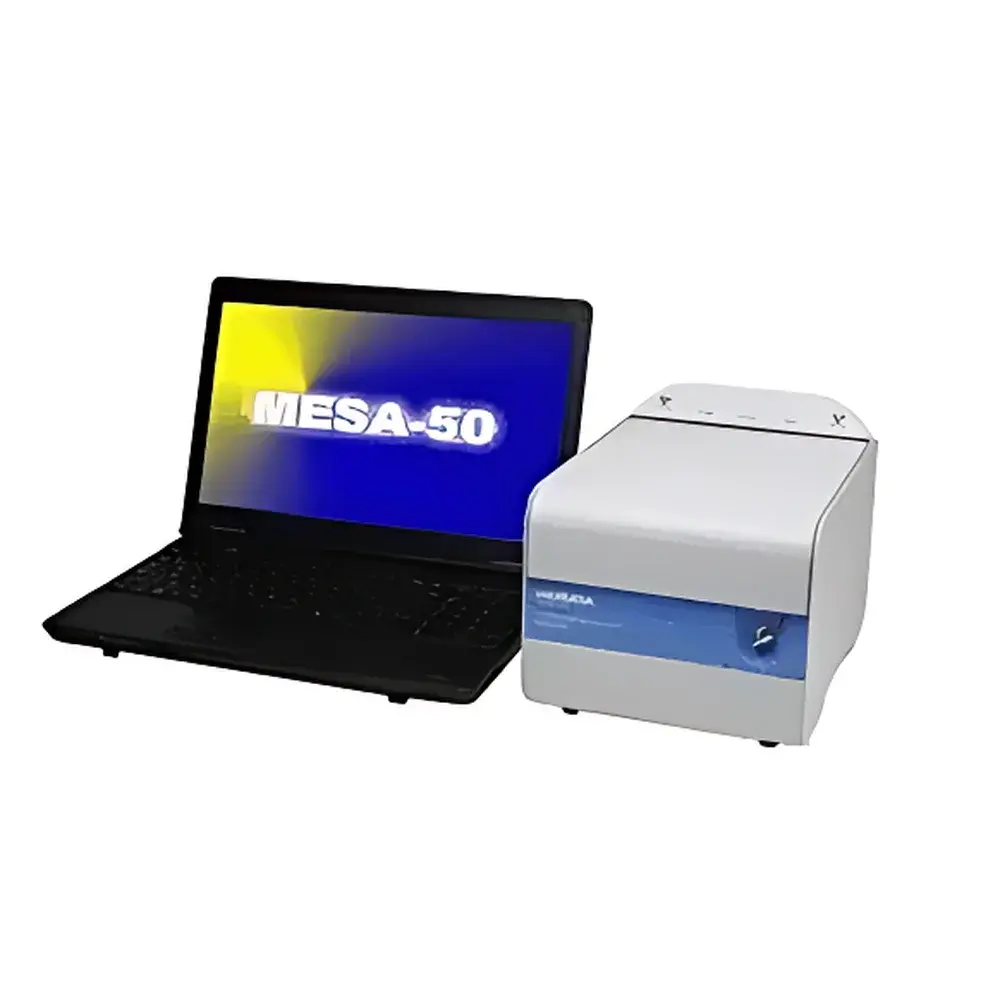
Horiba MESA-50 Wavelength Dispersive X-Ray Fluorescence Spectrometer
| Origin | Japan |
|---|---|
| Manufacturer Type | Authorized Distributor |
| Origin Category | Imported |
| Model | MESA-50 |
| Price Range | USD 42,000–70,000 |
| Instrument Type | Scanning |
| X-ray Tube Power | 10 W (50 kV, 0.2 mA) |
| Elemental Range | Al (13) to U (92) |
| Detector | Silicon Drift Detector (SDD) |
| Beam Spot Sizes | 1.2 mm, 3 mm, 7 mm (motorized auto-switching) |
| Primary Beam Filters | 4-position automatic filter wheel |
| Sample Environment | Ambient air (no vacuum required) |
| Dimensions | 294 × 208 × 205 mm |
| Weight | 12 kg |
| Battery Life | Up to 6 hours (integrated Li-ion) |
Overview
The Horiba MESA-50 is a benchtop energy-dispersive X-ray fluorescence (ED-XRF) spectrometer engineered for rapid, non-destructive elemental analysis of solids, powders, and liquids in ambient atmospheric conditions. Unlike wavelength-dispersive (WDXRF) systems—which rely on crystal diffraction and sequential scanning—the MESA-50 employs high-resolution silicon drift detector (SDD) technology coupled with digital pulse processing to deliver simultaneous multi-element quantification across the full range from aluminum (Al, Z = 13) to uranium (U, Z = 92). Its compact architecture integrates a micro-focus X-ray tube (50 kV, 0.2 mA), motorized beam collimation, and automated primary beam filtration—enabling optimized excitation for diverse matrices without vacuum or cryogenic cooling. Designed for regulatory compliance workflows—including RoHS, ELV, and halogen-free material verification—the MESA-50 meets the analytical throughput and reproducibility requirements of QC laboratories, recycling facilities, and R&D centers operating under ISO/IEC 17025 or IEC 62321 frameworks.
Key Features
- High-sensitivity SDD detector with <135 eV Mn Kα resolution at 0°C, enabling low-limit-of-detection (LOD) performance for trace heavy metals and restricted substances
- Motorized, three-position collimator system (1.2 mm, 3 mm, 7 mm) for spatially resolved analysis and heterogeneous sample mapping
- Four-position automatic primary beam filter wheel—optimized for light element enhancement (e.g., Cl, S, P) and high-Z suppression
- Integrated CCD camera with 10× optical zoom for precise sample positioning and area selection; real-time image overlay with analysis spot marking
- Self-contained lithium-ion battery pack supporting uninterrupted operation for up to six hours—ideal for field deployment or mobile lab applications
- No liquid nitrogen or vacuum pump required; ambient-air operation reduces infrastructure dependency and maintenance overhead
Sample Compatibility & Compliance
The MESA-50 accommodates flat, irregular, and irregular-height samples up to 100 mm × 100 mm × 50 mm (L × W × H) within its open-top sample chamber. It supports direct analysis of metals, polymers, ceramics, soils, coatings, and homogenized powders—without pelletization or pressing—via fundamental parameter (FP) or empirical calibration modes. For regulated testing, the instrument supports method validation per IEC 62321-5:2013 (RoHS) and EN 14382:2003 (ELV), with built-in reporting templates compliant with EU Directive 2011/65/EU and JIS C 0950. All measurement data include full audit trail metadata (operator ID, timestamp, instrument configuration, calibration status), satisfying GLP and GMP documentation requirements per FDA 21 CFR Part 11 when used with validated software configurations.
Software & Data Management
Controlled via Windows 7–10 compatible desktop software, the MESA-50 platform provides bilingual (English/Japanese) GUI with intuitive workflow navigation—from sample registration and measurement setup to quantitative report generation. The embedded digital pulse processor enables real-time spectrum accumulation, peak deconvolution, and background subtraction using iterative least-squares fitting. Quantitative analysis leverages matrix-matched standards or factory-loaded FP libraries with optional user-defined calibration curves. Export functionality includes CSV, PDF, and native .hms formats; Excel-integrated reporting tools allow direct pivot-table generation, statistical summary (RSD, recovery %), and batch comparison across production lots. Software updates are delivered via secure HTTPS portal with version-controlled release notes and change logs.
Applications
- Routine screening of electronic components, printed circuit boards (PCBs), and plastic housings for Pb, Cd, Hg, Cr(VI), Br, and Cl per RoHS/IEC 62321
- Automotive shredder residue (ASR) and end-of-life vehicle (ELV) component verification for regulated heavy metals
- Quality assurance of catalysts, pigments, and battery materials where elemental stoichiometry impacts performance
- Geological and environmental samples—soils, sediments, ores—for major and trace element profiling without digestion
- Forensic material identification and counterfeit detection via elemental fingerprinting of alloys and polymers
FAQ
Does the MESA-50 require vacuum or helium purge for light element analysis?
No. The SDD detector and optimized X-ray optics enable reliable detection of elements down to aluminum (Al) in ambient air—eliminating need for vacuum pumps or gas purging systems.
Can the instrument be calibrated for specific industrial standards such as IEC 62321-5?
Yes. Pre-configured calibration sets and certified reference materials (CRMs) aligned with IEC 62321-5 are available; users may perform in-house validation using NIST-traceable standards.
What is the typical measurement repeatability for Pb in polymer matrix at 1000 ppm level?
Under standard operating conditions (300 s counting time, 3 mm collimation), relative standard deviation (RSD) is ≤3.2% (n=10) for homogeneous polymer samples.
Is remote operation or network integration supported?
The system supports LAN-based instrument control and data transfer; optional OPC UA server module enables integration into MES or LIMS environments.
How often does the X-ray tube require replacement?
Rated lifetime exceeds 15,000 hours at nominal operating conditions; typical replacement interval is 5–7 years under daily QC use.





