
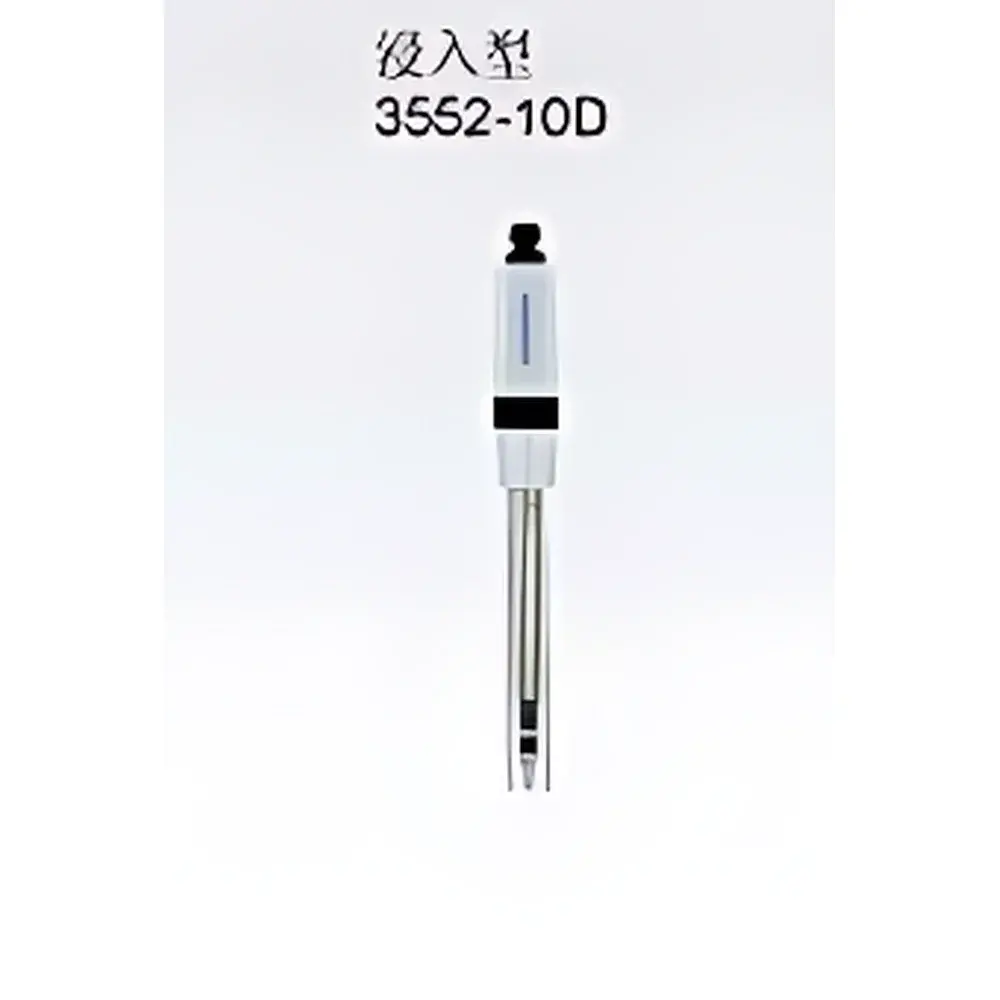
HORIBA Model 3552-10D Immersion-Type Conductivity Electrode
| Brand | HORIBA |
|---|---|
| Origin | Japan |
| Model | 3552-10D |
| Cell Constant | 100 m⁻¹ (1 cm⁻¹) |
| Conductivity Range | 0.1 mS/cm to 10 S/cm (1 μS/cm to 100 mS/cm) |
| Minimum Sample Volume | 15 mL |
| Temperature Range | 0–100 °C |
| Part Number | 3014081545 (9096000900) |
Overview
The HORIBA Model 3552-10D is a precision-engineered immersion-type conductivity electrode designed for high-accuracy, reproducible measurements in demanding laboratory and process analytical applications. Built upon HORIBA’s legacy of electrochemical sensor innovation, this electrode operates on the principle of two-electrode AC conductometry—applying a low-frequency alternating current to minimize polarization effects and electrode fouling while ensuring stable signal response across wide ionic strength gradients. With a certified cell constant of 100 m⁻¹ (equivalent to 1 cm⁻¹), it is optimized for mid-to-high conductivity ranges—specifically 0.1 mS/cm to 10 S/cm (1 μS/cm to 100 mS/cm)—making it suitable for concentrated electrolyte solutions, industrial wastewater, brines, pharmaceutical buffers, and chemical process streams where robustness and thermal stability are critical.
Key Features
- Immersion-style design with chemically resistant platinum black-plated electrodes for enhanced surface area and long-term signal stability
- Integrated temperature sensor (Pt100 or Pt1000 compatible) enabling real-time automatic temperature compensation (ATC) per ASTM D1125 and ISO 7888 standards
- Wide operational temperature range of 0–100 °C, validated for continuous use in autoclavable and steam-sanitizable environments
- Compact form factor with 15 mL minimum sample volume requirement—ideal for limited-sample applications without compromising measurement fidelity
- Rugged PEEK and glass-reinforced housing rated for IP67 ingress protection; compatible with standard BNC or DIN connectors per IEC 60068-2 environmental testing protocols
- Traceable calibration documentation aligned with ISO/IEC 17025 requirements; supports NIST-traceable standard solutions (e.g., KCl 0.01 mol/L, 0.1 mol/L, 1.0 mol/L)
Sample Compatibility & Compliance
The 3552-10D electrode demonstrates broad compatibility with aqueous and polar non-aqueous media—including acidic, alkaline, and saline matrices—provided pH remains within 2–12 to prevent irreversible platinum oxidation or coating degradation. It is routinely deployed in QC/QA workflows compliant with USP , EP 2.2.38, and JP 2.07 for purified water and water-for-injection (WFI) conductivity verification. Its construction meets RoHS Directive 2011/65/EU and REACH SVHC screening criteria. For regulated environments, the electrode integrates seamlessly with HORIBA LAQUA series meters equipped with audit-trail-enabled firmware compliant with FDA 21 CFR Part 11 and EU Annex 11 data integrity requirements.
Software & Data Management
When paired with HORIBA’s LAQUA Connect software (v3.2+), the 3552-10D enables automated calibration logging, multi-point drift analysis, and time-stamped conductivity-temperature profiles exportable in CSV, PDF, or XML formats. The software supports GLP/GMP-compliant report generation with electronic signatures, user access control levels (admin/operator), and encrypted local database storage. All measurement metadata—including electrode ID, calibration date, operator ID, ambient pressure, and solution batch number—can be embedded into exported files for full traceability in regulated laboratories.
Applications
- Pharmaceutical manufacturing: On-line monitoring of cleaning-in-place (CIP) rinse water conductivity to verify residue removal per FDA guidance
- Power plant chemistry: Continuous assessment of boiler feedwater purity and condensate return loop integrity
- Food & beverage QA: Salt concentration validation in brining tanks, soy sauce fermentation, and dairy processing effluents
- Environmental labs: High-range conductivity analysis of estuarine water, landfill leachate, and acid mine drainage samples
- Academic research: Kinetic studies of hydrolysis reactions and ion-exchange resin regeneration efficiency under elevated temperatures
FAQ
What is the recommended calibration frequency for the 3552-10D in routine QC use?
Calibration should be performed before each analytical session or at least once per 8-hour shift when used continuously. A two-point calibration using traceable KCl standards bracketing the expected sample range is required.
Can this electrode be sterilized in an autoclave?
Yes—the electrode body is rated for repeated autoclaving at 121 °C for 20 minutes; however, the cable assembly and connector must be removed prior to sterilization.
Is temperature compensation mandatory during measurement?
Yes. Conductivity is intrinsically temperature-dependent; all measurements must apply ATC using either built-in Pt100 sensing or external probe input to report values referenced to 25 °C per ISO 7888.
How often should the electrode be cleaned, and what cleaning agents are approved?
Clean after each use with deionized water. For organic fouling, soak in 5% v/v ethanol or isopropanol for ≤5 minutes. Avoid strong oxidizers (e.g., HNO₃ >10%) and abrasive scrubbing tools.
Does the 3552-10D support connection to third-party data acquisition systems?
Yes—via analog 4–20 mA or 0–5 V output (with optional signal conditioner) or digital RS-232/USB interface using HORIBA’s open ASCII command protocol for integration into SCADA or LIMS platforms.
Related Products






