
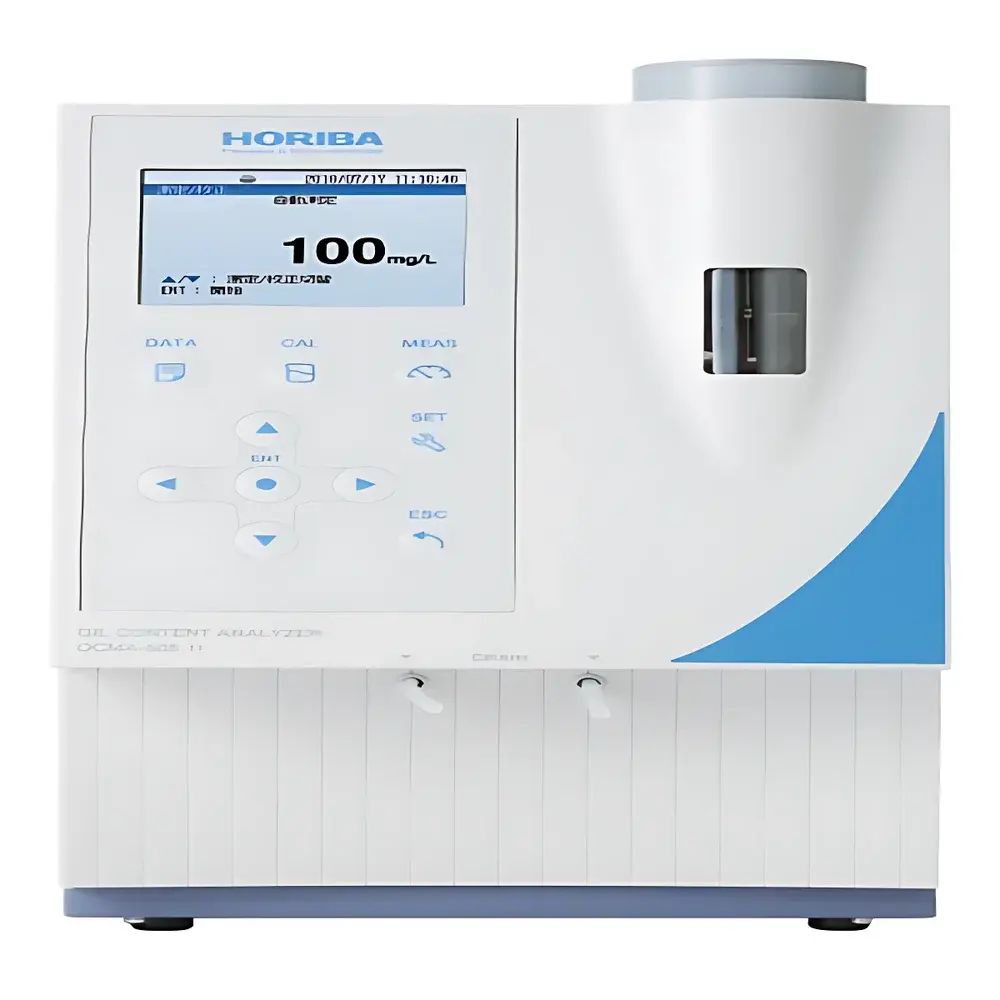
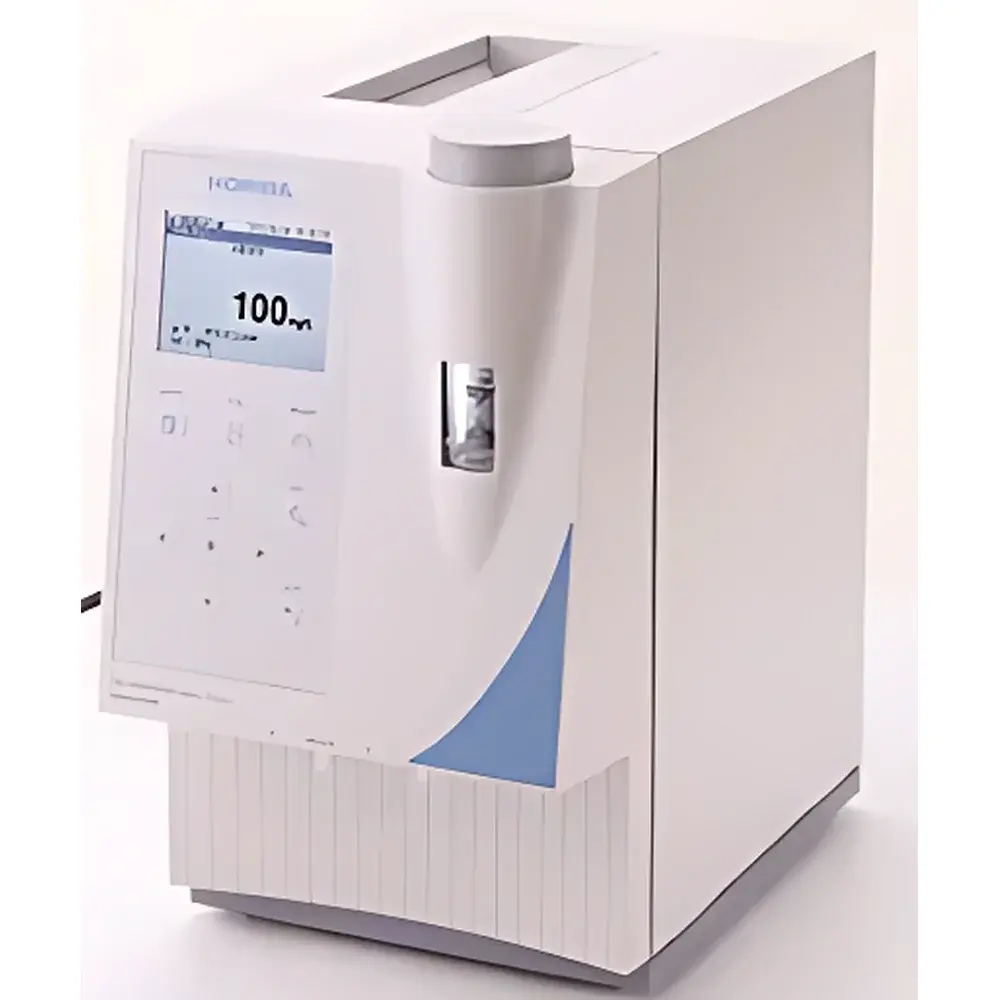
HORIBA OCMA-505H Portable Oil-in-Water Analyzer
| Brand | HORIBA |
|---|---|
| Origin | Japan |
| Model | OCMA-505H |
| Instrument Type | Portable |
| Measurement Principle | Non-Dispersive Infrared (NDIR) Spectrophotometry |
| Measurement Range | 0–200 mg/L (oil in water), 0–1000 mg/kg (oil in soil/sludge), 0–1 Absorbance |
| Accuracy | ±1% of reading (at 10–100 mg/L), ±4 mg/L + 1 digit (at 100–200 mg/L) |
| Resolution | 0.1 mg/L (0–99.9 mg/L), 1 mg/L (100–200 mg/L) |
| Repeatability | ±0.2 mg/L + 1 digit (0–10 mg/L), ±2 mg/L + 1 digit (10–100 mg/L), ±4 mg/L + 1 digit (100–200 mg/L) |
| Extractant | HORIBA H-519 solvent |
| Optional Accessory | Solvent Regenerator SR-305 |
Overview
The HORIBA OCMA-505H is a fully automated, portable oil-in-water analyzer engineered for rapid, field-deployable quantification of hydrocarbon contamination in aqueous matrices—including freshwater, seawater, industrial effluent, and wastewater treatment influent/effluent streams. It operates on the principle of non-dispersive infrared (NDIR) absorption spectroscopy, targeting the characteristic C–H stretching vibration band near 2960 cm⁻¹ (3.39 µm), which provides high selectivity for aliphatic and aromatic hydrocarbons commonly found in mineral oils, diesel, lubricants, and crude oil residues. Unlike conventional benchtop IR spectrometers requiring manual solvent extraction and cell loading, the OCMA-505H integrates a precision syringe-based liquid handling system that automates solvent extraction, phase separation, optical measurement, and waste disposal—all within a single compact housing. Its 0–200 mg/L dynamic linear range eliminates manual range switching, enabling seamless analysis across trace-level regulatory thresholds (e.g., EPA Method 1664A compliance at 10 mg/L) and higher concentrations typical of industrial spills or pretreatment monitoring.
Key Features
- Fully automated sample processing: integrated H-519 solvent extraction, biphasic separation, and NDIR absorbance measurement in <6 minutes per sample
- True portable architecture: battery-operable (optional), IP54-rated enclosure, weight <8.5 kg—designed for on-site deployment at wastewater plants, coastal monitoring stations, and offshore platforms
- Digital real-time diagnostics: English-language LCD interface displays operational status, error codes (e.g., “Solvent Low”, “Phase Separation Failure”, “Optical Drift Alert”), and raw absorbance values
- Quantitative precision syringe delivery: proprietary dual-syringe system ensures fixed-volume (50 mL water + 10 mL H-519) reproducibility, minimizing operator-induced variability
- Calibration traceability: supports multi-point calibration using certified reference standards traceable to NIST SRM 2781 (mineral oil in water); factory-calibrated with documented uncertainty budget
- Robust optical path: sealed, temperature-stabilized NDIR detector with dual-wavelength referencing (measurement/reference channel at 3.39 µm / 3.55 µm) compensates for solvent background and particulate scatter
Sample Compatibility & Compliance
The OCMA-505H is validated for direct analysis of clarified or filtered water samples (including saline matrices up to 3.5% NaCl). For turbid or emulsified samples, optional centrifugation or filtration (0.45 µm membrane) is recommended prior to injection. The instrument complies with key international method frameworks: its measurement principle aligns with ASTM D7066-22 (Standard Test Method for Determination of Oil and Grease and Selected Petroleum Hydrocarbons in Water by Extraction and Infrared Spectrophotometry), and its performance specifications meet the sensitivity and repeatability requirements outlined in ISO 9377-2:2000 (Water quality — Determination of hydrocarbon oil index — Part 2: Infrared spectrometric method). While not a GLP-certified platform, its audit-ready data logs (timestamped results, calibration history, error flags) support routine QA/QC in regulated environments operating under ISO/IEC 17025 or EPA-approved laboratory practices.
Software & Data Management
Data output is via RS-232 serial interface (USB adapter optional) to external PCs or printers. The embedded firmware stores up to 500 test records—including date/time stamp, sample ID, measured concentration (mg/L), absorbance value, and system diagnostic flags. No proprietary software is required; exported CSV files are compatible with LIMS integration and statistical process control (SPC) tools. Calibration coefficients and user-defined correction factors (e.g., for salinity interference compensation) are stored in non-volatile memory and survive power cycles. Firmware updates are performed via SD card—ensuring long-term maintainability without vendor dependency.
Applications
- Regulatory compliance monitoring: effluent discharge reporting per local environmental agency limits (e.g., EU WFD, US Clean Water Act NPDES permits)
- Industrial pretreatment verification: detection of hydrocarbon breakthrough in refinery, petrochemical, or metalworking shop wastewater streams
- Marine pollution response: rapid on-board screening of bilge water, ballast water, or harbor sediment pore water
- Environmental site assessment: field screening of groundwater plumes and surface water near UST (underground storage tank) sites
- Process optimization: real-time feedback for oil-water separator efficiency or activated carbon filter saturation endpoints
FAQ
What solvent is required for operation?
The OCMA-505H requires HORIBA’s proprietary H-519 extraction solvent—a chlorinated hydrocarbon blend optimized for NDIR response, low water solubility, and minimal spectral interference. Substitution with generic CCl₄ or Freon alternatives is not supported and voids calibration validity.
Can the instrument analyze oily sludge or sediment?
Yes—when configured for solid-phase analysis (0–1000 mg/kg), it accepts homogenized slurry samples extracted per ASTM D7678. Requires optional SR-305 solvent regenerator for extended field use due to higher solvent consumption.
Is the SR-305 solvent regenerator mandatory?
No—it is optional but strongly recommended for >10 daily analyses. The SR-305 uses dual-bed activated carbon and activated alumina to remove water, particulates, and oxidized hydrocarbons from spent H-519, restoring >95% spectral purity for reuse over ≥200 extractions.
How is calibration verified in the field?
A two-point verification check (0 mg/L blank + 50 mg/L standard) is performed before each analytical batch. Drift exceeding ±3% of mid-range value triggers automatic recalibration prompt and flags all subsequent results until corrected.
Does the OCMA-505H meet FDA 21 CFR Part 11 requirements?
No—it lacks electronic signature capability, audit trail encryption, and role-based access control. It is intended for environmental field screening—not pharmaceutical or food-grade release testing where Part 11 compliance is mandated.
Related Products







