
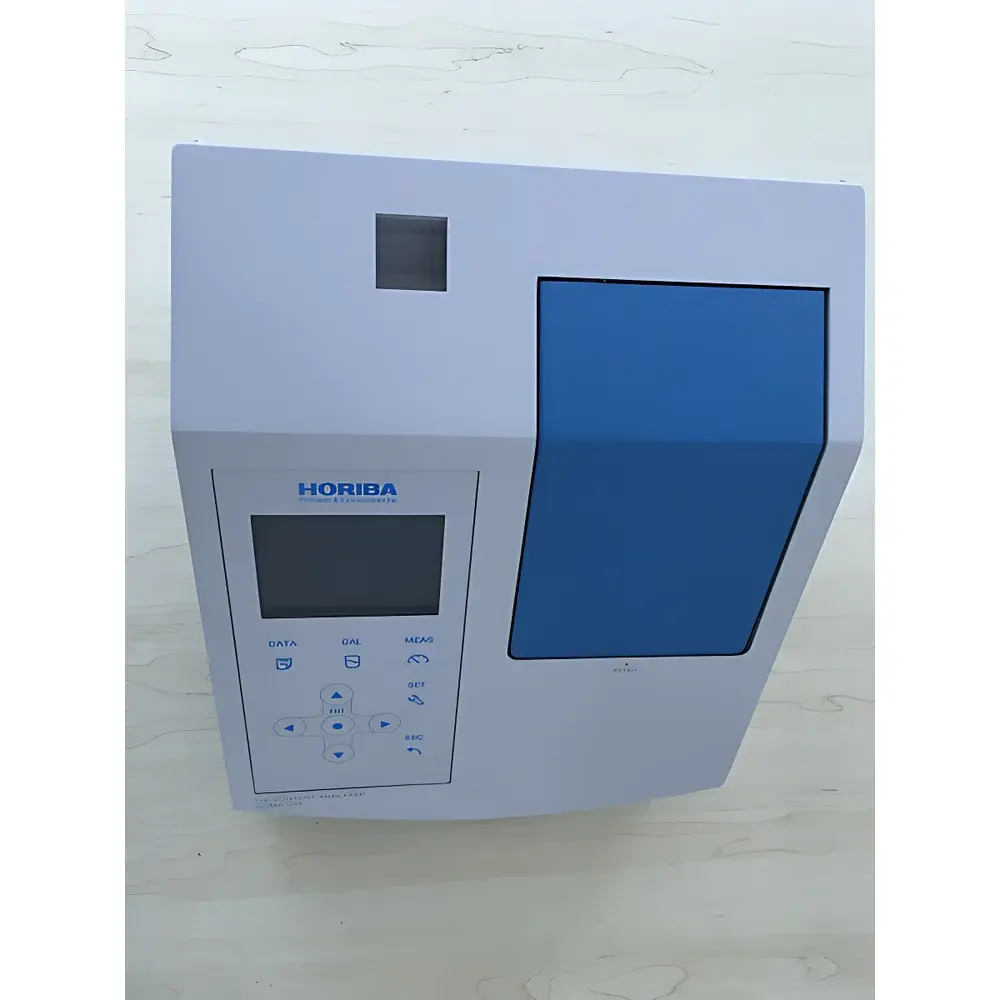
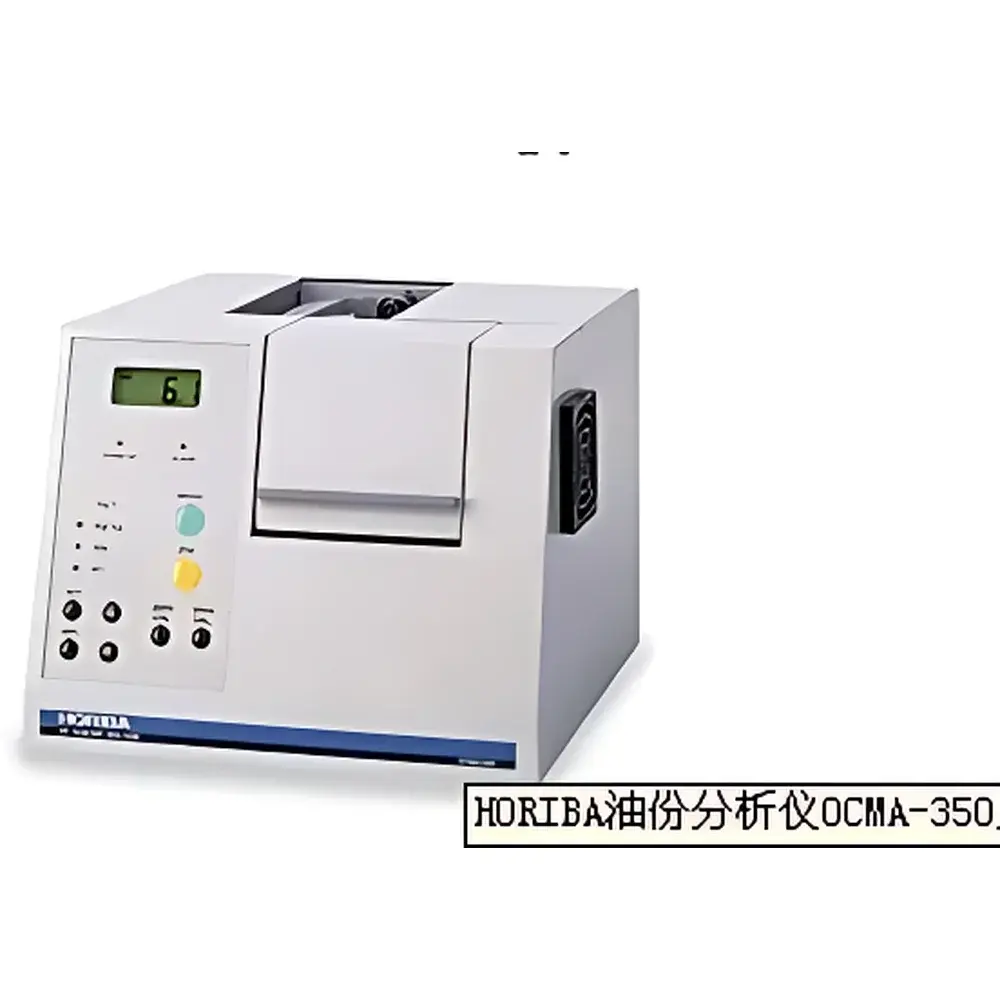
HORIBA OCMA-550 Oil Content Analyzer
| Brand | HORIBA |
|---|---|
| Origin | Japan |
| Model | OCMA-550 |
| Principle | Non-Dispersive Infrared (NDIR) Absorption with S-316 Solvent Extraction |
| Measurement Range | 0–200 mg/L (water), 0–1000 mg/kg (soil), 0–1 Abs |
| Accuracy | ±0.4 mg/L (0–9.9 mg/L), ±2.0 mg/L (10.0–99.9 mg/L), ±4 mg/L (100–200 mg/L), ±1% F.S. (0–1 Abs) |
| Resolution | 0.1 mg/L (equivalent to 0.1 ppm in aqueous phase) |
| Detector | Thermoelectric Sensor |
| Display | Backlit LCD with Timestamp |
| Interface | RS-232C, Parallel Printer Port |
| Power Supply | 230 V AC, 50 Hz |
| Dimensions | 250 × 200 × 285 mm (W × H × D) |
| Sample Cell | 200 mm Pathlength Quartz Cuvette |
| Compliance | ASTM D7066, ISO 9377-2 (oil-in-water), USP <1058> (instrument qualification framework), GLP/GMP-ready data logging |
Overview
The HORIBA OCMA-550 Oil Content Analyzer is a laboratory-grade, non-dispersive infrared (NDIR) spectrophotometric instrument engineered for precise quantification of hydrocarbon-based oil contaminants in aqueous and solid-phase environmental samples. It operates on the principle of selective infrared absorption at the characteristic C–H stretching band near 3.4 µm — a spectral region where hydrocarbons exhibit strong, reproducible absorbance, while the extraction solvent S-316 remains optically transparent. This enables highly specific detection without interference from water, suspended solids (SS), or common matrix components. The system requires prior liquid–liquid extraction using S-316, a chlorinated fluorocarbon solvent optimized for quantitative recovery of aliphatic and aromatic hydrocarbons (e.g., mineral oils, lubricants, cutting fluids). Following extraction, the solvent–oil mixture is introduced into a standardized 200 mm pathlength quartz cuvette; the instrument performs single-beam NDIR measurement and calculates concentration based on Beer–Lambert law calibration. Its design prioritizes analytical robustness in regulated environments — supporting trace-level detection down to 0.1 ppm (mg/L) in water and enabling direct reporting in mg/L, mg/kg, or absorbance units without manual conversion.
Key Features
- Triple-unit reporting capability: switch seamlessly between mg/L (for water extracts), mg/kg (for soil/sediment extracts), and Abs (absorbance at 3.4 µm) via front-panel menu
- Integrated timestamping and automatic zero calibration upon power-on, ensuring data traceability and baseline stability
- Thermoelectric detector with low drift and high signal-to-noise ratio, optimized for long-term operation under ambient lab conditions
- Backlit monochrome LCD display with intuitive icon-driven interface — no PC required for routine measurements
- Dual digital output: RS-232C serial port for connection to LIMS or data acquisition software, plus parallel printer port for hardcopy audit trails
- Compact benchtop footprint (250 × 200 × 285 mm) compatible with fume hoods and QA/QC laboratories with space constraints
- Designed for compatibility with HORIBA’s optional SR-300/SR-305 solvent regeneration systems, reducing solvent consumption and disposal costs per analysis
Sample Compatibility & Compliance
The OCMA-550 accommodates a broad range of sample matrices following standardized solvent extraction protocols. It is routinely deployed for wastewater effluent monitoring (post-treatment discharge compliance), industrial process water surveillance (e.g., metalworking fluid carryover), contaminated soil screening (EPA Method 418.1 equivalent workflows), and surface residue verification in precision manufacturing (e.g., semiconductor wafer cleaning validation, aerospace component degreasing QC). Its measurement methodology aligns with key international standards including ASTM D7066 (standard test method for oil and grease in water by infrared spectroscopy), ISO 9377-2 (water quality — determination of hydrocarbon oil index — part 2: infrared spectrometric method), and supports instrument qualification per USP and FDA 21 CFR Part 11 requirements when paired with validated software and audit-trail-enabled data management practices.
Software & Data Management
While the OCMA-550 operates as a standalone analyzer, its RS-232C interface enables integration with third-party laboratory information management systems (LIMS) or custom data acquisition platforms. All measurements include embedded timestamps, user ID fields (via optional keyboard accessory), and instrument serial number metadata. Raw absorbance values and calculated concentrations are transmitted in ASCII format with configurable delimiter settings. For regulated environments, users may implement external software solutions that enforce electronic signatures, version-controlled calibration records, and automated backup — fulfilling ALCOA+ (Attributable, Legible, Contemporaneous, Original, Accurate, Complete, Consistent, Enduring, Available) data integrity principles. The built-in parallel port supports direct printing to dot-matrix or thermal printers compliant with ISO/IEC 19794-5 for permanent record generation.
Applications
- Regulatory wastewater discharge testing per local environmental authority mandates (e.g., EU Industrial Emissions Directive, U.S. EPA NPDES permits)
- Validation of oil–water separation efficiency in treatment plants and oily water separators (OWS)
- Residual oil quantification on machined parts, stamped metals, and textile substrates prior to coating or plating
- Leachate analysis from landfills and contaminated brownfield sites
- Quality control of cleaning agents and solvent recycling processes in automotive and aerospace maintenance facilities
- Method transfer and reference measurement in inter-laboratory comparison studies requiring NDIR traceability
FAQ
What extraction solvent is required for the OCMA-550?
S-316 (1,1,2-trichloro-1,2,2-trifluoroethane) is the specified solvent for quantitative hydrocarbon extraction. It exhibits minimal IR absorbance at 3.4 µm and high solvation power for C8–C40 aliphatics and aromatics.
Can the OCMA-550 measure emulsified or dissolved oil fractions?
No — the method measures only solvent-extractable, non-polar hydrocarbons. Emulsified or surfactant-stabilized oil must first be broken via acidification, centrifugation, or filtration prior to S-316 extraction.
Is the instrument suitable for field use?
It is designed exclusively for controlled laboratory environments. No battery operation, environmental sealing, or shock resistance is provided.
How often does the instrument require calibration verification?
Per ASTM D7066, daily verification with certified reference standards (e.g., B-grade heavy oil supplied with unit) is recommended; full calibration curve verification every 30 days or after maintenance.
Does HORIBA provide IQ/OQ documentation support?
Yes — factory-issued Instrument Qualification templates (IQ/OQ/PQ) are available upon request and are structured to align with ISO/IEC 17025 and GxP laboratory quality systems.
Related Products







