
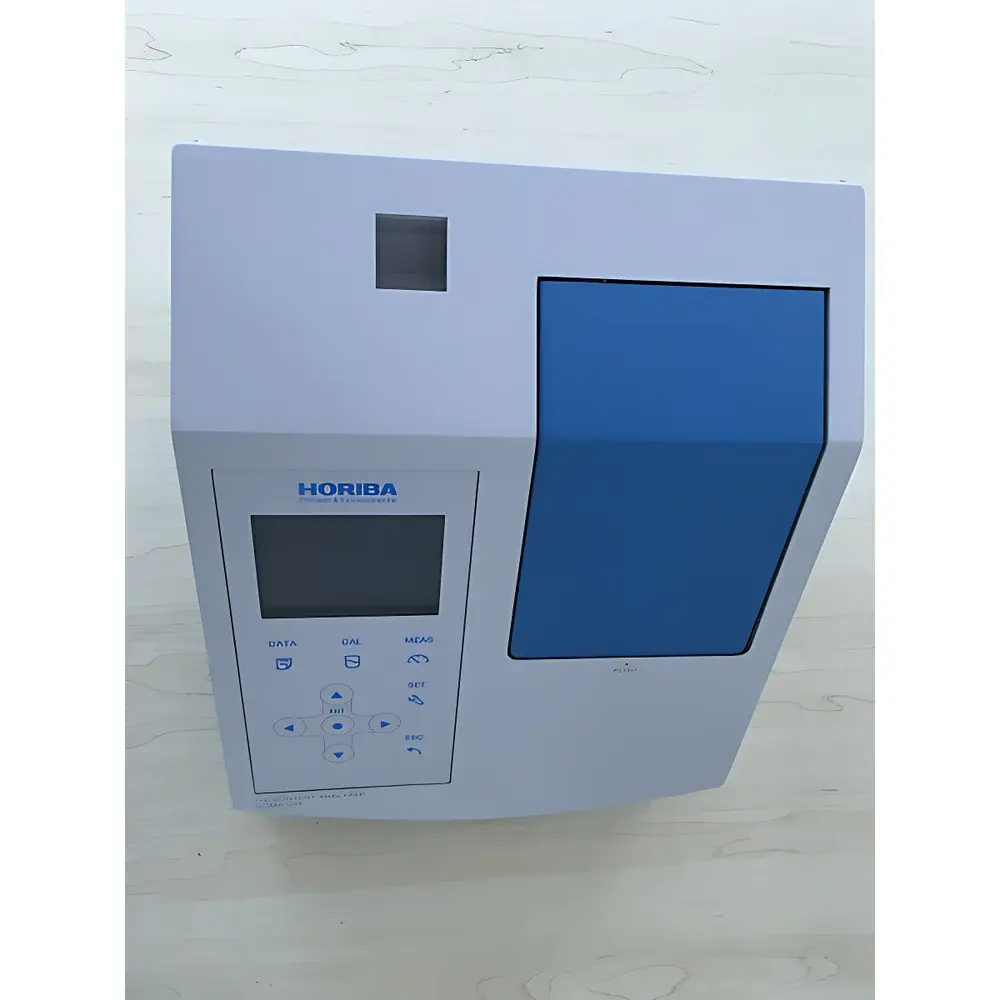
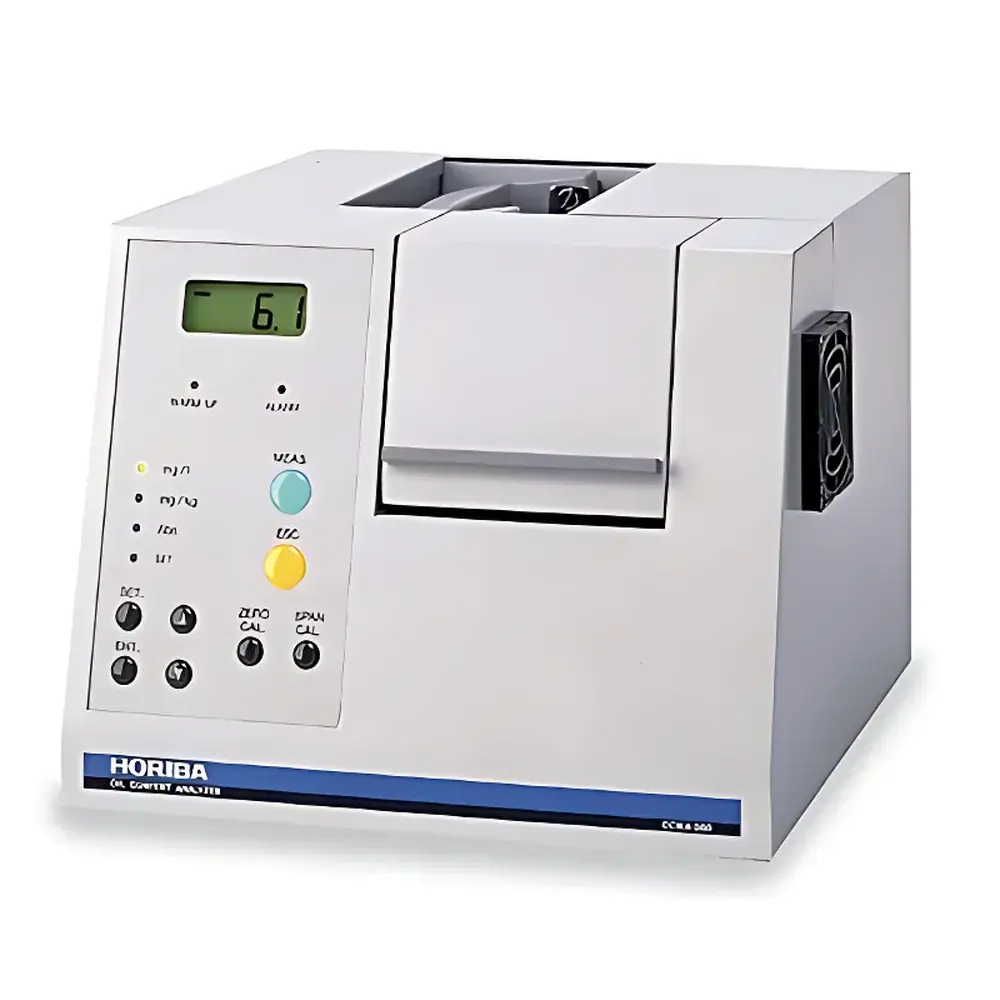
HORIBA OCMA-550 Oil Content Analyzer
| Brand | HORIBA |
|---|---|
| Origin | Japan |
| Model | OCMA-550 |
| Instrument Type | Portable |
| Measurement Principle | Non-Dispersive Infrared (NDIR) Absorption Spectrophotometry |
| Measurement Range | 0–200 mg/L, 0–1000 mg/kg, 0–1 Abs |
| Accuracy | ±1% of reading (at 1 mg/L level) |
| Resolution | 0.1 mg/L (for 0–99.9 mg/L range) |
| Repeatability | ±0.4 mg/L ±1 digit (0–9.9 mg/L), ±2.0 mg/L ±1 digit (10.0–99.9 mg/L), ±4 mg/L ±1 digit (100–200 mg/L), ±1% F.S. (0–1 Abs) |
| Detector | Thermopile Sensor |
| Light Source | IR Emitter at ~3.4 µm |
| Solvent Compatibility | S-316 (non-absorbing at 3.4 µm) |
| Display | Backlit LCD with timestamping |
| Data Interface | RS-232C serial port & parallel printer port |
| Dimensions | 250 mm × 200 mm × 285 mm (W × H × D) |
| Power Supply | 230 V AC, 50 Hz |
| Standard Cell | 20 mm pathlength quartz cuvette |
Overview
The HORIBA OCMA-550 Oil Content Analyzer is a portable, field-deployable instrument engineered for quantitative determination of hydrocarbon oil content in aqueous and solid-phase environmental samples using non-dispersive infrared (NDIR) absorption spectrophotometry. It operates at the characteristic C–H stretching absorption band near 3.4 µm — a spectral region where aliphatic and aromatic hydrocarbons exhibit strong, selective absorbance, while the extraction solvent S-316 remains optically transparent. This spectral selectivity ensures high specificity for petroleum-based oils and greases without interference from water, salts, or common organic solvents. Designed for compliance with EPA Method 1664 (revision B) and ISO 9377-2 principles, the OCMA-550 delivers trace-level sensitivity down to 0.1 ppm (equivalent to 0.1 mg/L) when coupled with standardized liquid–liquid extraction protocols. Its compact architecture and battery-free AC operation make it suitable for on-site analysis in wastewater treatment plants, hazardous waste characterization sites, industrial effluent monitoring stations, and laboratory-based QA/QC workflows.
Key Features
- Triple-unit measurement capability: switch seamlessly between concentration units — mg/L (for water extracts), mg/kg (for soil/sediment extracts), and absorbance (Abs) — directly on the instrument interface.
- Thermopile-based IR detector with stable thermal compensation, enabling high reproducibility across ambient temperature fluctuations (15–35 °C operating range).
- Backlit monochrome LCD display with integrated real-time timestamping for audit-ready result logging; no external PC required for basic operation.
- Dual data output: RS-232C serial interface supports ASCII-formatted data export to LIMS or spreadsheet software; parallel port enables direct connection to standard dot-matrix or thermal printers.
- Optimized optical path using 20 mm pathlength quartz cuvettes — resistant to S-316 solvent corrosion and compatible with low-volume (25 µL) micro-injection via included precision syringes.
- Automatic zero calibration upon power-on and user-initiated reference reset, minimizing drift-related errors during extended field campaigns.
Sample Compatibility & Compliance
The OCMA-550 is validated for use with S-316 (1,1,2-trichloro-1,2,2-trifluoroethane), a halogenated solvent selected for its negligible IR absorption at 3.4 µm and efficient hydrocarbon extraction efficiency per ASTM D7066 and ISO 9377-2. It accommodates pre-extracted samples from diverse matrices including surface water, groundwater, industrial wastewater, soil leachates, metal parts rinsates, and textile processing effluents. When operated within defined procedural controls — including controlled extraction time, phase separation, and cuvette cleaning protocols — the system meets data quality objectives aligned with US EPA SW-846 Method 3510C (separatory funnel extraction) and supports GLP-compliant documentation through timestamped readouts and optional external data capture. While not intrinsically certified for explosion-proof environments, its Class I, Division 2 suitability is confirmed under standard laboratory and outdoor sheltered conditions.
Software & Data Management
The OCMA-550 functions as a standalone analytical endpoint with embedded firmware that manages calibration coefficients, unit conversion logic, and signal averaging algorithms. No proprietary software installation is required for routine operation. Raw absorbance values and converted concentrations are stored in volatile memory with timestamps; persistent storage requires external transfer via RS-232C (9600 baud, 8N1). The instrument supports FDA 21 CFR Part 11–compatible data integrity practices when integrated into validated laboratory networks — specifically, operator identification, electronic signature capability (via connected terminal), and audit trail generation (when paired with compliant LIMS). Optional solvent regeneration accessories (e.g., SR-305) extend S-316 reuse cycles, reducing consumables cost and supporting ISO 14001-aligned waste minimization goals.
Applications
- Regulatory compliance monitoring of oil-in-water concentrations in discharge permits (e.g., NPDES, EU WFD Annex V).
- Verification of degreasing process efficacy in precision machining, semiconductor wafer cleaning, and electroplating facilities.
- Rapid screening of contaminated soils and sediments at brownfield remediation sites prior to confirmatory GC-FID analysis.
- Quality control of coolant emulsions, cutting fluids, and lubricant carryover in metalworking operations.
- Quantitative assessment of residual hydrocarbons on textiles, filters, and particulate matter (e.g., SS, TSS) following filtration-based sample preparation.
FAQ
What extraction solvent is required for the OCMA-550, and why is S-316 specified?
S-316 is mandatory due to its near-zero infrared absorbance at the 3.4 µm detection wavelength, ensuring only hydrocarbon signals contribute to the measured absorbance. Substitution with alternatives (e.g., CCl₄, HCFC-141b) introduces spectral interference and invalidates calibration traceability.
Can the OCMA-550 measure polycyclic aromatic hydrocarbons (PAHs) selectively?
No — it measures total extractable petroleum hydrocarbons (TEPH) based on bulk C–H bond density. PAH-specific quantification requires GC-MS or HPLC-UV analysis.
Is the instrument suitable for unfiltered or turbid samples?
No — all samples must undergo phase separation and filtration (0.45 µm) prior to analysis to prevent scattering artifacts and cuvette fouling.
How often does the instrument require recalibration?
Factory calibration remains stable for ≥12 months under normal use; field verification with certified reference standards (e.g., B-grade heavy oil) is recommended before each analytical batch.
Does the OCMA-550 support multi-point calibration?
No — it uses a single-point zero/reference correction and fixed slope calibration derived from NIST-traceable standards; linearity is verified over the full 0–200 mg/L range per ISO/IEC 17025 requirements.
Related Products







