
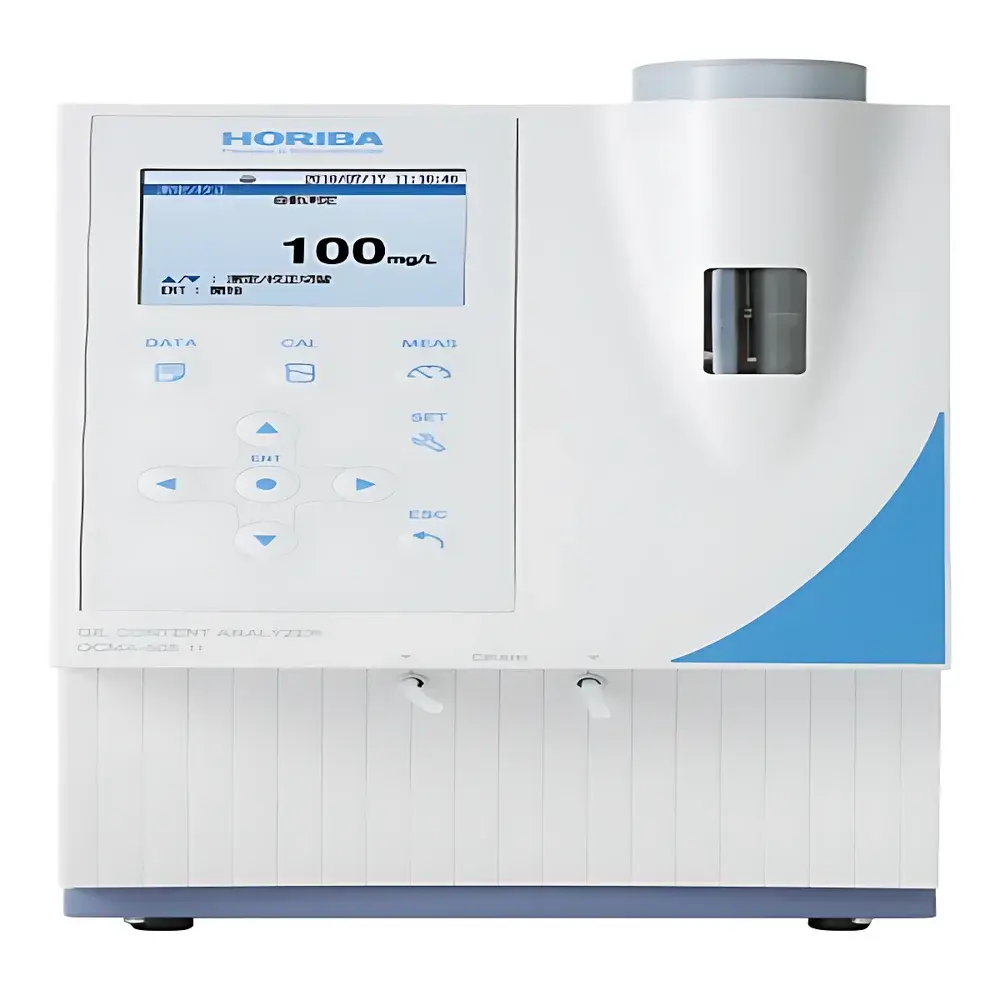
HORIBA OCMA-550 Portable Infrared Oil Content Analyzer
| Brand | HORIBA |
|---|---|
| Origin | Japan |
| Model | OCMA-550 |
| Instrument Type | Portable |
| Measurement Principle | Non-Dispersive Infrared (NDIR) Absorption Spectrophotometry |
| Measurement Range | 0–200 mg/L, 0–1000 mg/kg, 0–1 Abs |
| Detection Limit | 0.3 mg/L |
| Accuracy | ±1% of reading (for mg/L scale) |
| Resolution | 0.1 mg/L (0–99.9 mg/L range) |
| Optical Path Length | 20 mm quartz cell |
| Power Supply | 230 V AC, 50 Hz |
| Dimensions | 250 × 200 × 285 mm (W × H × D) |
| Detector Type | Thermoelectric sensor |
| Data Interface | RS-232C, parallel printer port |
| Display | Backlit LCD with timestamping |
Overview
The HORIBA OCMA-550 Portable Infrared Oil Content Analyzer is an engineered solution for quantitative determination of hydrocarbon-based oil contaminants in aqueous and solid-phase environmental samples. It operates on the principle of non-dispersive infrared (NDIR) absorption spectrophotometry, specifically targeting the C–H stretching vibration band near 3.4 µm — a region where aliphatic hydrocarbons exhibit strong, characteristic absorbance. The instrument is designed for post-extraction analysis: samples are first extracted using S-316 solvent (a chlorinated fluorocarbon selected for its spectral transparency at the measurement wavelength), and the resulting extract is introduced into a standardized 20 mm path-length quartz cuvette. Because S-316 exhibits negligible absorption at 3.4 µm, the measured absorbance is directly attributable to extracted oil components, enabling high selectivity and minimal matrix interference. The OCMA-550 delivers trace-level sensitivity with a detection limit of 0.3 mg/L and resolution of 0.1 mg/L in the low-concentration range, making it suitable for regulatory compliance monitoring, industrial effluent verification, and site remediation assessment.
Key Features
- Triple-unit display capability: simultaneous selection among mg/L (for water extracts), mg/kg (for soil/sediment extracts), and absorbance (Abs) — facilitating direct method alignment with ASTM D7066, ISO 9377-2, and EPA Method 1664B reporting conventions.
- Integrated thermoelectric detector with stable zero-point referencing; automatic baseline correction initiated after standard initialization sequence ensures long-term measurement reproducibility.
- Backlit LCD interface with embedded real-time timestamping — supports GLP-compliant recordkeeping without external software dependency.
- Dual data output: native RS-232C serial interface for integration with LIMS or custom acquisition software, plus parallel printer port for hard-copy audit trails.
- Compact benchtop footprint (250 × 200 × 285 mm) and 230 V AC / 50 Hz operation optimized for field laboratories, mobile environmental units, and QC labs with limited space.
- Compatible with optional SR-300/SR-305 solvent regeneration systems — reduces consumable costs and supports sustainable solvent reuse per ISO 14001-aligned lab practices.
Sample Compatibility & Compliance
The OCMA-550 is validated for use with S-316 solvent-extracted samples from diverse matrices including surface water, groundwater, wastewater, soil, sludge, metal parts, and textile surfaces. Its optical design conforms to the spectral requirements of widely adopted regulatory methods: EPA Method 1664B (revision B) for n-hexane extractable material (HEM), ISO 9377-2:2000 for petroleum hydrocarbons in water, and ASTM D7066-19 for oil-in-water quantification. While the instrument itself does not perform extraction, its NDIR detection module meets the instrumental performance criteria specified in Section 9.2 of EPA 1664B for infrared photometers. All measurements adhere to documented calibration protocols traceable to NIST-certified mineral oil standards. The system supports audit-ready documentation through timestamped LCD readouts and ASCII-formatted serial output compliant with FDA 21 CFR Part 11 when paired with validated data acquisition software.
Software & Data Management
The OCMA-550 operates as a standalone analytical endpoint with no embedded operating system or proprietary firmware dependencies. Data management relies on hardware-level functionality: all measurements include automatic time/date stamping stored in volatile memory and displayed in real time. For extended data handling, the RS-232C interface transmits ASCII-encoded results (including unit identifier, numeric value, and timestamp) at 9600 baud, 8N1 configuration — compatible with standard terminal emulators, spreadsheet import tools, and laboratory information management systems (LIMS). No drivers or software installation is required. When used in regulated environments, laboratories must implement procedural controls — such as defined calibration frequency, operator training records, and manual logbook cross-referencing — to satisfy GLP or GMP documentation requirements. The absence of onboard storage or user-modifiable parameters inherently limits data integrity risks associated with electronic records manipulation.
Applications
- Environmental site assessment: rapid screening of groundwater plumes and soil cores for petroleum hydrocarbon contamination during Phase II investigations.
- Industrial wastewater compliance: routine monitoring of effluent discharge points against local regulatory thresholds (e.g., ≤10 mg/L oil & grease under EU Urban Wastewater Treatment Directive).
- Manufacturing process control: validation of cleaning efficacy for machined parts, semiconductor wafers, and precision optics using residual oil quantification per JIS Z 8401 or ISO 5725 precision criteria.
- Treatment plant performance verification: quantification of oil removal efficiency across API separators, coalescers, and activated carbon filters.
- Regulatory reporting: generation of auditable concentration data supporting Tier 2 risk assessments, RCRA Land Disposal Restrictions (LDR), and SPCC Plan documentation.
FAQ
What extraction solvent is required for OCMA-550 operation?
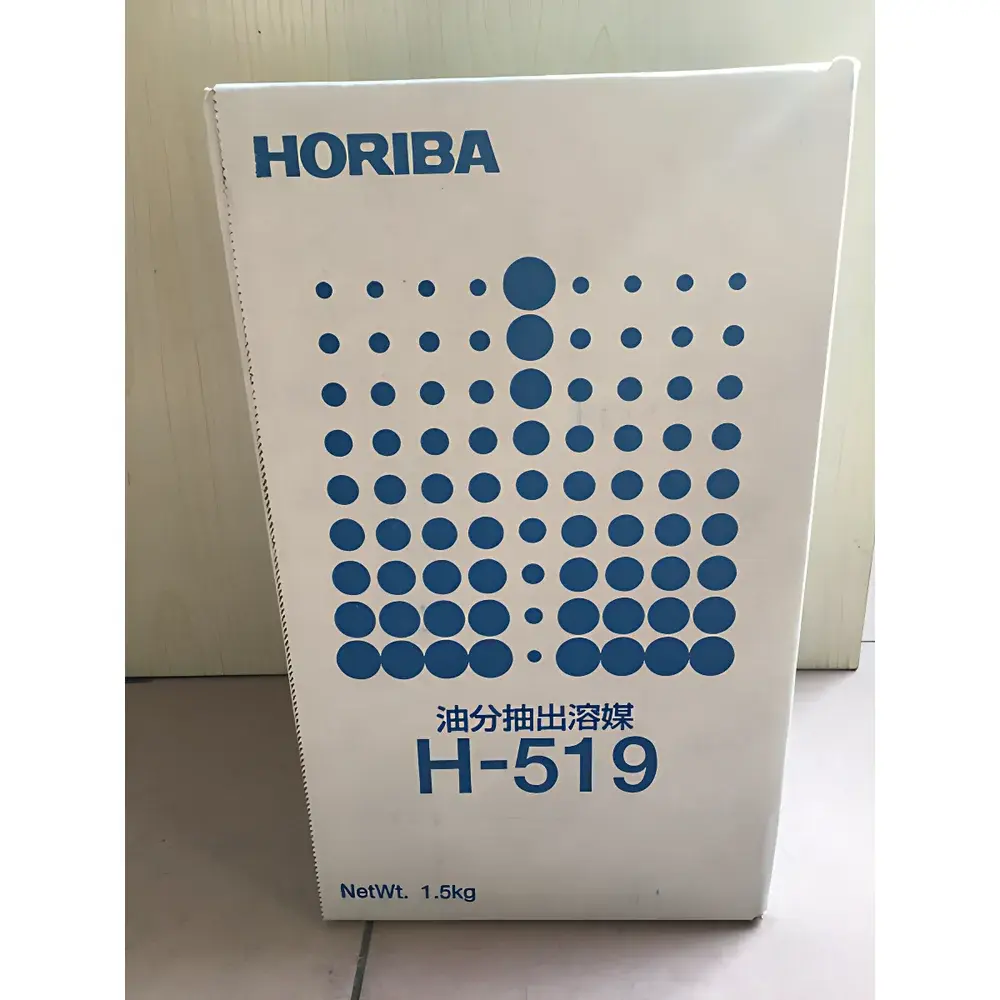
S-316 (1,1,2-trichloro-1,2,2-trifluoroethane) is the specified extraction solvent. Its infrared transparency at 3.4 µm ensures selective measurement of hydrocarbon absorbance without solvent interference.
Can the OCMA-550 measure emulsified or dissolved oil fractions?
No. The instrument measures only solvent-extractable hydrocarbons — i.e., free, dispersed, and non-aqueously soluble oil phases. Emulsified or micellar-bound fractions require prior phase separation or acidification per EPA 1664B Section 7.3.
Is calibration traceable to national standards?
Yes. Calibration is performed using certified mineral oil standards (e.g., NIST SRM 2781), and the instrument’s linearity and repeatability meet the acceptance criteria outlined in ISO/IEC 17025 Clause 7.7 for calibrated equipment.
Does the OCMA-550 support multi-point calibration?
The device performs single-point calibration using a blank (S-316 only) and one certified standard. Multi-point verification is conducted externally via laboratory-developed calibration curves adhering to ISO Guide 35 principles.
What maintenance is required for long-term accuracy?
Annual verification of detector response stability and cuvette transmission characteristics is recommended. Quartz cuvettes must be cleaned with lint-free wipes and spectroscopic-grade methanol to prevent residue-induced drift.







