
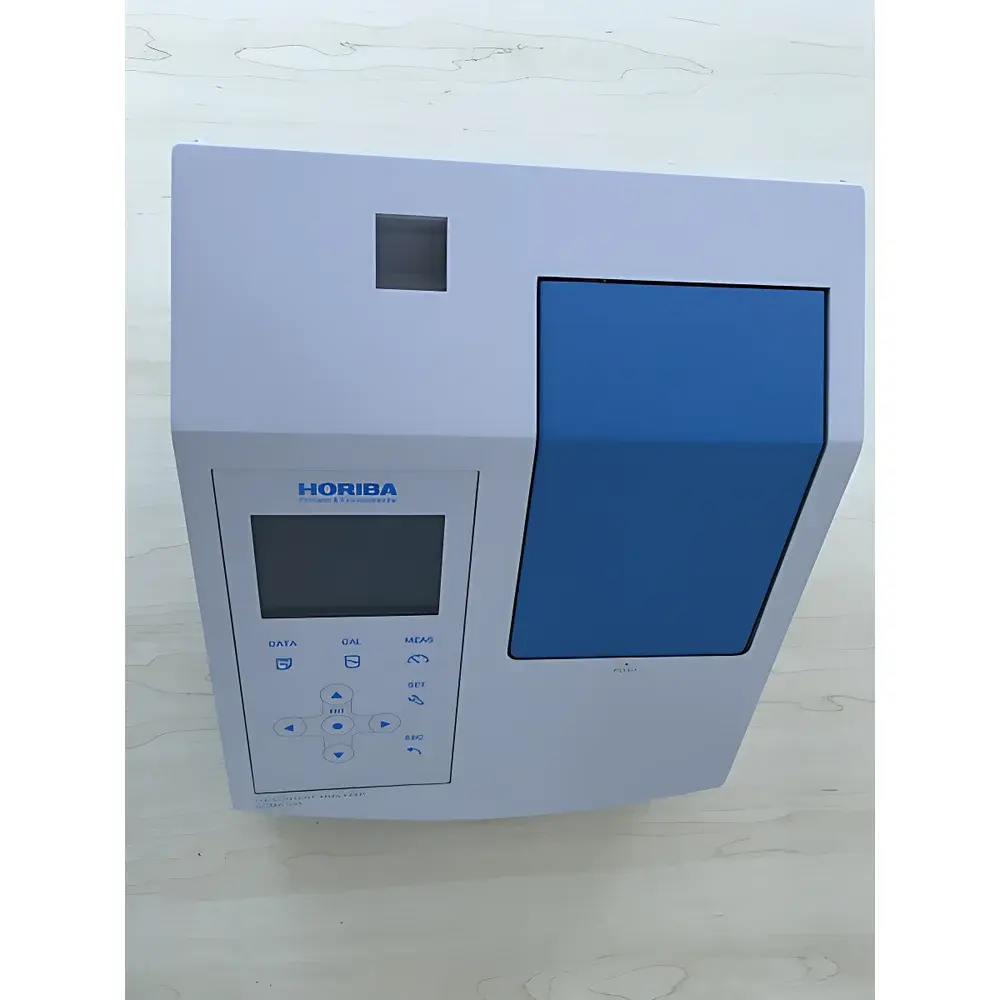
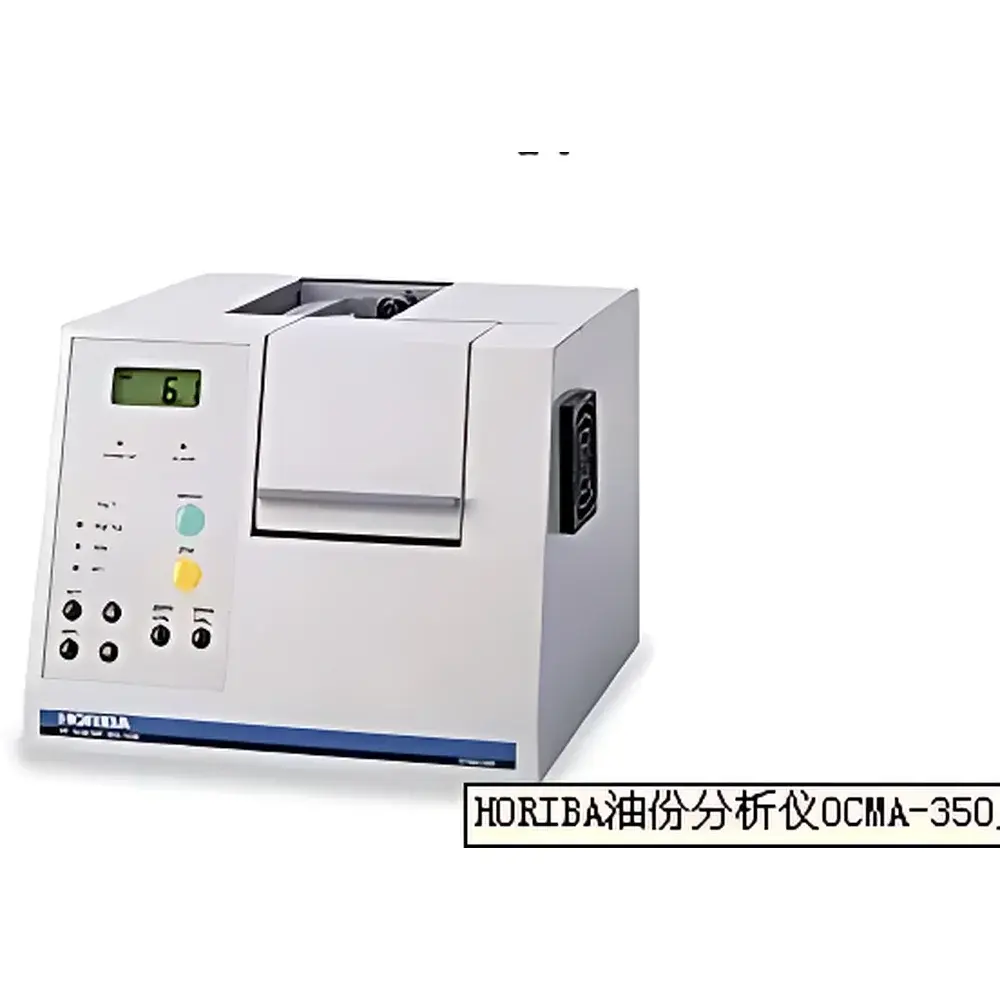
HORIBA OCMA-555 Infrared Oil-in-Water Analyzer
| Brand | HORIBA |
|---|---|
| Origin | Japan |
| Model | OCMA-555 / OCMA-550 |
| Instrument Type | Portable |
| Measurement Principle | Non-Dispersive Infrared (NDIR) Absorption Spectrophotometry |
| Measurement Range | 0–200 mg/L (oil-in-water), 0–1000 mg/kg (soil), 0–1 Abs |
| Accuracy | ±0.4 mg/L (0–9.9 mg/L), ±2.0 mg/L (10.0–99.9 mg/L), ±4 mg/L (100–200 mg/L), ±1% F.S. (0–1 Abs) |
| Resolution | 0.2 mg/L (or 0.2 mg/kg / 0.2 Abs) |
| Detector | Thermoelectric Sensor |
| Light Source | IR Emitter @ ~3.4 µm |
| Solvent Compatibility | H-997 (non-absorbing at 3.4 µm) |
| Dimensions | 250 × 200 × 285 mm (W × H × D) |
| Power Supply | 230 V AC, 50 Hz |
| Display | Backlit LCD with Timestamp |
| Data Interface | RS-232C, Parallel Printer Port |
| Standard Accessories | Quartz Cuvette with Lid, Power Cord, Heavy Oil Standard (B-grade), 2 A Fuse, 10 mL & 25 µL Syringes |
Overview
The HORIBA OCMA-555 is a portable, field-deployable infrared oil-in-water analyzer engineered for quantitative determination of hydrocarbon contamination in aqueous and solid matrices using non-dispersive infrared (NDIR) absorption spectrophotometry. It operates on the fundamental principle that aliphatic C–H stretching vibrations absorb strongly near 3.4 µm — a spectral region where the proprietary extraction solvent H-997 exhibits negligible absorption. This enables selective, interference-free quantification of total petroleum hydrocarbons (TPH) and related oil fractions without spectral overlap from water, particulates, or common solvents. The instrument is calibrated against traceable heavy oil standards and delivers results traceable to ISO 9377-2 (Petroleum hydrocarbons in water — Part 2: Determination by infrared spectrophotometry after extraction) and ASTM D7066-04 (Standard Test Method for Determination of Oil and Grease and Selected Petroleum Hydrocarbons in Water by Infrared Spectrophotometry). Designed for regulatory compliance workflows, it supports GLP/GMP-aligned data integrity through built-in timestamping and audit-ready output logging.
Key Features
- Triple-unit measurement capability: switch seamlessly between mg/L (for water), mg/kg (for soil/sludge), and absorbance (Abs) modes — all calibrated to the same optical path and detector response.
- Thermoelectrically stabilized IR detector ensures long-term baseline stability and minimal drift across ambient temperature fluctuations (10–40 °C operating range).
- Integrated backlit LCD display with real-time timestamping enables unambiguous record-keeping compliant with EPA 1664A and ISO/IEC 17025 documentation requirements.
- Single-button operation after sample introduction: no manual wavelength selection or zeroing required — automatic baseline normalization occurs post-cuvette insertion.
- Compact, ruggedized chassis (250 × 200 × 285 mm) with IP20-rated enclosure suitable for laboratory, mobile lab van, and field site deployment.
- RS-232C serial interface and parallel printer port support direct connection to LIMS, ELN systems, or legacy thermal printers for hardcopy generation.
Sample Compatibility & Compliance
The OCMA-555 is validated for use with liquid-phase extracts prepared via liquid–liquid extraction using HORIBA H-997 solvent — a chlorinated hydrocarbon blend specifically formulated for minimal IR absorption at 3.4 µm and high extraction efficiency for C10–C40 aliphatic and aromatic hydrocarbons. It accommodates both filtered and unfiltered aqueous samples containing suspended solids (SS), provided turbidity does not exceed 100 NTU — particulate interference is mitigated by the narrow-band optical design and fixed-pathlength quartz cuvette (10 mm). For soil analysis, standard EPA SW-846 Method 3550C extraction protocols apply. Regulatory alignment includes compliance with US EPA Methods 1664A and 418.1, ISO 9377-2, and JIS K 0102 (Japanese Industrial Standard for oil content in wastewater). All factory calibrations are NIST-traceable; user verification is supported via included B-grade heavy oil standard.
Software & Data Management
While the OCMA-555 operates as a standalone instrument with embedded firmware, its RS-232C interface enables integration into automated data acquisition environments. ASCII-formatted output includes measurement value, unit code, timestamp (YYYY-MM-DD HH:MM:SS), and instrument ID — structured for direct ingestion into CSV-compatible spreadsheets or SQL-based environmental databases. No proprietary software is required; terminal emulation (e.g., Tera Term, PuTTY) suffices for raw data capture. For regulated environments, the device satisfies FDA 21 CFR Part 11 requirements when paired with validated third-party data capture software featuring electronic signature, audit trail, and role-based access control. Optional solvent recovery system SR-305 (sold separately) extends H-997 reuse cycles while maintaining extract purity per ISO 11348-3 solvent quality thresholds.
Applications
- Industrial effluent monitoring: real-time verification of oil removal efficiency in API separators, coalescers, and membrane filtration units.
- Hazardous waste site characterization: rapid screening of groundwater plumes and excavated soils for TPH prior to remediation.
- Manufacturing process control: quantification of residual cutting oils on machined metal parts, semiconductor wafers, and textile substrates.
- Wastewater treatment plant compliance: discharge permit verification per local limits (e.g., EU Urban Wastewater Directive Annex I, China GB 8978-1996).
- Environmental emergency response: on-site triage of spill-impacted surface water and sediment during Tier 1 assessment.
- Research laboratories: method development for oil-in-water emulsion stability studies and surfactant efficacy testing.
FAQ
What extraction solvent is required for OCMA-555 operation?
HORIBA H-997 solvent is mandatory — its spectral transparency at 3.4 µm ensures selective oil detection. Substitution with hexane, CCl₄, or other IR-active solvents invalidates calibration and violates ISO 9377-2 protocol.
Can the OCMA-555 measure dissolved hydrocarbons without extraction?
No. It requires pre-extraction into H-997 solvent; direct aqueous measurement is not supported due to water’s strong IR absorption at 3.4 µm.
Is the 0.2 mg/L resolution applicable across the full 0–200 mg/L range?
Resolution is hardware-limited to 0.2 mg/L (or equivalent unit), but stated accuracy varies by concentration tier per ISO 9377-2 Annex B — see technical specifications for uncertainty bands.
Does the instrument support multi-point calibration?
Factory calibration is single-point (using B-grade heavy oil standard); user recalibration is not field-serviceable and must be performed by authorized HORIBA service centers.
How often should the quartz cuvette be cleaned, and with what?
Rinse immediately after each use with fresh H-997 solvent, followed by nitrogen purge; avoid ultrasonic cleaning or abrasive wipes to preserve optical surface integrity.
Related Products







