
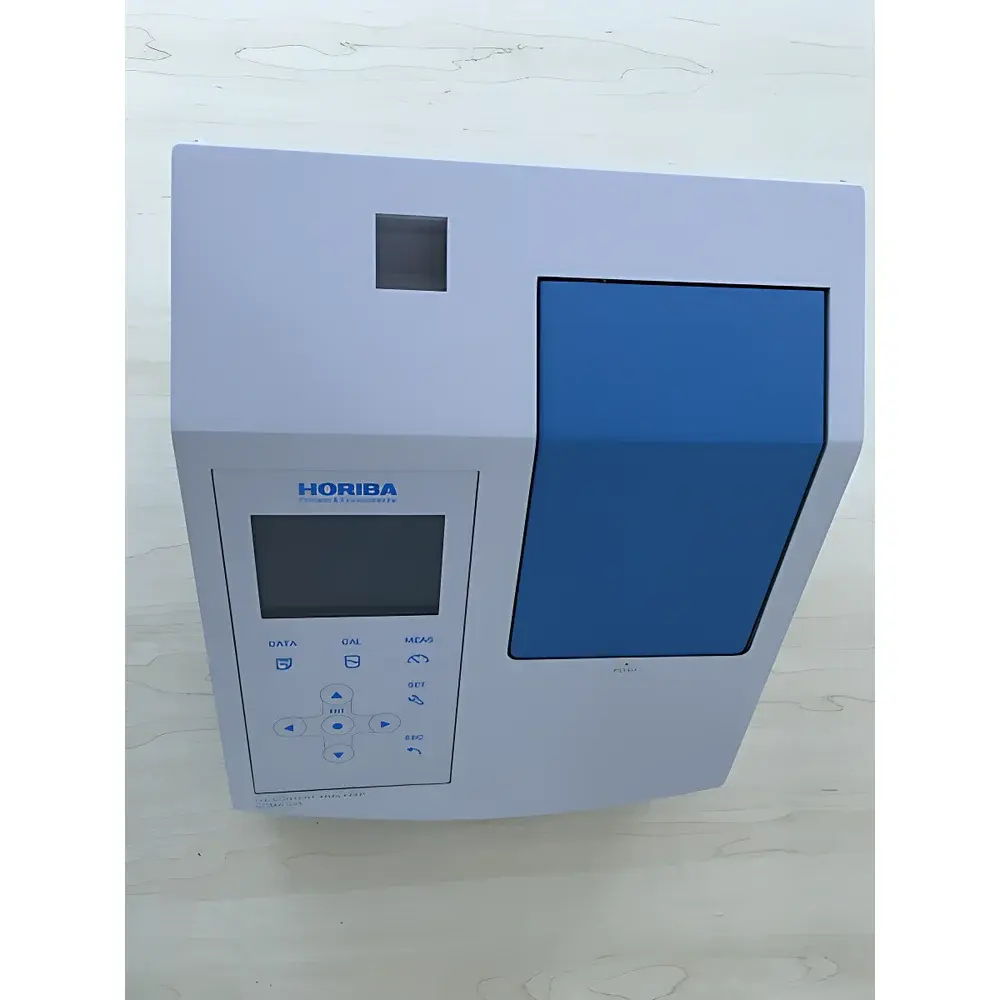
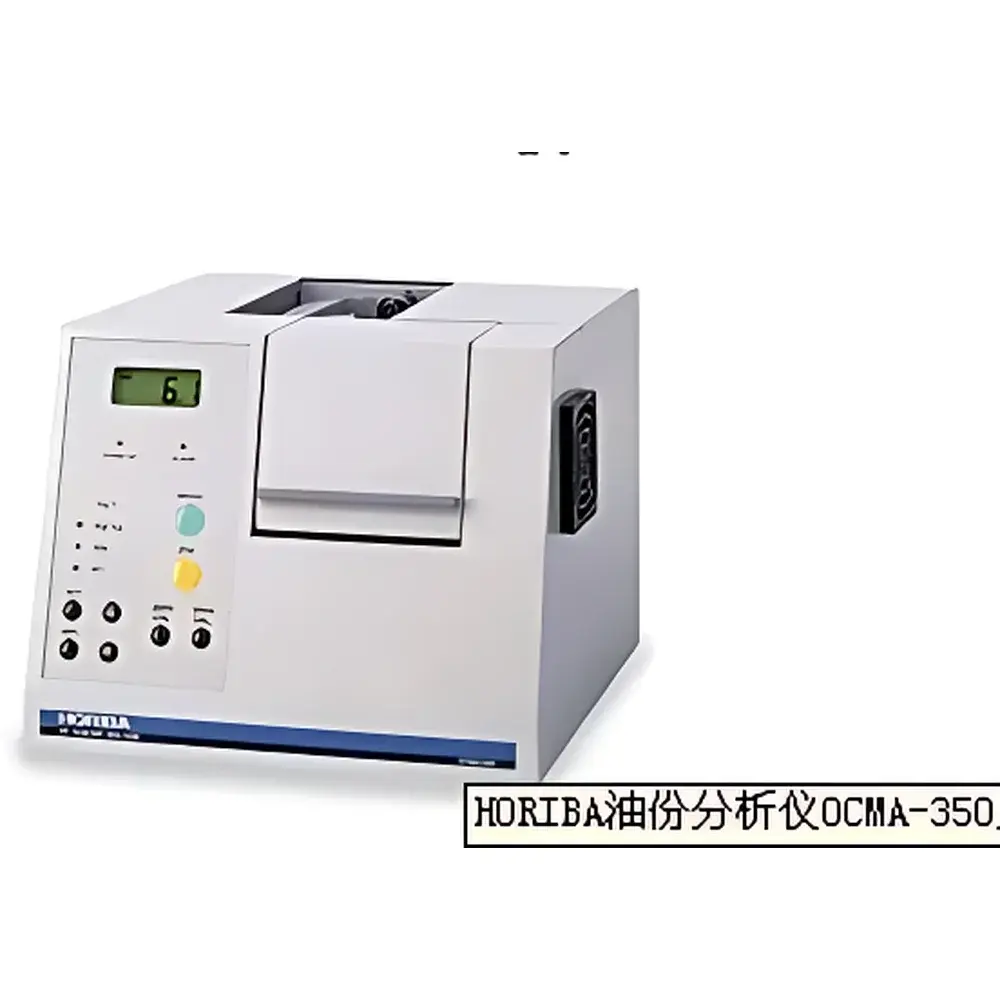
HORIBA OCMA-555 Portable Oil Content Analyzer
| Brand | HORIBA |
|---|---|
| Origin | Japan |
| Model | OCMA-555 |
| Instrument Type | Portable |
| Measurement Principle | Non-Dispersive Infrared (NDIR) Absorption |
| Extraction Solvent | H-997 |
| Measurement Range | 0–200 mg/L (water), 0–1000 mg/kg (soil), 0–1 Abs |
| Detection Limit | 0.1 ppm |
| Repeatability | ±0.4 mg/L (0–9.9 mg/L), ±2.0 mg/L (10.0–99.9 mg/L), ±4 mg/L (100–200 mg/L), ±1% F.S. (0–1 Abs) |
| Display | Backlit LCD with timestamping |
| Interface | RS-232C, Parallel Printer Port |
| Power Supply | 230 V AC, 50 Hz |
| Dimensions | 250 × 200 × 285 mm (W × H × D) |
| Detector | Thermoelectric Sensor |
| Cell | 200 mm Pathlength Quartz Cuvette |
| Compliance | Designed for ASTM D7066, ISO 9377-2, and EPA Method 1664B-aligned workflows |
Overview
The HORIBA OCMA-555 Portable Oil Content Analyzer is a field-deployable, non-dispersive infrared (NDIR) spectrophotometric instrument engineered for precise quantification of hydrocarbon-based oil residues in aqueous and solid-phase environmental samples. Unlike fluorescence-based systems (e.g., OCMA-550), the OCMA-555 employs H-997 solvent extraction followed by NDIR detection at the characteristic C–H stretching absorption band near 3.4 µm — a wavelength where H-997 exhibits negligible absorbance, ensuring selective measurement of extracted petroleum hydrocarbons only. This methodology delivers high specificity for aliphatic and aromatic hydrocarbons commonly found in industrial lubricants, cutting fluids, diesel, and crude oil contaminants. The analyzer is purpose-built for on-site applications requiring regulatory-grade data integrity, including wastewater discharge verification, soil remediation site assessment, and process water monitoring in semiconductor fabrication, precision machining, and metal finishing facilities.
Key Features
- Triple-unit reporting capability: automatic switching between concentration units — mg/L (for water extracts), mg/kg (for soil/sediment extracts), and absorbance (Abs) — enabling direct compliance with reporting formats required by environmental agencies and internal QA protocols.
- Integrated thermoelectric detector with temperature-stabilized optical path ensures long-term baseline stability and minimizes drift during extended field operation.
- Backlit monochrome LCD display with real-time timestamping supports GLP-compliant recordkeeping; all measurements are stored locally with date/time stamp and unit selection metadata.
- Dual communication interfaces: RS-232C serial port for bidirectional data exchange with LIMS or laboratory PCs, and parallel printer port for immediate hardcopy generation without external drivers.
- Optimized for H-997 solvent — a low-toxicity, high-extraction-efficiency alternative to S-316 — offering improved safety profile while maintaining full compatibility with EPA Method 1664B validation requirements.
- Compact, ruggedized chassis (250 × 200 × 285 mm) with integrated carry handle and sealed optical compartment enables reliable use in mobile labs, containment zones, and outdoor sampling campaigns.
Sample Compatibility & Compliance
The OCMA-555 accommodates a broad range of sample matrices following standardized solvent extraction procedures. For water samples, liquid–liquid extraction using H-997 yields recoveries ≥95% for C10–C40 hydrocarbons per ASTM D7066. Soil and sediment samples require homogenization and Soxhlet or ultrasonic-assisted extraction prior to analysis. The system meets functional equivalency criteria under ISO 9377-2 (Water quality — Determination of hydrocarbon oil index) and aligns with analytical performance specifications outlined in EPA Method 1664B (n-Hexane Extractable Material). While not inherently 21 CFR Part 11 compliant, its audit-ready data logging architecture — including immutable timestamps, unit selection traceability, and no post-acquisition editing capability — supports GxP-aligned documentation practices when deployed within validated workflows.
Software & Data Management
The OCMA-555 operates as a standalone instrument with embedded firmware controlling all measurement sequences, calibration routines, and display logic. No proprietary PC software is required for basic operation. However, raw absorbance values, concentration results, selected units, and timestamps are transmitted via ASCII-formatted RS-232 packets — fully compatible with custom LabVIEW, Python, or Excel-based data ingestion scripts. Optional HORIBA-supplied terminal emulation utilities enable batch export to CSV for integration into enterprise LIMS platforms. All internal memory retains up to 1,000 measurement records with rollover protection; data persistence is maintained during power interruption due to non-volatile EEPROM storage.
Applications
- Regulatory compliance monitoring of effluent discharge from electroplating, metalworking, and textile dyeing facilities.
- Routine verification of cleaning efficacy in semiconductor wafer rinsing baths and precision component degreasing lines.
- Field screening of contaminated soils at brownfield sites prior to excavation and remediation prioritization.
- Quality control of reclaimed process water in closed-loop industrial cooling and machining systems.
- Validation of oil–water separator performance across municipal and industrial wastewater treatment plants.
- Supporting ISO 14001 environmental management system audits through traceable, repeatable hydrocarbon quantification.
FAQ
What extraction solvent is required for the OCMA-555?
H-997 solvent is specified for OCMA-555 operation. It replaces S-316 used in earlier OCMA models and offers enhanced safety and equivalent extraction efficiency for EPA Method 1664B target analytes.
Can the OCMA-555 measure emulsified or dispersed oil without phase separation?
No. The instrument requires complete solvent extraction followed by phase separation and filtration to remove suspended solids and water droplets prior to analysis. Emulsion-breaking steps must be performed offline per standard method protocols.
Is calibration traceable to NIST standards?
The OCMA-555 accepts user-prepared calibration standards traceable to NIST SRM 2721 (Mineral Oil in Water). Factory calibration uses certified reference materials; users perform daily zero and span checks using blank H-997 and mid-range mineral oil standards.
Does the instrument support multi-point calibration?
Yes — the firmware allows entry of up to five calibration points to generate a non-linear response curve, improving accuracy across the full 0–200 mg/L range, particularly at low concentrations (<5 mg/L).
What maintenance is required for long-term reliability?
Annual verification of optical path cleanliness and detector responsivity is recommended. Quartz cuvettes must be cleaned with H-997 followed by isopropanol and lint-free wipes; no routine lamp replacement is needed as the IR source has >10,000-hour lifetime.
Related Products







