
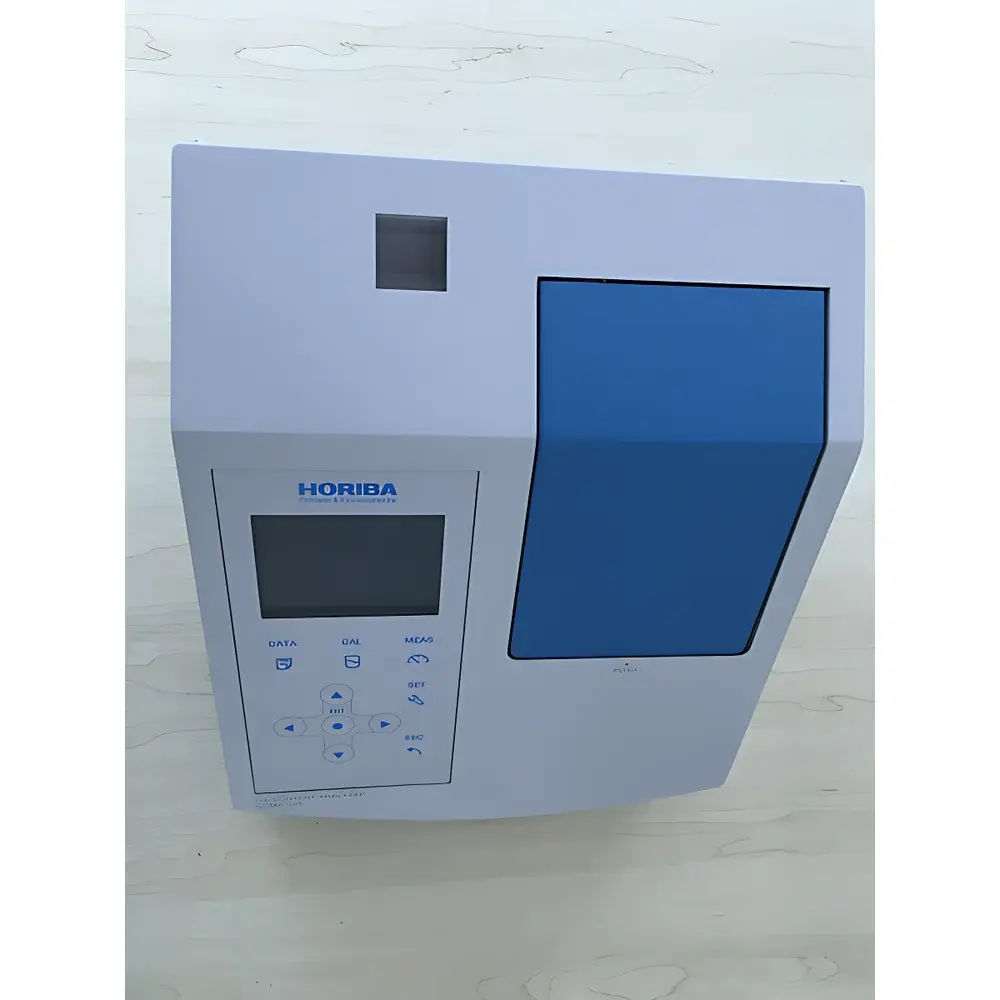
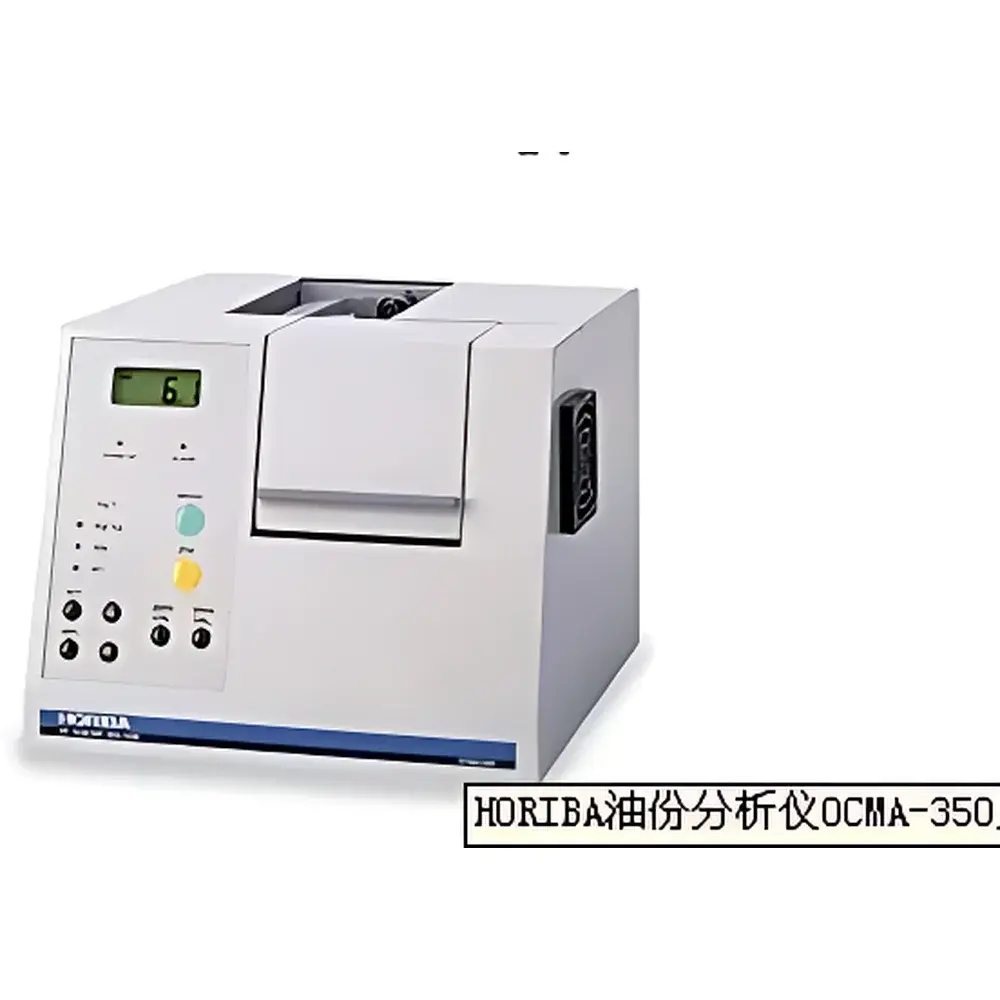
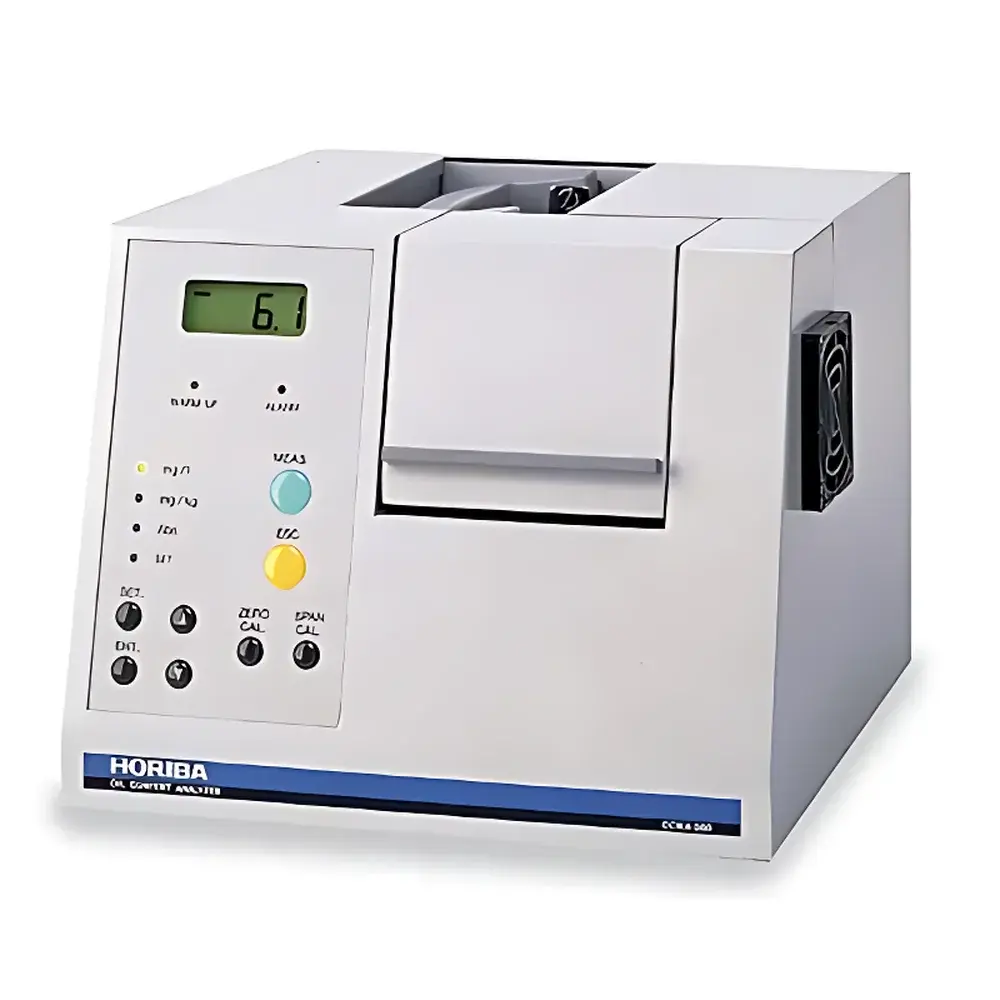
HORIBA OCMA-555 Portable Oil Content Analyzer
| Brand | HORIBA |
|---|---|
| Origin | Japan |
| Model | OCMA-555 |
| Principle | Non-Dispersive Infrared (NDIR) Absorption with H-997 Solvent Extraction |
| Measurement Range | 0–200 mg/L (water), 0–1000 mg/kg (soil), 0–1 Abs |
| Resolution | 0.2 mg/L (at low range) |
| Repeatability | ±0.4 mg/L (0–9.9 mg/L), ±2.0 mg/L (10.0–99.9 mg/L), ±4 mg/L (100–200 mg/L), ±1% F.S. (Abs mode) |
| Detector | Thermoelectric Sensor |
| Display | Backlit LCD with timestamping |
| Interface | RS-232C, Parallel Printer Port |
| Power Supply | 230 V AC, 50 Hz |
| Dimensions | 250 × 200 × 285 mm (W × H × D) |
| Standard Accessories | Quartz Cuvette with Lid, H-997 Solvent, Calibration Standard (Heavy Oil B), Syringes (10 mL & 25 µL), Power Cord, 2 A Fuse |
Overview
The HORIBA OCMA-555 is a portable, laboratory-grade oil content analyzer engineered for precise quantification of hydrocarbon contaminants in aqueous and solid-phase environmental matrices. It operates on the principle of non-dispersive infrared (NDIR) absorption spectroscopy — specifically targeting the characteristic C–H stretching vibration band near 3.4 µm — following solvent extraction using HORIBA’s proprietary H-997 reagent. Unlike fluorescence-based alternatives, the OCMA-555 leverages infrared absorbance, which provides superior specificity for total petroleum hydrocarbons (TPH), including aliphatic and aromatic fractions, without interference from naturally occurring organic fluorophores. The instrument is calibrated against certified heavy oil reference standards traceable to NIST-maintained hydrocarbon matrices, ensuring metrological consistency across field and regulatory lab environments. Its design adheres to core principles of method validation per ISO 17025 and supports compliance with EPA Method 1664B (for water) and ASTM D7066 (for soil extracts), where solvent-extraction/IR detection is an accepted alternative to gravimetric or GC-FID approaches.
Key Features
- Triple-unit display capability: switch seamlessly between concentration units — mg/L (for water samples), mg/kg (for soil/sediment extracts), and absorbance (Abs) — without recalibration.
- Integrated timestamping functionality: each measurement is automatically annotated with date and time, supporting audit-ready data integrity for GLP/GMP and environmental reporting workflows.
- Thermoelectric detector architecture: delivers stable baseline performance across ambient temperature fluctuations (10–35°C), eliminating the need for active cooling or purge gas.
- Optimized optical path: 200-mm pathlength quartz cuvette ensures high signal-to-noise ratio for sub-ppm-level detection sensitivity (limit of quantitation: 0.1 ppm in water matrix).
- One-button operation: after solvent extraction, sample introduction and analysis require only a single press — minimizing operator-dependent variability.
- RS-232C and parallel printer interfaces: enable direct connection to LIMS, legacy lab PCs, or thermal printers for real-time hardcopy generation.
Sample Compatibility & Compliance
The OCMA-555 is validated for use with water, wastewater, leachate, soil extracts, and surface wipe samples prepared via H-997 solvent extraction. It accommodates heterogeneous matrices containing suspended solids (SS) or colloidal organics, provided phase separation is achieved prior to analysis — a requirement aligned with US EPA 1664B Section 7.2. The instrument meets electrical safety requirements per IEC 61010-1 and electromagnetic compatibility per EN 61326-1. Its measurement protocol supports traceability under ISO/IEC 17025:2017 Clause 7.7 (Uncertainty of Measurement) when used with certified reference materials (e.g., HORIBA Heavy Oil Standard B). For regulated discharge monitoring, data generated with the OCMA-555 may be submitted in accordance with EU Water Framework Directive Annex V reporting templates and China’s GB/T 16488–1996 (replaced by HJ 637–2018, for which OCMA-555 serves as a compliant IR alternative).
Software & Data Management
While the OCMA-555 operates as a standalone instrument, its RS-232C interface enables bidirectional communication with third-party data acquisition software compliant with FDA 21 CFR Part 11. Audit trails — including user ID, timestamp, measurement value, unit selection, and calibration status — are embedded in ASCII-formatted output streams. No proprietary software is required; raw data can be parsed directly into Excel, LabArchives, or custom LIMS platforms using standard terminal emulation (e.g., Tera Term, PuTTY). Optional solvent regeneration systems (SR-305) integrate mechanically with the analytical workflow but do not interface electronically — preserving system simplicity and reducing validation burden in regulated settings.
Applications
- Industrial effluent monitoring: real-time verification of oil-water separator efficiency in metalworking, textile, and food processing facilities.
- Hazardous waste site characterization: rapid screening of soil cores and groundwater samples during Phase II ESA investigations.
- Post-cleaning validation: quantification of residual cutting oil on precision machined parts, semiconductor wafers, and aerospace components.
- Treatment plant compliance: verification of final discharge concentrations against local limits (e.g., ≤10 mg/L TPH in municipal pretreatment ordinances).
- Research applications: kinetic studies of oil biodegradation in microcosms, where repeated low-concentration measurements demand high repeatability.
FAQ
What solvent is required for OCMA-555 operation?
HORIBA H-997 solvent is mandatory — it exhibits negligible IR absorption at 3.4 µm, enabling selective detection of hydrocarbons without spectral interference.
Can the OCMA-555 measure diesel, gasoline, and lubricating oils simultaneously?
Yes — the NDIR method responds to total C–H bond density; however, quantitative accuracy assumes matrix-matched calibration using representative fuel standards.
Is the instrument suitable for unattended operation?
No — it requires manual cuvette loading and solvent handling; it is not designed for continuous flow or autosampler integration.
How often must calibration be performed?
Initial calibration is factory-set; users should verify with standard B before each analytical batch and recalibrate if drift exceeds ±2% of full scale in Abs mode.
Does the OCMA-555 comply with ISO 8217 for marine fuel testing?
No — it is intended for environmental matrices only; ISO 8217 specifies distillation and viscosity methods for bunker fuels, not IR-based extraction assays.







