
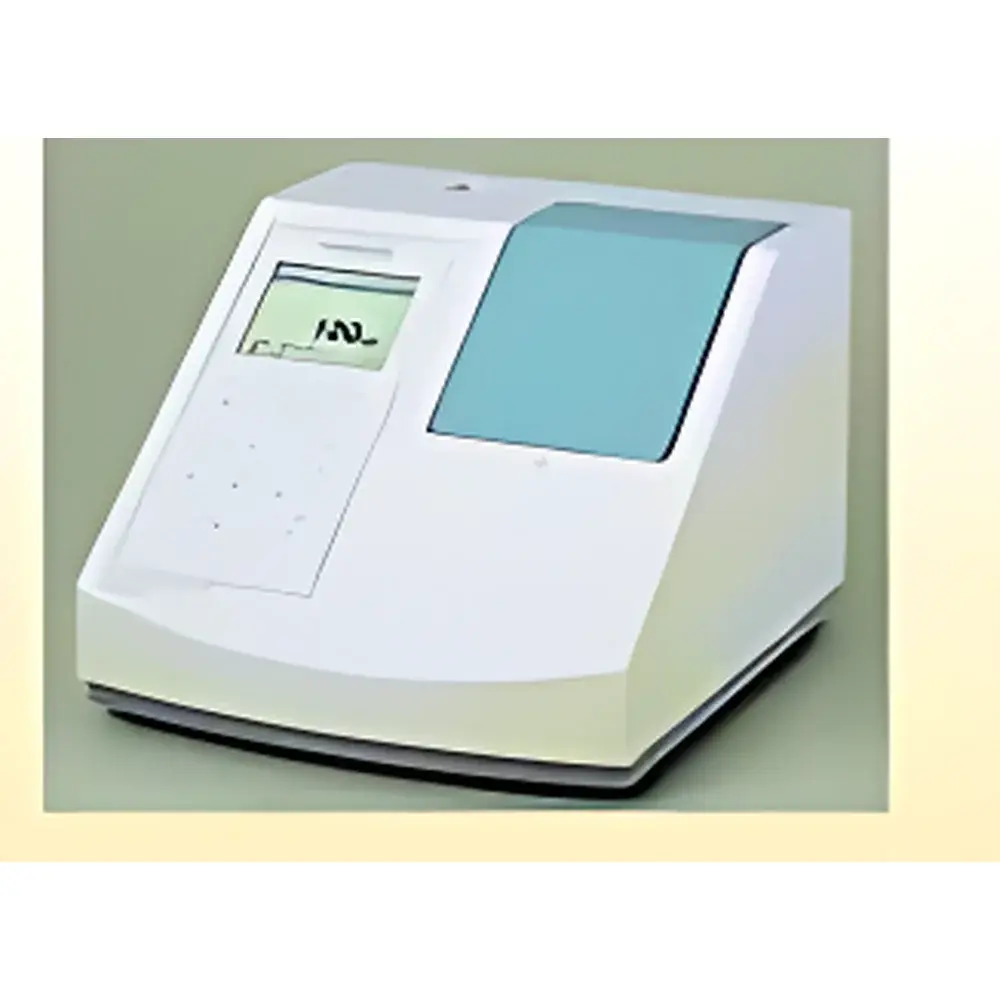
HORIBA OCMA-555 Portable Oil Content Analyzer
| Brand | HORIBA |
|---|---|
| Origin | Japan |
| Model | OCMA-555 |
| Instrument Type | Portable |
| Measurement Principle | Non-Dispersive Infrared (NDIR) Absorption at ~3.4 µm |
| Measurement Ranges | 0–200 mg/L, 0–1000 mg/kg, 0–1 Abs |
| Accuracy | ±1% of reading (for mg/L range) |
| Resolution | 0.1 mg/L (0–99.9 mg/L), 1 mg/L (100–200 mg/L), 0.01 Abs (0–1 Abs) |
| Repeatability | ±0.4 mg/L ±1 digit (0–9.9 mg/L), ±2.0 mg/L ±1 digit (10.0–99.9 mg/L), ±4 mg/L ±1 digit (100–200 mg/L), ±1% F.S. (0–1 Abs) |
| Detector | Thermopile sensor |
| Display | Backlit LCD with timestamping |
| Interface | RS-232C port, parallel printer port |
| Power Supply | 230 V AC, 50 Hz |
| Dimensions | 250 × 200 × 285 mm (W × H × D) |
| Standard Accessories | Quartz cuvette with lid, power cord, heavy oil standard (B-grade), 2 A fuse, 10 mL syringe, 25 µL microsyringe |
| Optional Accessory | Solvent Regenerator SR-305 |
Overview
The HORIBA OCMA-555 is a portable, field-deployable oil content analyzer engineered for precise quantification of hydrocarbon contaminants in aqueous and solid-phase environmental samples. It operates on the principle of non-dispersive infrared (NDIR) absorption spectroscopy, specifically targeting the characteristic C–H stretching vibration band near 3.4 µm — a spectral region where hydrocarbons exhibit strong, selective absorbance while common extraction solvents such as HORIBA’s proprietary H-997 remain optically transparent. This spectral selectivity ensures measurement specificity to petroleum-based oils and greases without interference from solvent residuals or matrix components. Unlike fluorescence-based methods, the NDIR approach employed by the OCMA-555 delivers robust, chemically grounded quantification aligned with established regulatory frameworks for total petroleum hydrocarbons (TPH). The instrument is calibrated using certified heavy oil standards traceable to NIST-maintained reference materials, supporting data integrity in compliance-driven workflows including EPA Method 1664 (revision B), ISO 9377-2, and ASTM D7066.
Key Features
- Triple-unit display capability: switch seamlessly between concentration units — mg/L (for water extracts), mg/kg (for soil/sediment extracts), and absorbance (Abs) — enabling direct interpretation across regulatory reporting formats.
- Integrated timestamping and data logging: all measurements are automatically tagged with date/time stamps, satisfying basic GLP documentation requirements for field and lab use.
- Thermopile-based infrared detector: provides stable, drift-resistant response over extended operation without active cooling or frequent recalibration.
- Backlit LCD interface: optimized for readability under variable ambient lighting conditions, including outdoor field deployment and low-light laboratory settings.
- RS-232C and parallel printer interfaces: support direct data export to PCs or thermal printers for audit-ready record generation; compatible with LIMS integration via ASCII protocol.
- Compact, ruggedized housing: designed for transportability in mobile environmental monitoring units, emergency response vehicles, and on-site remediation teams.
Sample Compatibility & Compliance
The OCMA-555 is validated for use with solvent-extracted samples prepared using HORIBA H-997 — a non-polar, IR-transparent extraction medium optimized for recovery of aliphatic and aromatic hydrocarbons from water, soil, sludge, and surface wipes. Its detection architecture accommodates heterogeneous matrices, including wastewater effluents containing suspended solids (SS) and emulsified oils, provided phase separation is achieved prior to analysis. The system meets functional equivalency requirements for TPH determination under US EPA SW-846 Method 418.1 (modified) and supports compliance verification per ISO 16703:2004 (petroleum hydrocarbons in water) and JIS K 0102 (Japanese Industrial Standard for oil in industrial wastewater). While not intrinsically compliant with FDA 21 CFR Part 11, its audit trail capabilities (timestamped readings, manual operator ID entry) facilitate adaptation into GxP-aligned quality systems when paired with procedural controls.
Software & Data Management
The OCMA-555 operates as a standalone analytical endpoint with no embedded operating system or firmware-upgradable software. All data handling occurs at the instrument level: measurements are stored in volatile memory with up to 100 result entries, each retaining unit selection, absorbance value, calculated concentration, and timestamp. Export is performed via ASCII-formatted serial transmission (RS-232C) at 9600 baud, 8N1, allowing ingestion into spreadsheet applications, custom LabVIEW interfaces, or enterprise LIMS platforms. No proprietary drivers or cloud connectivity are required. For long-term archival, users commonly pair the device with HORIBA’s optional SR-305 solvent regenerator — an activated carbon/activated alumina column system that restores >95% of H-997 solvent purity across ≥50 regeneration cycles, reducing consumable costs and waste generation in high-throughput labs.
Applications
- On-site screening of groundwater and surface water at brownfield sites and spill response zones.
- Verification of oil removal efficiency in industrial wastewater treatment trains and membrane filtration systems.
- Residual oil quantification on machined metal parts, semiconductor wafers, and textile substrates following cleaning processes.
- Regulatory compliance testing for discharge permits (e.g., NPDES), landfill leachate monitoring, and soil excavation clearance.
- Quality assurance of solvent recycling operations in electroplating, metalworking, and precision manufacturing facilities.
FAQ
What extraction solvent is required for OCMA-555 operation?
HORIBA H-997 is the designated extraction solvent; it exhibits negligible absorbance at 3.4 µm, ensuring selective detection of hydrocarbons only.
Can the OCMA-555 measure diesel, gasoline, or lubricating oils individually?
No — it reports total extractable petroleum hydrocarbons (TEPH) as a composite signal; speciation requires GC-FID or GC-MS.
Is calibration traceable to national standards?
Yes — factory calibration uses B-grade heavy oil certified against NIST SRM 2721 (crude oil) and is documented in the instrument certificate of conformance.
Does the instrument require daily recalibration?
No — automatic zero-point adjustment occurs at power-on; full calibration is recommended before each analytical session or after solvent change.
What is the minimum detectable concentration?
The limit of detection (LOD) is 0.1 mg/L based on signal-to-noise ratio ≥3 under standard operating conditions with 1 cm pathlength quartz cuvettes.







