
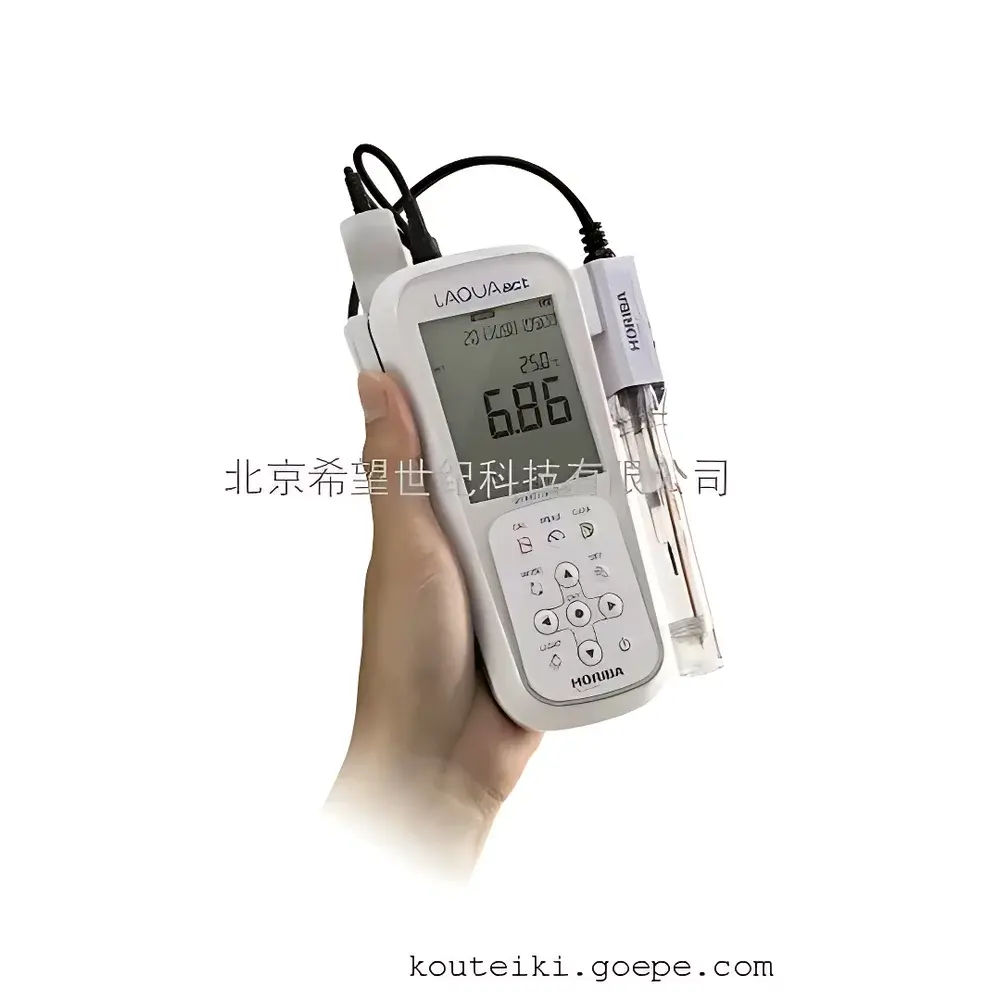
HORIBA OM-71 Portable Dissolved Oxygen Meter
| Brand | HORIBA |
|---|---|
| Origin | Japan |
| Model | OM-71 |
| Instrument Type | Portable/Handheld Water Quality Analyzer |
| Measured Parameter | Dissolved Oxygen (DO) |
| Measurement Principle | Membrane-Type Galvanic Cell |
| DO Range | 0.00–20.00 mg/L |
| Saturation Range | 0.0–200.0 % |
| Oxygen Concentration Range | 0.0–50.0 % |
| Resolution | 0.01 mg/L (DO), 0.1 % (saturation & O₂ conc.) |
| Accuracy | ±0.1 mg/L ±1 digit (DO), ±0.1 % (saturation & O₂ conc.) |
| Temperature Compensation | 0–40 °C |
| Salinity Compensation | 0–40 ppt |
| Atmospheric Pressure Compensation | Yes |
| Temperature Range (Measurement) | 0.0–100.0 °C (display), –30 to 130 °C (sensor limit) |
| Temp. Accuracy | ±0.1 °C ±1 digit |
| Display | Backlit monochrome LCD |
| Data Storage | 1,000 readings with timestamp, ID, and temperature |
| Protection Rating | IP67 |
| Operating Environment | 0–45 °C, RH ≤80 % non-condensing |
| Power | 2 × AAA alkaline or Ni-MH batteries |
| Dimensions | 67 × 28 × 170 mm (W × D × H, max thickness 80 mm) |
| Weight | ~270 g (without batteries) |
Overview
The HORIBA OM-71 is a compact, field-deployable dissolved oxygen (DO) meter engineered for high-reproducibility measurements in environmental monitoring, wastewater treatment, aquaculture, and freshwater/marine research applications. It employs a membrane-type galvanic cell sensor — a robust electrochemical transduction method widely accepted in regulatory and routine water quality practice. Unlike optical sensors, the galvanic cell design requires no external power for the sensing element, delivers stable zero-current output, and exhibits low drift over extended field use. The OM-71 integrates automatic temperature compensation (0–40 °C), real-time atmospheric pressure correction, and salinity compensation (0–40 ppt), enabling accurate DO reporting across diverse aquatic matrices — from low-salinity rivers to coastal estuaries. Its measurement outputs include dissolved oxygen concentration (mg/L), percent saturation (%), and oxygen partial pressure equivalent (%O₂), all traceable to standardized calibration protocols aligned with ISO 5814 and ASTM D888.
Key Features
- IP67-rated housing ensures full dust ingress protection and submersion resistance up to 1 m for 30 minutes — validated for rigorous outdoor and industrial site deployment.
- Backlit monochrome LCD with large-character display supports legible operation under low-light conditions and direct sunlight exposure.
- Auto-Hold function captures and locks stable readings; ideal for single-operator field sampling where hands-free verification is required.
- Integrated clock, sample ID tagging, and 1,000-point internal memory with timestamping comply with GLP data integrity requirements for audit-ready records.
- Intelligent electrode diagnostics provide immediate visual feedback on sensor status post-calibration — reducing uncertainty in field validation workflows.
- Universal power compatibility: operates on two AAA alkaline or rechargeable Ni-MH cells (~500 h typical runtime), with optional AC adapter support for lab-based benchtop use.
- Ergonomic, impact-resistant chassis constructed from alcohol- and chemical-resistant polymer — optimized for repeated handling in humid, corrosive environments.
Sample Compatibility & Compliance
The OM-71 is designed for direct immersion measurement in natural waters (streams, lakes, groundwater), treated effluents, aquaculture tanks, and process streams. Its galvanic DO probe tolerates moderate turbidity and suspended solids without clogging, though biofouling mitigation (e.g., periodic cleaning per HORIBA’s LAQUAact maintenance guidelines) is recommended for long-term deployments. The instrument meets IEC 60529 (IP67), conforms to electromagnetic compatibility standards per IEC 61326-1, and supports documentation practices aligned with ISO/IEC 17025-accredited laboratories. While not FDA 21 CFR Part 11-certified out-of-the-box, its timestamped, ID-tagged data logs are compatible with validated LIMS integration when paired with HORIBA’s optional communication software and secure transfer protocols.
Software & Data Management
Data export is supported via USB connection to Windows-based PCs using HORIBA’s LAQUA Software Suite (v3.0+), which enables batch download, CSV export, trend visualization, and report generation with customizable templates. All stored entries include measurement value, temperature, date/time stamp, user-defined ID, and sensor diagnostic flags. The system enforces immutable logging — no post-acquisition editing of raw records — supporting ALCOA+ principles (Attributable, Legible, Contemporaneous, Original, Accurate, Complete, Consistent, Enduring, Available). Optional Bluetooth-enabled adapters (sold separately) allow wireless transmission to tablet-based field notebooks compliant with EPA Method 365.3 workflows.
Applications
- Regulatory compliance monitoring under national water quality standards (e.g., US EPA Clean Water Act, EU WFD, China GB 3838–2002).
- Biochemical oxygen demand (BOD) incubation tracking in wastewater treatment plants.
- Aquatic ecosystem health assessment — correlating DO profiles with pH, conductivity, and temperature gradients in stratified reservoirs.
- Validation of aeration efficiency in activated sludge basins and oxidation ditches.
- Field verification of DO sensor performance prior to deployment of fixed online analyzers (e.g., HORIBA AP-200 series).
- Educational laboratory instruction in environmental chemistry and limnology, where portability and intuitive interface reduce operator training time.
FAQ
What calibration standards are required for the OM-71?
The OM-71 uses a one-point or two-point calibration protocol with saturated air (100 % saturation at local temperature/pressure) and/or zero-oxygen solution (sodium sulfite, 0.00 mg/L). HORIBA recommends certified reference solutions traceable to NIST SRM 1692 for verification.
Can the OM-71 measure DO in seawater?
Yes — with enabled salinity compensation (0–40 ppt) and atmospheric pressure input, it reports accurate mg/L values in marine environments per Winkler-derived equivalency standards.
Is the sensor replaceable in the field?
The galvanic DO probe is a modular, screw-threaded assembly; replacement requires only basic hand tools and does not necessitate factory recalibration if using HORIBA OEM electrodes.
Does the OM-71 support GLP audit trails?
It maintains immutable timestamps, user IDs, and calibration history in non-volatile memory — meeting core GLP record-keeping requirements for environmental testing labs.
How often should the membrane and electrolyte be renewed?
HORIBA specifies 6-month intervals for standard field use; more frequent replacement is advised in high-fouling or high-temperature applications (>35 °C continuous exposure).







