
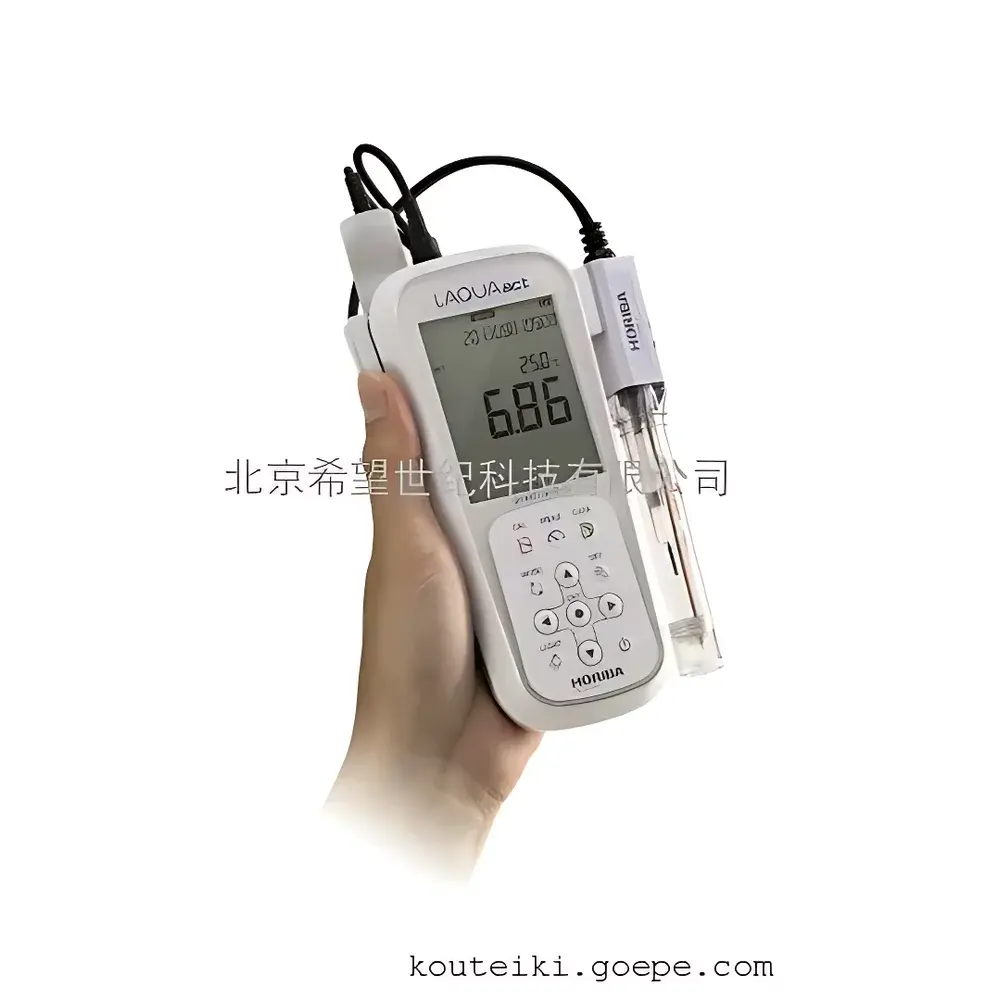
HORIBA OM-71 Portable Dissolved Oxygen Meter
| Brand | HORIBA |
|---|---|
| Origin | Japan |
| Model | OM-71 |
| Instrument Type | Portable |
| Measurement Principle | Galvanic Cell (Electrochemical Membrane Probe) |
| Measurement Range (DO) | 0.00–20.00 mg/L |
| Accuracy (DO) | ±0.01 mg/L |
| Repeatability | ±0.05% |
| Detection Limit | ±2 ppb |
| Temperature Range (Measurement) | −30 °C to 130 °C (Display: 0.0–100.0 °C) |
| Temperature Accuracy | ±0.1 °C ±1 digit |
| Saturation DO Range | 0.0–200.0 % |
| O₂ Concentration Range | 0.0–50.0 % |
| Salt Compensation | 0–40 ppt |
| Atmospheric Pressure Compensation | Yes |
| Display | Backlit Monochrome LCD |
| Data Storage | 1,000 sets with timestamp & ID |
| Communication | USB/RS-232 (PC connectivity, GLP/GMP-compliant data export) |
| Protection Rating | IP67 |
| Operating Environment | 0–45 °C, 0–80% RH (non-condensing) |
| Power | 2 × AAA alkaline or Ni-MH batteries (~500 h battery life) |
| Dimensions (W×D×H) | 67 × 28 × 170 mm (max. thickness 80 mm) |
| Weight (without batteries) | ~270 g |
Overview
The HORIBA OM-71 Portable Dissolved Oxygen Meter is a field-deployable, IP67-rated analytical instrument engineered for high-reliability measurement of dissolved oxygen (DO), oxygen concentration (%O₂), saturation ratio (%SAT), and temperature in aqueous environments. It employs a galvanic cell-type electrochemical membrane probe—distinct from polarographic sensors—which operates without external polarization voltage, delivering stable zero-current output, extended sensor lifetime, and minimal maintenance requirements. The device is calibrated per ISO 5814:2012 and ASTM D888–22 standards for dissolved oxygen determination in water, ensuring traceable performance in environmental, aquacultural, industrial effluent, and surface water monitoring applications. Its dual-compensation architecture—automatically correcting for temperature (0–40 °C), salinity (0–40 ppt), and barometric pressure—enables accurate DO reporting across diverse geographic and operational conditions, including coastal estuaries, recirculating aquaculture systems (RAS), hydroponic nutrient solutions, and municipal wastewater outfalls.
Key Features
- IP67-rated housing and probe interface—fully submersible to 1 m for 30 minutes; certified for field use in rain, dust, and splash-prone environments
- Galvanic membrane electrode with integrated thermistor for simultaneous DO and temperature measurement—no warm-up time required
- Auto-compensated DO calculation using built-in atmospheric pressure sensor and user-configurable salinity input
- Backlit monochrome LCD display with intuitive icon-based navigation and real-time AutoHold stabilization
- GLP/GMP-compliant data logging: 1,000 measurement records with timestamp, sample ID, operator code, and environmental parameters
- USB and RS-232 interfaces supporting direct PC connection for audit-trail export compliant with FDA 21 CFR Part 11 requirements
- Self-diagnostic system verifying electrode integrity, membrane hydration status, and calibration validity prior to each measurement cycle
- Low-power architecture enabling >500 hours of continuous operation on two AAA alkaline cells; compatible with rechargeable Ni-MH batteries
Sample Compatibility & Compliance
The OM-71 is validated for use with freshwater, brackish water, seawater (up to 40 ppt salinity), and process water containing suspended solids ≤50 mg/L. It meets the functional and metrological requirements of ISO 5814 (electrochemical determination of dissolved oxygen), ISO 7888 (water quality—determination of conductivity), and EPA Method 360.1 for field DO screening. The instrument’s firmware supports configurable calibration protocols—including single-point (air-saturated water) and two-point (zero-oxygen and air-saturated) methods—and maintains full audit trail metadata (calibration date, standard used, operator ID, ambient pressure/salinity). All stored data include embedded timestamps synchronized via internal real-time clock, satisfying GLP documentation requirements for environmental laboratories and regulatory submissions.
Software & Data Management
Data acquisition and reporting are managed through HORIBA’s proprietary OM-Link software (Windows-compatible), which enables secure import of measurement logs, batch export to CSV or PDF formats, and generation of compliance-ready reports with digital signatures. The software enforces role-based access control, automatic versioning of calibration files, and encrypted local storage—supporting 21 CFR Part 11 electronic record integrity. Measurement intervals can be preconfigured (1 s to 60 min), and stored datasets retain full contextual metadata: GPS coordinates (when paired with optional Bluetooth GNSS module), atmospheric pressure, salinity, temperature, and electrode response slope. Exported files include embedded checksums for data integrity verification during third-party audits or inter-laboratory comparisons.
Applications
- Aquaculture management: Real-time DO monitoring in hatcheries, transport tanks, and RAS to prevent hypoxia-induced mortality
- Surface water quality surveillance: Field assessment of eutrophication indicators in rivers, lakes, and reservoirs per EU WFD criteria
- Industrial effluent compliance: On-site verification of DO levels prior to discharge to meet NPDES or local permit limits
- Hydroponics and controlled-environment agriculture: Optimization of root-zone oxygenation in nutrient film technique (NFT) and deep water culture (DWC) systems
- Environmental impact assessments: Baseline and post-intervention DO profiling during dredging, construction, or remediation projects
- Research-grade field studies: High-temporal-resolution DO profiling in benthic boundary layers and sediment-water interfaces
FAQ
What calibration standards are recommended for the OM-71?
Air-saturated water (at known temperature, salinity, and barometric pressure) is the primary single-point standard. For critical applications, a two-point calibration using sodium sulfite solution (0% saturation) and air-saturated water is advised per ISO 5814 Annex B.
Does the OM-71 support automatic temperature compensation during DO measurement?
Yes—temperature compensation is applied in real time using the integrated NTC thermistor; users may select automatic or manual temperature input depending on application constraints.
Can the OM-71 measure dissolved oxygen in highly turbid or viscous samples?
The galvanic probe is tolerant of moderate turbidity (<50 NTU) and non-abrasive suspended solids; however, biofouling or oil films require periodic membrane cleaning per HORIBA Technical Bulletin TB-OM71-03.
Is the instrument suitable for underwater deployment beyond 1 meter?
While IP67-certified for 1 m / 30 min immersion, prolonged submersion or deployment at depth exceeding 1 m requires optional waterproof extension cable and pressure-rated probe housing (accessory OM-71-EXT-KIT).
How is data integrity ensured during PC transfer?
All USB/RS-232 transfers utilize CRC-16 error-checking; exported CSV files include SHA-256 hash values in accompanying metadata files to verify authenticity and prevent tampering.
Related Products







